The BiblioSanctum has moved!

You will be automatically redirected to the new address in 5 seconds. If that does not occur, please visit
http://www.bibliosanctum.com
and update your bookmarks. See you at our new home!

Showing posts with label Pyr. Show all posts

Sunday, June 22, 2014

YA Weekend: Earth Star by Janet Edwards

Earth Star by Janet Edwards

Genre: Young Adult, Science Fiction

Series: Book 2 of Earth Girl

Publisher: Pyr (April 15, 2014)

Author Information: Website | Twitter

Mogsy's Rating: 4 of 5 stars


Jarra has carried out a successful rescue mission, saved lives at the risk of losing her own, and received the Earth Star and the highest honor of the Artemis medal. But still our protagonist finds herself defined by her disability.

I’d been eagerly waiting to read this book ever since I read Earth Girl. Earth Star is the sequel, picking up right where the first book left off. Things have pretty much returned to normal after the events of the unprecedented solar storm that put the New York dig site and Jarra in the spotlight. The whole world knows she’s Handicapped now, that she is among one in a thousand born with an immune system disorder that confines her to earth. But while most of her classmates have come to terms with learning her secret, not everyone has been so accepting of Jarra.

I continue to enjoy this series for its ability to engage as well as its departures from the usual YA conventions. Unsurprisingly, these books probably won’t be for everyone, though I do wish more people knew about them. Not only is there an important message, I also love the universe Janet Edwards has created, and here she expands the idea further by throwing humanity a curveball – the possibility of aliens on Earth’s doorstep. When the military discovers a strange sphere in orbit, the planet goes into high alert and Jarra is drafted to help.

You would think that the arrival of an extraterrestrial presence might bring humankind together, but that isn’t the case. The book continues the theme of showing how deep-rooted bigotry and intolerance can be, even though Jarra has proven herself to be as capable as any Norm time and time again. The prejudice against the Handicapped has been ingrained in this society for generations, and Earth has become a second-class planet, with those who have the immune disorder somehow seen as less than human.

But there is hope yet. There are plenty of those who don’t share those close-minded views. Jarra and her boyfriend Fian have gotten much closer since the first book; the two have pledged their commitment to each other and Fian continues to be Jarra’s strongest and most loyal supporter. But like I said, we aren’t going to be treated to the same old tropes here, so Jarra and Fian’s relationship also has a completely different dynamic than your typical YA novel. I wouldn’t recommend going into these books expecting a strong romance plot. It’s just not that kind of book, and I’m cool with that. Still, that doesn’t mean that it is completely devoid of romantic tension. A private person by nature, Jarra still struggles with opening up to Fian, and Fian comes across as almost insecure in his desperation to get through to her. His role feels slightly diminished here, but then I suppose the force of Jarra’s personality has a way of overshadowing those around her.

For make no mistake, these books are all about Jarra’s journey, her own exceptional fight against adversity, from without and within. But I also like the fact she is not painted as the invincible hero. Reviewers including myself have noted in the first book that her character seems to be an expert at everything and know all the answers. In spite of that, I see now that she has her fears and doubts. The message is clear: as a Handicapped, Jarra is nevertheless able to do everything that a Norm can do, but it works both ways. She’s also just as liable to fall victim to her own anxieties and lose confidence in herself, just like everyone else.

After all, she’s only human. Like all of us.


A review copy of this book was provided to me by the publisher in exchange for an honest review. My thanks to Pyr Books!

Friday, June 20, 2014

Book Review: The Leopard by K.V. Johansen

The Leopard by K.V. Johansen

Genre: Fantasy

Series: Book 1 of Marakand

Publisher: Pyr (June 10, 2014)

Author Information: Website | Twitter

Mogsy's Rating: 3 of 5 stars 


The Leopard was a really tough book to rate and as I sit down to write this review, I find myself waffling back and forth on my thoughts. For one thing, I did not expect the unconventional structure, effectively dividing the novel into two separate parts. Because The Leopard is also the first installment of a duology, with the bulk of the story still left untold in book two, it’s also hard to decide how I really feel based on what happened here alone.

After the prologue, we are introduced to Deyandara, a bastard tribal princess who suddenly becomes her mother’s sole heir when everyone else in the family was murdered. But before this news even has the chance to settle, Deyandara is made messenger to the goddess Catairanach, who sends her on a quest to seek out the assassin known as the Leopard. Said assassin, whose true name is Ahjvar, is a cursed man who only wants to die, taking his burden to the grave. However, Deyandara’s message from the goddess changes all that. If he accepts her mission to kill the mad prophet known as the Voice of Marakand, Catairanach promises to free him from his curse. Along with his companion the escaped slave Ghu, Ahj sets off to perform this one final task.

Then we reach Part Two of the novel, which features a whole cast of different characters, apparently bringing back some of the familiar faces for those who have read Blackdog, an earlier novel based in K.V. Johansen’s world of the Marakand. We don’t get to see much (or anything) of Deyandara, Ahjvar or Ghu again. I don’t even know what more I can say beyond that, since Part Two also really lost me, and I found myself struggling through the rest of the novel. The truth is, while I ate up Part One, I practically had to force myself through Part Two, and almost had to throw in the towel. I spent most of the time trying to care about Moth, Mikki, and the other new characters, but never quite managed.

Though it is not necessary to read Blackdog first before tackling The Leopard, I wonder if I would have enjoyed this second part more if I had. At the very least, I think I would have felt more of a connection to the characters, this group of mysterious shapeshifters and otherworldly beings whose convoluted activities only seem to have a tenuous link to the storyline I read in Part One. In Part Two we see that Ahj’s activities have resulted in some rather strong ripples, but I still found it hard to stay focused since all the while Ahjvar, Deyandara and Ghu remained ever present in the back of my mind. It wasn’t long until I realized I wish I could have been reading about them instead.

This book won’t be for everyone; because of the vast difference in my feelings for the two different story lines, I still wonder if it is for me. Johansen’s style also takes getting used to. She clearly loves detail, but it’s a double-edged sword. The wonderful descriptions that made Part One such a vivid and scintillating experience also made Part Two feel lagging and tedious – though no doubt this has a lot to do with how effectively each story line captured my attention. My love of the setting was a constant, however; I’m a big fan of sword and sorcery set in Middle Eastern and Eastern influenced worlds, and Johansen’s writing is perfect for bringing this environment to life.

The world of Marakand really is quite lovely, and I enjoy its people, cultures and magic. But it wasn’t enough, because ultimately the main issue I had with this book was its structure. It’s one thing to weave two different storylines in tandem, it’s quite another to place a very distinct split in the middle of a novel. I put a lot of stock in characters and I’m usually extremely averse to the idea of drastic changes in players or perspective, so I don’t think this book worked for me – but it might for you.


A review copy of this book was provided to me by the publisher in exchange for an honest review. My thanks to Pyr Books!

Wednesday, May 28, 2014

Waiting on Wednesday 05/28/14

"Waiting On Wednesday" is a weekly meme hosted by Breaking the Spine that lets us feature upcoming releases that we can't wait to get our hands on!

Mogsy's Pick:

Covenant's End by Ari Marmell: February 2015 (Pyr)

I'm a big fan of Ari Marmell's Widdershins Adventures. Pyr's Young Adult fiction is always a bit unconventional, unique and out of the box, and that's what I appreciate about them, and that's also why I love this series. The more I read, the more I become emotionally invested. The end of the second book practically destroyed me, ripping out my heart and cutting it to pieces. Evidently, all I could do was ask for more, because I read book three straight afterward, and I have to say, I think it's setting up for some pretty big things. 

We're looking at quite a wait until February 2015, but for now we can enjoy the cover, done by the incredible Jason Chan. The simple, elegant and clean style of his Widdershins covers have always been my favorites of his, and the one for the fourth book is the best yet.

"The thief Widdershins and her own “personal god,” Olgun, return to their home city of Davillon after almost a year away. While Shins expects only to face the difficulty of making up with her friends, what she actually finds is far, far worse. Her nemesis, Lisette, has returned, and she is not alone. Lisette has made a dark pact with supernatural powers that have granted her abilities far greater than anything Widdershins and Olgun can match. 

Together, Widdershins and Olgun will face enemies on both sides of the law, for Lisette’s schemes have given her power in both Davillon’s government and its underworld. For even a slim chance, Shins must call on both old friends-some of whom haven’t yet forgiven her-and new allies. 

Even with their help, Widdershins may be required to make the hardest sacrifice of her life, if she is to rid Davillon-and herself-of Lisette once and for all"

Saturday, May 17, 2014

YA Weekend: Earth Girl by Janet Edwards

Earth Girl by Janet Edwards

Genre: Young Adult, Science Fiction

Series: Book 1 of Earth Girl

Publisher: Pyr (March 5, 2013)

Author Information: Website | Twitter

Mogsy's Rating: 4.5 of 5 stars


When I think about Young Adult books from Pyr, words that spring immediately to mind are “distinct”, “unconventional” and “unique”. I guess that’s why I’ve been counting on this book to lift me out of my YA slump. I’ve been feeling rather burned out by the love triangles, broody heroes, and paranormal/fantasy settings in this category lately, and Earth Girl looked like the perfect cure to this particular malaise.

My instincts proved correct.

The story of Earth Girl takes place in the far-flung future, narrated by eighteen-year-old Jarra. There are many names for people like her. Handicapped. Throwback. Nean. Ape. All of them mean one thing: that she is among the one in a thousand born with an immune disorder that confines her to earth. Humans have developed portal technology at this point, using it to colonize a multitude of worlds, but Jarra can’t visit any of them. If she traveled anywhere she would go into anaphylactic shock in seconds, and die if not returned immediately to earth’s atmosphere.

But even in the year 2788, humanity has its bigoted attitudes. So when the time comes to enroll in university, Jarra chooses her preferred subject History, but decides to invent a fake military background for herself to apply at a school on another planet whose class of norms who would be on earth for the first year of practical studies. Jarra is sick and tired of being looked down on for being handicapped, and she’s determined to show a bunch of stupid Exos just what an ape girl is capable of.

There is therefore nothing subtle about the social message in Earth Girl. This is a book infused with emotion and meaning. But even beyond this, there is so much more to love. While the plot may be a bit predictable at times, very little else about this novel falls prey to clichés, especially when it comes to the characters. You meet Lecturer Playdon, for example, and might immediately label him a hardball professor, bent on giving our protagonist a hard time – because adults obviously are in YA novels just to get in the way! Or take Dalmora Rostha, daughter of a rich, famous vid director. She’s totally going to be the snooty, spoiled and annoyingly fake arch nemesis in this story, am I right? Now the lascivious pair of Betas though, surely they are there just to provide comic relief, cause trouble and flunk out?

Nope, nope, and nope, wrong on all counts. This book will surprise you at every turn, and I can’t tell you how refreshing that is.

I also confess, I have another reason for loving this book. For you see, in the context of Earth Girl, Jarra’s “practical prehistory studies” is just another word for Archaeology. And I love Archaeology. While studying it and going on digs in college, I’d always entertained thoughts of future archaeologists excavating our modern cities and wondered what they would make of our civilization from the things they find. It’s like the author was reading my mind! When Jarra and her class dig up the ruins of New York, the methods and technology they use may be very different, but still the systematic methods are there and so is the culture and spirit of a dig site. World building is fantastic in terms of creating a great atmosphere.

My only quibbles are minor. The dialogue can be stunted at times, making Jarra and her friends sound and act like they are much younger than their eighteen years. Fian, the romantic interest, is probably the worst offender. Jarra also seems to be an expert at everything. A character even makes a joke about this at one point in the novel. As well, there is a tendency to tell instead of show and moments of overt info-dumping, but as many of these instances are worked into a classroom setting, they were easily forgivable. Other than that, as you can see from my rating, this book was close to perfect.

Thank you, Janet Edwards, for breathing some new life into YA for me. Earth Girl was a very enjoyable read and I’m looking forward to the next book.


A review copy of this book was provided to me by the publisher in exchange for an honest review. My thanks to Pyr Books!

Friday, May 9, 2014

Book Review: The Barrow by Mark Smylie

The Barrow by Mark Smylie

Genre: Dark Fantasy

Related to: Artesia

Publisher: Pyr

Publication Date: March 2014

Author Info: www.swordandbarrow.com

Wendy's Rating: 4 of 5 stars -- a dark and unique gem within the fantasy genre. 

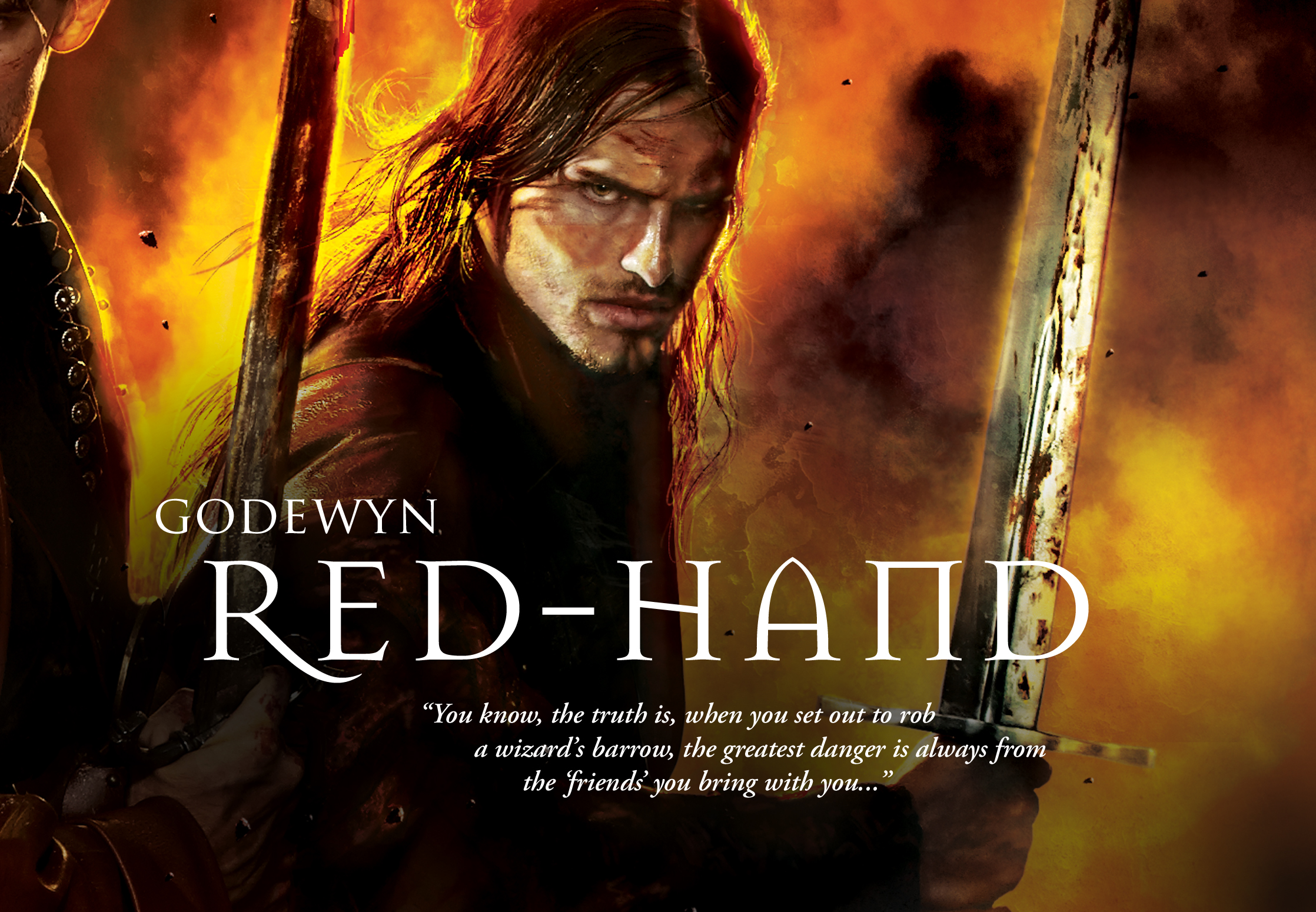
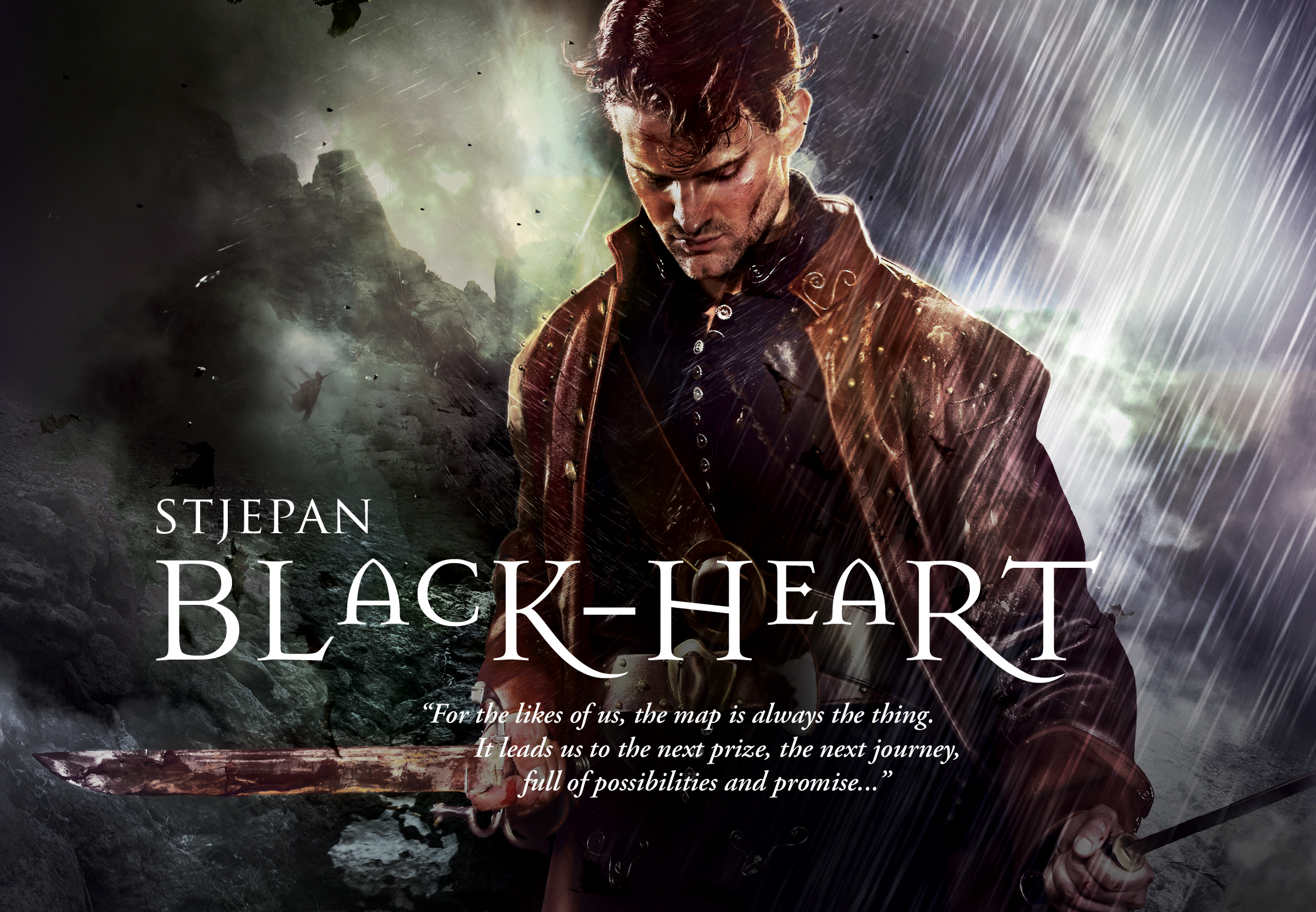
A treasure hunting expedition goes horribly wrong when Stjepan Black-Heart steals from the Nameless cults. Violence and horror befalls the group in one of the most thrilling prologues I've ever read. The survivors escape with an even bigger prize than they had ever expected: a map to the Barrow, wherein lies a priceless sword. The journey to the barrow is dangerous and the barrow itself is more so, but Black-Heart and his people are willing—only, the pesky map gets cursed and is lost in the process of trying to decipher it. But when it reappears in the most unexpected of places, things really start to get dark and crazy as the anti-heroes embark on their deadly adventure.

First of all, I love the Black-Heart. Well, I love all the characters, mainly because none of them are particularly likable and none of them are your typical fantasy heroes or even your typical fantasy anti-heroes. Let's just say that I will be inviting none of them over for dinner. Anyway, Black-Heart I am fond of because at first, he is introduced as the dark, emotionless badass that rarely cracks a smile, but soon enough, you learn that he is actually the well-educated royal cartographer who is known well by those above and below the law. I love that the story remains entirely centred on Black-Heart and this map, even as more and more fascinating tidbits are revealed about him.

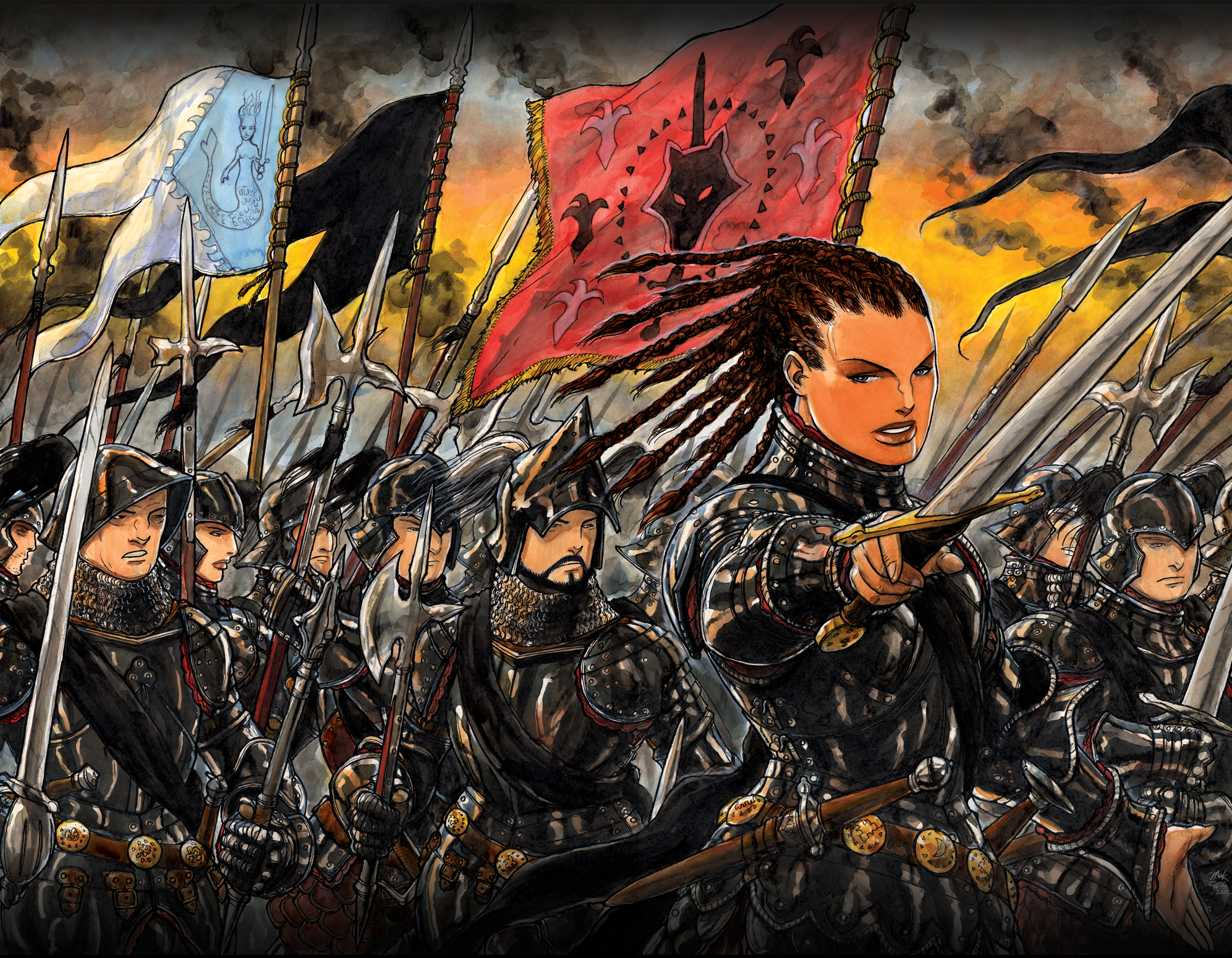
Fans of Smylie’s Artesia might be disappointed that she does not make an appearance beyond fleeting images in dreams and memories. This is the Black-Heart’s story and Smylie tells it well, without having to rely on Stejpan's sister, and expanding on the world he's already built in the stunning Artesia graphic novels.

As mentioned, The Barrow is an adventure story, complete with a fellowship in search of treasure. But Smylie makes it clear that these people are not in the least bit interested in saving the world or being heroes. They are in this for the treasure and some of them just might stab a man in the back to get it.

The Barrow does suffer from an over indulgence of tell, rather than show and often feels like a historical tour of the Known Worlds as Black-Heart and his crew make their way toward their goal. While I appreciate the wealth of knowledge and have always loved Smylie’s world, having so much within the book itself can be overwhelming. However, being a fan of Artesia, I did enjoy the mentions of deities and magical events that I was already familiar with. Smylie’s mythology is immense, with rich stories that go well beyond myth, since magic is very real and does play a significant role in The Barrow.

Technically speaking, the long sentences and paragraphs are problematic, as well as the point of view changes that occur within each chapter. However, I am very impressed with Smylie’s transition from graphic novels, where images tell most of the story, to novel format where words have to paint those pictures. I think, with lessons learned from this book and background lore already given, Smylie will be able to tighten up the writing to focus more closely on the plot.

As others have already pointed out, this book does contain a lot of sexually explicit content. Personally speaking, I’m a big girl and in my maturity, I’ve grown more comfortable with dealing with sexuality in its many forms. As a society, we have a long way to go when it comes to sexual maturity and moving beyond the oppressive Victorian sensibilities that plague us. Anyway, The Barrow does contain a lot of sex, especially within the first hundred plus pages or so, and some of it is quite perverse. One might argue that it comes off as mere titillation and I would agree that perhaps it goes on too long—but no more so than the violence or any other aspect of the story that Smylie spells out in detail as he weaves us into his world. I consider it important to the lore and, considering Smylie’s vast mythology, am not really surprised by it as such debauchery is not unheard of within the actual mythologies of the real world. Shall we take a walk through one of my favourites, Greco-Roman mythology, and see how often rape (sometimes in animal form) is attributed to Zeus? And consider, in turn, the debauchery common to the Romans in their time.

Now, all that said, I was ultimately disappointed that the female characters were most often and unsurprisingly the victims of these acts and the only woman who comes out of the story reasonably unscathed, sexually, is Erim, who is disguised as a man.

I was quite fond of Erim though. Another intriguing and completely atypical character in a book that is a dark and unique gem within the fantasy genre.

Tuesday, May 6, 2014

Book Review and Giveaway (US & Canada): The Silk Map by Chris Willrich

*** The giveaway is now over, thank you to all who entered! ***


Genre: Fantasy

Series: Book 2 of Gaunt and Bone

Publisher: Pyr (May 6, 2014)

Author Information: Website | Twitter

Mogsy's Rating: 4 of 5 stars


After the events of The Scroll of Years, Persimmon Gaunt and Imago Bone are back in action in The Silk Map, and this time on an even more exhilarating and perilous adventure. I promise you’ll never see anything else quite like these books, with its themes of East meets West and sword-and-sorcery fantasy with just a dash of the metaphysical.

While The Silk Map is the follow-up to The Scroll of Years, it can most definitely be enjoyed on its own. I can’t stop marveling at the ease with which the author can throw his readers into the middle of a situation but still manage to convey all the complexities and nuances in the relationships between his characters. In fact, The Scroll of Years was not the first time Gaunt and Bone appeared either; they had been starring in their own short fiction adventures for more than a decade now, but not having read those stories before tackling this series did not hinder me at all. Chris Willrich quite simply has a talent of writing extremely convincing characters, and upon picking up these books you can immediately feel the weight of the history behind Gaunt and Bone, partners in crime and partners in love.

But like all couples, they’ve had their differences and hit their rough spots. The story picks up once again in the faraway land of Ancient China-inspired Qiangguo, where Gaunt and Bone had taken asylum from their enemies. Gaunt had given birth to their son in the first book, but in order to save him from the clutches of evil forces, she and Bone had had no choice but to lock their child away in a pocket dimension within a magical scroll. Now that scroll has been lost, and together with their allies, our two protagonists must find a way to recover it and rescue their son trapped inside. Their journey leads them to the make a bargain with the Great Sage Monkey, a demi-god who knows of a way to retrieve the scroll. In exchange for her help, the minor deity asks that Gaunt and Bone seek the mystical land of Xembala and bring back the great treasure of the Iron Moths, that impossibly valuable material they produce called ironsilk. Their quest will involve traveling along the Braid of Spice, a fictional trade route that will lead them into the west.

Chris Willrich describes in the acknowledgements how this story was in part inspired by the history and tales of the Silk Road, which should already tell you what a gorgeous book this is. In antiquity, this route served as a bridge between the East and West, connecting people from all walks of life. The Silk Map brings to life a version of that diverse setting, blending a rich combination of fantasy and myth with elements from that ancient culture in its own unparalleled way.

Written beautifully in a literary and almost formal style, the prose is also something to be sipped and savored. I liked that there’s actually a lot of humor woven into the dialogue, sometimes hidden in sly references and wordplay, and if you blink you might miss it. While it’s true this made me take longer to finish the book, it is by no means a slow read. The Silk Map is a tale of adventure at its heart, and there is plenty of action and swashbuckling fight scenes interspersed with the quieter moments where you can sit back and enjoy as a character spins a yarn. Like The Scroll of Years, this book features poems and other stories within the larger narrative, often used to explain or expand upon the plot. Willrich’s writing style perfectly complements the speculative quality of these anecdotes, reminiscent of folklore and the legends told in the Far East Asian tradition.

For me, the highlight of The Silk Map had to be the interplay between Gaunt and Bone. Their relationship so far has been a journey as harrowing as the quest they have embarked upon to find their son. Their love will be checked, tested, and probed over the course of this novel and how they each come to terms with the conflict is as important as the other aspects in the plot, though no one can doubt Bone’s devotion to his partner, and of course, Gaunt shows us why it would be a mistake to underestimate the lengths a mother would go to for her child.

Interested in an Asian-themed fantasy or looking for a more subtle, elegant touch to your sword and sorcery without sacrificing the heroic element and adventure? Check out these books. The heady and sometimes dreamlike mix of history and mythology also make them an excellent choice.
 
*** Join us next week for an interview with Chris Willrich! ***


A review copy of this book was provided to me by the publisher in exchange for an honest review. My thanks to Pyr Books! 

* * *
THE SILK MAP GIVEAWAY

Thanks to the wonderful folks at Pyr, we have two print copies of The Silk Map up for grabs in this giveaway open to residents of the US and Canada. Entering is super easy, all you have to do is send an email to bibliosanctum@gmail.com with your Name and valid Mailing Address using the subject line "THE SILK MAP" by 11:59pm Eastern time on Wednesday, May 14th, 2014.

Only one entry per household, please! Two winners will be randomly selected when the giveaway ends and then be notified by email. All information will only be used for the purpose of contacting the winners and sending them their books. Once the giveaway ends all entry emails will be deleted.

So what are you waiting for? Enter to win a copy of this amazing book! Good luck!

Wednesday, March 26, 2014

Waiting on Wednesday 03/26/14

"Waiting On Wednesday" is a weekly meme hosted by Breaking the Spine that lets us feature upcoming releases that we can't wait to get our hands on!
Mogsy's Pick: 

The Leopard by K.V. Johansen: June 10, 2014 (Pyr Books)

The Leopard is the first book of a two-series, set in the same world but can be read apart from K.V. Johansen's Blackdog. I have an ARC so I'm not technically waiting, but I'm still really looking forward to it and also wanted to feature that lovely cover. And if you think that's pretty, check out the equally stunning cover to book two, The Lady, coming out this winter (and will be featured in a future WoW too, no doubt!)

"Part one of a two-book epic fantasy, set in a world as richly drawn as J.R.R. Tolkien's Middle Earth, but with Mideastern and Eastern flavors.

In the days of the first kings in the North, there were seven devils…

Ahjvar, the assassin known as the Leopard, wants only to die, to end the curse that binds him to a life of horror. Although he has no reason to trust the goddess Catairanach or her messenger Deyandara, fugitive heir to a murdered tribal queen, desperation leads him to accept her bargain: if he kills the mad prophet known as the Voice of Marakand, Catairanach will free him of his curse. Accompanying him on his mission is the one person he has let close to him in a lifetime of death, a runaway slave named Ghu. Ahj knows Ghu is far from the half-wit others think him, but in Marakand, the great city where the caravan roads of east and west meet, both will need to face the deepest secrets of their souls, if either is to survive the undying enemies who hunt them and find a way through the darkness that damns the Leopard.

To Marakand, too, come a Northron wanderer and her demon verrbjarn lover, carrying the obsidian sword Lakkariss, a weapon forged by the Old Great Gods to bring their justice to the seven devils who escaped the cold hells so long before.
"

Tuesday, March 4, 2014

Book Review: Blood and Iron by Jon Sprunk

Blood and Iron by Jon Sprunk

Genre: Fantasy

Series: Book 1 of The Book of the Black Earth

Publisher: Pyr (March 11, 2014)

Author Information: Website | Twitter

Mogsy's Rating: 3.5 of 5 stars 


When trying to make a good impression, the saying goes you should put your best foot forward as soon as possible, and that's definitely true for books as well. The fact that Blood and Iron was a bit slow in doing so may have weakened it a little in my eyes, but it is by no means a bad book. Indeed there are a lot of strengths, ones that I think would have made this book even better if the narrative had seized full advantage of them and taken things all the way.

The book's description begins with "Set in a richly-imagined world, this action-heavy fantasy epic and series opener is like a sword-and-sorcery Spartacus." If that sounds like your thing, then I have great news for you, because that is exactly what Blood and Iron delivers. "Richly-imagined world" doesn't even begin to do the setting justice; this is one incredible feat of world building Jon Sprunk has managed to achieve in his creation of an empire resplendent in its diversity of people and places.

The writing certainly does not skimp on the details. Every time a character enters a new environment, we are treated to an explosion of information about the surroundings, from the beautiful shoreline where the main protagonist Horace washes up after a shipwreck, to the decadent throne room of Queen Byleth's palace where he ends up being a political prisoner of sorts. When it's discovered that Horace possesses the latent abilities of a sorcerer, we are introduced to the beginnings of a complex world of magic as well.

Individually, the characters are also pretty interesting. Considered a "savage" by the slave-keeping, bloodthirsty culture of the Akeshians. Horace is our main character simply trying to stay alive in the intricate web of customs and politics in Byleth's court. Byleth herself is someone I could not get a bead on for much of the novel. Depending on whose point of view you're looking at, she's either strong or powerless, a tyrant or a victim, manipulative or vulnerable, though perhaps that is why of all the characters I found her the most intriguing.

For the most part, however, it feels like the plot of this novel is too too narrowly focused on the machinations at court, when my overall sense is that it wants to be something more. I didn't exactly get the feeling there was war and a greater conflict on a grand scale out there, which is what I think the narrative wants you to know but somehow doesn't quite manage to convey. It's almost like the bigger story is always just there lurking beneath the surface, and I kept waiting for it to break out but it never did, at least not until close to the very end.

Part of this has to do with what I thought were a couple of underutilized perspectives, namely those of Alyra, a slave who is really a spy in the queen's court, and Jirom, the badass mercenary and gladiator extraordinaire. Scenes with the former working for her underground network or the latter fighting in his army's battles, both of which would have expanded the story's scope, were only inserted here and there between Horace and Byleth's dealings with each other. All the while, there seemed to be a lot more nonessential rehashing of events between the protagonist and the queen that take place at the palace. 

It took a while for it to click with me where this story wanted to go. As such, the novel has the feel of a long introduction, albeit a good one. Like I said, there's a lot to like in here; it just takes a while for everything to consolidate, but the ending was without question stronger than the way it began. Now that we've got the ball rolling, I'm looking forward to seeing what the second book will bring.


A review copy of this book was provided to me by the publisher in exchange for an honest review. My thanks to Pyr Books!

Monday, February 17, 2014

Book Review and INTERNATIONAL GIVEAWAY: The Barrow by Mark Smylie

***Our GIVEAWAY for THE BARROW is now over. Thanks for all who entered!***


Genre: Fantasy

Series: Book 1

Publisher: Pyr (March 4, 2014)

Author Information: Website

Mogsy's Rating: 4.5 of 5 stars


Before we begin, I feel I should make it known that this book is not for the faint of heart. If you know you'll feel uncomfortable with things like brutal violence, ear-bendingly foul language, and extremely graphic sex, then you may wish to reconsider having a go at this ... especially when it comes to that last one. In general, I am not the kind to be bothered by lewd and explicit acts in books, and yet there were still certainly no shortages of eyebrow raises from me with this one! Anyway, it was enough that I feel I should say something. Fair warning!

And now with that out of the way, let's get down to the reasons why this book totally rocks. If you're the kind of person who likes the combination of a good adventure story with the dark and gritty aspects of fantasy (of course, keeping in mind the caveats mentioned above) then you'll love The Barrow! Incidentally, this is exactly the kind of mix I enjoy. The fact that it was even darker than I expected was a nice surprise, though I don't know if I would call it full-out grimdark. In an interview with The BiblioSanctum, Mark Smylie described the book as more of an "archetypal Dungeons & Dragons adventure as run through the filter of Lock, Stock and Two Smoking Barrels" ... and well, yes, actually I suppose that description would do nicely!

Furthermore, the book also takes place in the world of Mark Smylie's Artesia graphic novels. I won't deny that an emotional attachment to the setting was a factor for me, but if you are not familiar with the comics, do not fret! This is a brand new self-contained story, no previous knowledge of the world or characters required -- which is actually great for me too, since I'd only read the first volume and it was quite a while ago. However, you can still tell that writing a story within a setting that has already been established works well in the novel's favor; the world-building is phenomenally robust and very deep, with many layers to the descriptions of the people and places.

As the reader, I felt like I was transported right there -- and that is both a wonderful and terrifying experience, considering the type of world we're thrown into, one filled with dark magics, shady politics, and disreputable characters. Scoundrels and perverts lurk at every corner, and if you're really unlucky, you might even run afoul of demonic horrors and evil gods. The main plot is actually quite simple, deceptively so perhaps; on a routine tomb-robbing operation, Stjepan Black-Heart and his crew stumble upon an ancient map which details the final resting place of a long-dead wizard, who was said to have been buried with a priceless legendary sword.

Here's where the adventure narrative comes in. To find the sword, our protagonists must first gather their allies and go forth to locate this tomb. Of course, epic quests are never so easy or straightforward. But even when a curse placed on the map kills one of the essential members of the crew and ends up transcribing itself onto the skin of a young noblewoman, you think that would stop the Black-Heart? Nope! Whether it's wealth, fame, freedom, or absolution, everyone on this journey has a reason to find this fabled Barrow, which makes this story a riveting one filled with secrets and unexpected twists.

Among these colorful personalities, some of the characters are so disturbing it will make you sick to your stomach, while others are so crazy it will make you laugh; but there's definitely no accusing any of them for being boring. Out of everyone, I think I like Erim the best. A young woman masquerading as a man, Erim is Stjepan's protege, and despite her skill with the blade, in many ways she is as sheltered as her mentor is well-traveled. It's ironic that she doesn't find herself to be very interesting, because she was my favorite with her quiet introspection and fierce loyalty. That pretty much also makes her the most honorable of the lot; we're talking about some rather grim and nasty characters here, after all.

This is a book that pulls you in immediately, starting with an explosive intro that sets the tone and mood of the story quite nicely. It also contains possibly one of the most heart-pounding prologues that has ever graced the pages of a fantasy novel, and my head is still reeling from the events at the end of that chapter. However, the pacing of the novel is a bit uneven, which is probably the only quibble I have about this book. After the introduction comes a middle that slows down considerably as the characters travel towards their destination. There are frequent stops along the way, but the good news is that something interesting happens at every one of them. These encounters often added to the depth of the lore and setting, giving me more of a sense of the world's vastness. 

But while it took me several days to read the first three-quarters of this book, I think I devoured the last 150 or so pages in one exhilaratingly intense sitting. Everything that happens after they find the Barrow is pure insanity. Also, I just love twists and surprises! It's a climax and conclusion that goes beyond just being an ending, because more importantly it reveals how all the themes and undercurrents of the novel come together. It speaks much about Mark Smylie's skills as a storyteller. He marks his transition to full-length novels with this incredible debut, and I'm glad to hear we will be seeing more from him following The Barrow.


A review copy of this book was provided to me by the publisher in exchange for an honest review. My thanks to Pyr Books!

* * *
.
THE BARROW GIVEAWAY


And now here's what you all have been waiting for! Thanks to the kind folks at Pyr, we have two print copies of The Barrow up for grabs, and entering our giveaway is easy peasy! There are no geographic restrictions. That's right, international entries welcome! All you have to do is send an email to bibliosanctum@gmail.com with your Name and valid Mailing Address using the subject line "THE BARROW" by 11:59pm Eastern time on Monday, February 24th, 2014.

Only one entry per household, please! Two winners will be randomly selected when the giveaway ends and then be notified by email. So what are you waiting for? Enter to win a copy of this amazing book! Good luck!

Sunday, January 26, 2014

Book Review: The Stormcaller by Tom Lloyd

The Stormcaller by Tom Lloyd

Genre: Epic Fantasy

Series: Book 1 of Twilight Reign

Publication Date: October 21, 2008 (Pyr)

Author Information: Website | Twitter

Mogsy's Rating: 4 of 5 stars 


I have to say I did things a little bit backwards when it came to this series. It all started with The God Tattoo, Tom Lloyd's anthology of stories from the Twilight Reign that I read last year. Needless to say, I enjoyed it very much. Furthermore, it made me want to explore everything else this world had to offer, so when Pyr gave me the opportunity to read and review The Stormcaller, the first book of the series that began it all, I very enthusiastically accepted.

That collection of tales had given me a taste of the Twilight Reign universe, and piqued my interest with its promise of a dark and epic fantasy. Here was the world I had been introduced to, one of white-eyes, ancient deities and terrible magic. Now I was finally able to see the wider context, getting the full depth of the story filled with gods and demons, clandestine politics and violent clashes between warring peoples. I feel like what I'd gotten from the anthology was just a nibble. And here, this was the whole cake.

Born into a life of poverty, our main protagonist Isak is a white-eye, a genetic rarity known to make those with the condition bigger, stronger, and more aggressive. Feared and mistrusted by those around him, Isak had resigned to the fact that he would never be accepted, until fate intervenes and raises him to a position of power as the heir to the Lord of the Fahlan. In some ways, I feel the book comprises of several distinct parts, and this section of the story would be the first of them, focusing on Isak's transition from a simple peasant to someone with status.

Now, while it's true that a lot of fantasy stories begin this way, I thought Isak's background was a big part of what set his tale apart. For one thing, I find the lore and history behind white-eyes fascinating. Purported to be stronger, faster and more charming than normal men because they are god-touched and divinely chosen to be leaders, white-eyes are still no less shunned and despised by many. Because of this, Isak has to prove himself twice over to satisfy his detractors.

Regrettably, I also think this part of the book was the most difficult to get through. As Isak learns the ropes, this section of the story is mostly filled with descriptions of the things he learns and the people he meets, and it's the most slow-moving part of the story. Add to that, the writing style took some time for me to get used to. I thought the prose came across rather stark and ponderous, and while I wouldn't say I disliked the writing, it still felt like it was missing something -- lightness or emotion, perhaps, though to be fair, the story is meant to be quite dark and heavy. To get through this first part of the book, I did feel I had to work at it.

The action didn't come until later, but I have to say the plot picks up considerably once we follow Isak and his people into war against the elves. This section of the story is driven by several pitched battles, and here the author also starts fleshing out his world in earnest, giving it history and depth. As the layers were filled in one by one (culture, religions, politics, etc) I finally began to feel the full weight of the Twilight Reign universe.

I ended up loving the second half of this novel. It encompassed the final section of the story, in which Isak travels to Narkang with his retinue, and they meet the celebrated King Emin. I won't deny this probably had to do with having read The God Tattoo first; Emin was a character that featured prominently in a couple of the stories in the anthology, and so in a way, I felt like I already knew him and had a good grasp of the setting of Narkang. And lastly, this part of the book also featured the climax of the final battle, which was a great way to bring everything to a close.

All told, it took me a while to read The Stormcaller, partly because it's such a long book but also because I had to settle in to the writing style. Still, I enjoyed this one. I may have come to this series in a roundabout way, but further exploring a world that fascinated and intrigued me was so worth it.


A review copy of this book was provided to me by the publisher in exchange for an honest review. My thanks to Pyr Books!

Thursday, January 16, 2014

COVER LOVER: Behind the Scenes with The Barrow

Cover Lover is a feature originally created by our friend and fellow book blogger, Jaedia at Once Upon A Time. Usually, we chat about covers that strike our fancy, of which The Barrow's cover most definitely is one, but Eisner award nominated Author and Artist Mark Smylie, Pyr®'s award-winning Editorial and Art Director Lou Anders and the incredible scifi/fantasy cover Illustrator Gene Mollica have graciously helped me take this feature one giant step further by offering us some insight on the cover design process.

Some covers are more symbolic. Some covers focus on a particular aspect of or event within the story. Some, like this one, seem to directly reflect the book’s description of an epic, swash-buckling adventure. What factors go into selecting a particular image? How closely should the image reflect the actual story or particular elements of the story?  

Lou Anders: The most important job for a book cover is that it connects the right book with the right reader. I’ve likened book covers in the past to the patterns and colors of different flowering plants, signalling to the appropriate insects “This is the flower you want; stay away from that one over there. Try this!” Book covers have about thirty seconds or less to catch the casual bookstore browser’s eye, and if they can’t do that, then it doesn’t matter how attractive they are. In fact, before the book ever reaches the shelf, its first (and arguably most important) audience is the book buyer who determines how many copies to buy for his/her store. At Barnes & Noble, that’s one individual, who buys for all of science fiction and fantasy nationally.  I think it is wonderful when a book cover depicts its contents accurately and in line with its author’s intent, and we always strive for this, but an accurate representation of the contents is not as important as an accurate presentation of the type of experience the book promises. The most important consideration is that the book cover accurately indicates the promise of the book. That’s it right there. The book cover is a promise, and we need to keep that promise.  In this particularly case, a lot of directions were tried and discarded, because, although they were wonderful pieces of art in their own right, they promised a different experience from the one Mark’s story provided.

Behind the scenes
Gene Mollica: To be honest, the decision as to what kind of image is best for a certain book usually happens before it gets to me, the artist - it's made by the editors, art directors, and publishers based on what they think is most powerful about the book, the market they're going after, and hopefully some input from the author. Then, they call me with a description, and I concept and create the image - the model, the clothes, the pose, the setting, and the mood. There are all kinds of covers in science fiction/fantasy - I tend to like the ones that are more photographic or photo-real appearing, and dramatically lit. For The Barrow, I had the opportunity to work very closely with both the editor and the author, which doesn't always happen - Mark actually lives nearby so he came to my office and I showed him my ideas, some models, and the costume design before we did the shoot. I really wanted to bring the gritty tone and the characters to life and I'm pretty happy with the way it turned out.

Mark Smylie:  There’s obviously a huge range in terms of sf/fantasy covers, though I think the range in fantasy tends to be a bit more narrow.  If it works, The Barrow is a novel about some pretty grim and gritty characters doing some very dangerous and dirty work; I won’t go so far as to call it grimdark, I wasn’t even aware of that term until recently, but if it winds up with that label I don’t think I’d object too hard.  It’s kind of like an archetypal Dungeons & Dragons adventure as run through the filter of Lock Stock and Two Smoking Barrels: a predominantly street-level view of the world, loaded with (casual) violence and tension and hopefully some unexpected twists.  There are all sorts of other themes and layers that run through the book – well, there are if I was successful as a writer, that is – such as the fate of women in a medieval-style patriarchal culture, the question of who you trust and why, how you decide what you’re loyal to, how history and lineage are bound up in a present reality.  I think when Lou and I were initially discussing cover ideas we had discussed a fairly wide range of cover concepts, with some of them hitting more on some of those additional themes and elements rather than focusing on the main vibe of the book.  But in the end Lou thought it would be best to really emphasize that gritty quest-narrative that drives the book, and I think the result is spot-on.

How much editorial input is there prior to and during the design process? Does an editor see the design before it is complete? Does the editor have input on what it should look like?

Lou Anders: In this case, I am both Editorial Director and Art Director of Pyr, so yes. This editor commissions the artist, communicates the art brief, views the roughs and art directs the entire process. I also oversea the work of our three very talented in-house designers (Jacqueline Nasso Cooke, Nicole Sommer-Lecht, and Grace M. Conti-Zilsberger).

Gene, what information do you get to work with in order to create a cover? Do you read the story itself, or are you just provided an overview? 

Gene Mollica:  I was really fortunate with this project because I got a lot more than just the usual brief overview; I had the pleasure of working with two very visual people who like to be hands on. Lou knew very well what he needed and what visual directions to take. Mark is a fabulous artist and provided very clear illustrations and descriptions of each of the characters.
Together we made a great team, as we continued to nail down and refine the concept. We reviewed models / talent for the photography; once we picked the talent, we then discussed wardrobe carefully so that I could start designing the costumes (all of the wardrobes for the characters were custom made by my fabulous costumer).

It got really fun when we realized that both Mark and I lived just minutes from each other – that called for a face to face throw down of who has the best weapons in their arsenal. Mark won, incredibly convenient that he’s also a collector of fine rare medieval weapons. So like two big kids we got into the costumes, weapons, baldric, belts, knives and swords – work life doesn’t get better than this.

So this assignment was a hell of lot of fun, rarely do you get this much direct insight from an editor and the author. Together, hopefully we achieved a great cover.

Mark Smylie:  I might take issue with Gene saying I won the arsenal contest.  Gene’s got a great collection of weapons and props, certainly far more pieces than I do, and I even had a bit of a geek moment when I spotted the sword he used for the cover of Joe Abercrombie’s Best Served Cold (which I believe wound up being used as Erim’s sword on the cover, though you don’t really get a look at the hilt; there are other pictures from the studio shoot where you can see that it’s the same sword).

As an artist yourself, Mark, did you consider doing the cover? Why or why not? How much input did you have on the process? How do you feel about the end result?

Mark Smylie:  Lou actually asked me early on if I wanted to do the cover; I think he assumed the answer would be yes.  But I declined.  My art style uses a mix of watercolor, colored pencil, and ink line, and I think it works well in comics or in roleplaying game illustrations but maybe less so in the realm of sf/fantasy book covers, which tend to be either painterly, photorealistic, or very design-oriented.
Mark Smylie's Artesia
Since I come out of comics and graphic novels as a writer/creator/illustrator, I wanted there to be a clear message to the reader: this is a fantasy novel.  It’s not a graphic novel in disguise, or somehow translated into a prose work (well, okay, technically it was a screenplay first; but it was never intended to be a comic).  So I thought it was important to have someone do the cover who could give it that feeling of “hey, look, it’s an actual fantasy novel.”  Lou and I kicked some ideas around – I think the only stipulation I asked was that it couldn’t be someone that I already knew – and at one point he suggested Gene.  I had seen a number of Gene’s covers (such as the cover he did for Best Served Cold, and for Brian McClennan’s Promise of Blood and the Powder Mage series) and really loved the idea of a sharp, photorealistic style to it.  I was able to provide some details and sketches and sample photos as a kind of look-book for the characters and their equipment, and then as Gene mentioned since it turned out we lived not too far from each other I was able to pop over to his studio and take a look at some of the available weapons and costume choices.  With the comic I’ve always tried to inject realism into the armor and weaponry and costuming, and Gene and his costumer have a great sense of how to mix fantasy and historical elements in the look of the character’s clothes.  It was fun to be asked to be involved in the process and I really loved Gene’s end result (so much so that I asked Gene to do individual character portraits that I am using on the book’s website, at www.swordandbarrow.com).


Wednesday, January 8, 2014

Waiting on Wednesday 01/08/14

"Waiting On Wednesday" is a weekly meme hosted by Breaking the Spine that lets us feature upcoming releases that we can't wait to get our hands on!

Mogsy's Pick 

The Silk Map by Chris Willrich: May 6, 2014 (Pyr)

I can't remember the last time I came across a book like The Scroll of Years -- action-adventure fantasy, gorgeously written but with such wit and an elegant touch! The Silk Map is the sequel, and I am looking forward to reading more about Imago Bone and Persimmon Gaunt.  

"It's Brent Weeks meets China Mieville in this wildly imaginative fantasy adventure featuring high action, elegant writing, and sword and sorcery with a Chinese flare.

At the end of The Scroll of Years, the poet Persimmon Gaunt and her husband, the thief Imago Bone, had saved their child from evil forces at the price of trapping him within a pocket dimension. Now they will attempt what seems impossible; they will seek a way to recover their son. Allied with Snow Pine, a scrappy bandit who's also lost her child to the Scroll of Years, Gaunt and Bone awaken the Great Sage, a monkeylike demigod of the East, currently trapped by vaster powers beneath a mountain. The Sage knows of a way to reach the Scroll -- but there is a price. The three must seek the world's greatest treasure and bring it back to him. They must find the worms of the alien Iron Moths, whose cocoons produce the wondrous material ironsilk.

And so the rogues join a grand contest waged along three thousand miles of dangerous and alluring trade routes between East and West. For many parties have simultaneously uncovered fragments of the Silk Map, a document pointing the way toward a nest of the Iron Moths. Our heroes tangle with Western treasure hunters, a blind mystic warrior and his homicidal magic carpet, a nomad princess determined to rebuild her father's empire, and a secret society obsessed with guarding the lost paradise where the Moths are found -- even if paradise must be protected by murder."

Tuesday, January 7, 2014

Book Review: A Guile of Dragons by James Enge

A Guile of Dragons by James Enge

Genre: Fantasy

Series: Book 1 of A Tournament of Shadows

Publisher: Pyr

Date of Publication: August 21, 2012

Author Information: Website | Twitter


Mogsy's Rating: 3 of 5 stars - "Dynamic character relationships and an intriguing mix of fantasy elements in this adventurous tale about dwarves versus dragons"
 
James Enge's A Guile of Dragons is actually the first book of a "prequel" series called A Tournament of Shadows featuring his celebrated character Morlock Ambrosius. Not having read the original books, I'm sure my experience is probably going to differ wildly from that of a reader who is already familiar with the world and character, but knowing beforehand that I was going into an origins-type story was good preparation for what to expect.

Most of the book covers the life of young Morlock. We begin at a point before he is even born, then watch as he is given to the dwarves as an infant. Morlock's real father is Merlin -- yes, that Merlin -- though he is raised among the dwarven folk; as such things go, the character's struggles with his birthright and mixed feelings about his heritage eventually emerge as one of the overarching themes of the story.

But on top of that, the book is also an adventure, with an ancient war between dwarves and dragons at its heart. When the dwarven territories are invaded, their defenders taken prisoner or placed under the corrupted influence of dragonspells, it falls to Morlock to protect his surrogate family and the people who raised him.

This was a good story, well told in its complexity and showing of relationships between different characters, but I have a feeling I'm not clicking with it as much as I should. I'm sure a lot of it had to do with the book and I getting off on the wrong foot, with the introductory chapters throwing me off with its pacing. The sections that take place before Morlock's birth and up to the brief scenes of his childhood with the dwarves feel like they should have been a prologue, separated from the rest of the book.

I understand the importance of including this time of his life as part of his back story, but I don't know if it meshes that well with everything that comes afterward. The first part of the book felt like a running commentary on the circumstances behind Morlock's birth, resulting in a disconnect between myself and the character. Fortunately, the book really gets going once he reaches adulthood and we get into the meat of the story, when we encounter the dragons and their violent confrontations with the dwarves.

What follows is a very intriguing take on the history behind the dwarven-dragon conflict, and the intricacies in the nature of the two societies. The character dynamics also pick up, and as factors like bitter resentment or shifting loyalties start to come into play, things get a lot more interesting. The author throws in a lot of surprising twists, and I have to say one of my favorite aspects of this book is how Enge incorporates elements from legend and Arthurian fantasy into the world lore.

My overall feeling is that you can definitely read A Guile of Dragons on its own, but I have no doubt I'm also missing out on a lot of the subtleties. Yet despite delving into this one without any context, I was on the whole impressed. After seeing how the events of this book has shaped Morlock as a character, I admit I find myself curious about him and his future exploits.

3 of 5 stars

A review copy of this book was provided to me by the publisher in exchange for an honest review.  

Sunday, December 15, 2013

YA Weekend: Planesrunner by Ian McDonald

Planesrunner by Ian McDonald

Genre: Young Adult Science Fiction Fantasy

Series: Book 1 of Everness

Publisher: Pyr (US ed.)

Date of Publication: December 6, 2011

Author Information: Website | Twitter


Mogsy's Rating: 4 of 5 stars -  "One of the most well-written and interesting YA novels I've ever read and just plain fun, this book will appeal to a wide audience"

Add Ian McDonald's Planesrunner to the list of the most interesting and well-written young adult novels I've read this year. With the third book coming out soon, I'd initially picked this up to get caught up with the series, but in doing so I also finally discovered why so many readers have been raving about Everness. Adventurous and fun but also fresh and clever, if you're looking for a YA offering that's a little different but has a great story at the same time, consider checking this one out.

Planesrunner tackles a topic in fantasy and science fiction that I have a great interest in: multiple universes and alternate dimensions. I have rarely seen it handled with such detail when it comes to YA fiction, though. The protagonist is Everett Singh, whose father is a brilliant scientist and one of the leading researchers in the study of parallel earths. But then Tejendra Singh is kidnapped from the streets of London one day, leaving his son with a mysterious file on his computer called the Infundibulum.

The Infundibulum ends up being a map to the parallel earths -- all 10 to the power of 80 of them! -- making Everett the guardian of the most valuable tool in the whole entire multiverse. But there are others who see the Infundibulum as a powerful weapon, nefarious factions in the group of plenipotentiaries of the Ten Known Worlds. To escape their reach, Everett travels to a very different parallel earth. With the help of new friends, he is determined to find and rescue his father, while fighting to protect the Infundibulum at all costs.

Hard sci-fi readers will probably find the science behind the quantum physics and theory of multiple universes to be on the light side, but I still find Planesrunner to be a fabulously clever novel. There's enough information to enjoy this fun and action-filled story without getting bogged down with details, and when it comes to his imaginings of parallel earths, Ian McDonald takes things all the way. 

The sights and sounds in the world Everett ends up in, designated E3, are beyond amazing. It is a world where fossil fuels have never existed, leading to a society powered by a system that can only be described as a souped-up version of steampunk or, as Everett so amusingly observed, "electropunk". Everett ends up being taken in by an airship crew, thus introducing the reader to the rich, imaginative culture and language of the "Airish". The author certainly does not skimp on the descriptions of the people and their way of life, making it easy to picture the setting and put myself right there.

I also thoroughly enjoyed the characters, though Everett himself comes off as a bit unrealistic as a 14 or 15-year-old boy. The extent of his intelligence is played up and so farfetched it's difficult for me to feel otherwise, but on the other hand, his more mature point of view and way of thinking might make him more relatable to a non-YA reader, thus making Planesrunner a book that may appeal to a much wider audience. 

And finally, this book was just plain fun. Where else would I be able to get the craziness and thrills of an actual airship duel outside the pages of this awesome novel? I love YA fiction like this -- quick, clever and full of great ideas. The Everness series is simply "bonaroo"! Looking forward to continuing Everett's journey with the next book, Be My Enemy, and then on to Empress of the Sun, dropping early next year.

4 of 5 stars

Friday, December 13, 2013

Book Review: The Doctor and the Dinosaurs by Mike Resnick

The Doctor and the Dinosaurs by Mike Resnick

Genre: Steampunk, Western

Series: Book 4 of Weird West Tales

Publisher: Pyr

Date of Publication: December 10, 2013

Author Information: Website | Twitter


Mogsy's Rating: 3 of 5 stars - "Meant to be sensational and a little over the top, and in that sense the book does its job and does it well. Fun and entertaining"

The Doctor and the Dinosaurs is my first venture into Mike Resnick's Weird West Tales, and actually my first exposure to the author, period. Like many kids growing up, I went through a phase in my childhood where I was just nuts for dinosaurs. I suppose a part of that love has stayed with me all this time, because when I saw the cover and description for this one I just couldn't resist.  

This is the fourth book of the series starring Doc Holliday of American Old West fame, but if I'm not mistaken, each installment can be read on its own. We seem to be catching our protagonist at a pretty bad time though, as the book opens on Doc bedridden and coughing out his lungs in a sanitarium, dying of the dastardly consumption. But then he is visited by the medicine man and great chief Geronimo, who grants him one more year of life in exchange for a favor. 

Doc Holliday is tasked to stop two paleontologists who have been carrying out their digs on sacred Comanche burial grounds in Wyoming. Sounds easy enough. But that was before Doc learned that the two scientists involved are none other than Edward Drinker Cope and Othniel Charles Marsh, two men who hate each others' guts and are locked in eternal competition. Time is running out and the Comanche medicine men have made things clear: stop desecrating their lands or they will unleash a horde of monsters, the kind our world has not seen in 65 million years.

A crazy blend of steampunk, fantasy, alternate history and western, this book was as much fun as I thought it would be! I've never had the pleasure of reading a "true" dime novel from the latter half of the 1800s, but I wouldn't be surprised if Mike Resnick is in some way emulating the spirit and style of the popular fiction in those days. As you would expect from the above synopsis, the book's story and characters are more sensational than deep, with an entertaining plot that contains more clever, snappy dialogue than exposition. Nevertheless, that's the kind of book it was intended to be. In that sense, it does the job and does it well.

This book was also such a treat for the part of me that still loves dinosaurs. We all know there's no shortage of stories about the Old West featuring famous gunfighters like Doc Holliday, Wild Bill Hickok, Wyatt Earp, Cole Younger, and the list goes on. But while this series also features an impressive list of shootists, I loved how this particular story directed its focus to another significant event that took place during America's Gilded Age -- the Great Dinosaur Rush. For one, the hatred between Cope and Marsh was so intense, their rivalry so frenzied, that the two men actually spawned a period in paleontological history known as the Bone Wars. It's fascinating stuff! I was happy to see a spotlight on this idea, and an entire story built around it.

Is The Doctor and the Dinosaurs a little over the top? Perhaps. But is it fun? Definitely. I picked up this book hoping for an afternoon of fun, light reading, and that's exactly what it delivered.
 
 3 of 5 stars
 
A review copy of this book was provided to me by the publisher in exchange for an honest review.