The BiblioSanctum has moved!

You will be automatically redirected to the new address in 5 seconds. If that does not occur, please visit
http://www.bibliosanctum.com
and update your bookmarks. See you at our new home!

Showing posts with label feminist fiction. Show all posts

Thursday, August 22, 2013

Wendy: A book you thought you wouldn’t like but ended up loving

Sorrows Of Adoration by Kimberly Chapman

I'm not typically a romance fan, but a friend wrote this book and I read it initially out of that 'obligation,' but by 2:00AM the next morning, I was so completely smitten with the characters and their emotional struggles that I spent the rest of the day in an exhausted book funk, desperately needing to get home from work so I could finish the book.
Click here for my original review.

Wednesday, April 17, 2013

Princeless and Beyond: An Interview with Jeremy Whitley

We've read Princeless Volume 1: Save Yourself almost every day since I picked it up at the beginning of the month, so when I told my daughters that I'd be interviewing the creator, Jeremy Whitley, they demanded participation. Izzy (4) was eager to learn about Jeremy's daughter and proudly show off her hair, which is "poofy" just like Princess Adrienne's. Ivy (7) cut right to the chase and asked Jeremy why he wrote Princeless.

"I wanted to write a book about a girl that was strong, smart and independent - like I want my daughter to be when she grows up."

Sixteen year old Princess Adrienne Ashe is definitely all that and more. As a princess locked in a dragon-guarded tower, she decides to take her fate into her own hands and save herself rather than wait for some prince to do it for her. Having a strong female person of colour as the main protagonist is certainly a refreshing change, but I hadn't expected Princeless to cover so many other issues common to the comic book industry, such as sexism and gender stereotyping. These problems were presented in a way that my girls could easily understand and discuss with me, which is exactly what Jeremy was aiming for. "I wanted to put it out there to get adults and kids talking."  The pervasive sexism and, to a slightly lesser extent, racism are issues that have always troubled Jeremy since he began collecting comics. He felt these were significant issues that Adrienne needed to talk about within the context of the story. Some critics complained that the commentary was inappropriate for a younger audience but Jeremy argues that kids can handle a lot more than we give them credit for. Obviously the Eisner Awards agreed, nominating Princeless in the Best Publication for Kids category. Issue #3, the one featuring the call to armor regarding sexism in the industry was nominated in the Best Single Issue category. Not that Jeremy intends for Princeless to be preachy. He promises that volume two of the series, illustrated by Emily C. Martin and available now, will lay off the commentary to allow more focus on the action, characters and story. Well, mostly, he says, sheepishly pointing out the parody cover of issue #2.

Jeremy has a lot in store for us with Princess Adrienne as she and her friends, Bedilia the blacksmith and Sparky the dragon continue their quest to rescue other princesses.  It's an all girls adventure that passes the Bechdel Test, even if he hadn't purposely put together this female cast with the test in mind. "I didn't want to create a book about girls with only one girl who may fall into the trap of still having to be rescued." He cites the current incarnation of Wonder Woman as an example of this problem. Wonder Woman is mainly surrounded by males who's focus is moving the plot forward instead of the female lead.

Illustrations by Emily C. Martin
Colours by Soojin Paek
On Free Comic Book Day (May 4, 2013), we'll meet Asian princess Raven Xingtao in a Princeless story called "Girls Who Fight Boys," along side Jamal Igle’s Molly Danger. Like the other princesses, Raven is trapped in a tower awaiting rescue. Her tower is guarded by one of the knights hired to hunt for Adrienne's "killer" who has no interest in fighting girls. While there are similarities in their plight, Raven offers a different perspective that will give Adrienne something to think about. "Adrienne doesn't have a feel for the fact that not everyone wants what she does," which tends to be an issue for headstrong people, Jeremy points out.

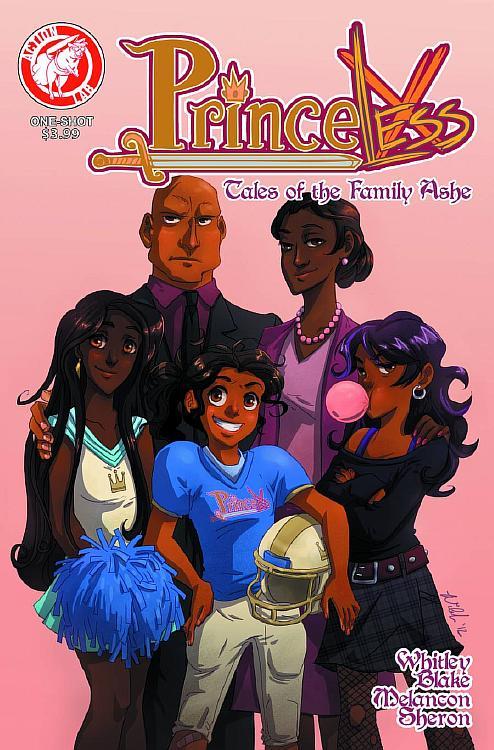
Jeremy hopes to do a story arc featuring Raven and Adrienne, but in the mean time, we'll be seeing a lot more of Adrienne's sisters in the main story, as well as in Tales of the Family Ashe.  This one-shot will show "what makes them tick and give them a chance to shine."  It will also give some insight into the young King Ashe. Turns out he wasn't always so curmudgeonly.

While Princeless is very much about breaking the gender stereotype for girls, it also touches on the problems boys have to deal with. Volume 1 features a short story on Prince Charm school and Adrienne happens to have a twin brother named Devin who is constantly reminded of his unkingly ways by his father.
"Devin is a smart kid with a lot of talent, it’s just not a talent his father is at all interested in. Devin is a poet, a designer, a thinker, a creator, and an excellent speaker. All of these would be excellent qualities for a king to have, but his father is interested in having someone that he knows can ride into battle and lead his troops." [X]
Devin does not feature in Tales of the Family Ashe, but hopefully we will see much more of him some time in the future. Perhaps even in a Princeless cartoon...?

Jeremy recently put out feelers about the possibility of putting together a Kickstarter for a Princeless animated pilot. He would love to see this happen, not for the sake of vanity, but for the same reason he created the comic in the first place. Unfortunately, research and chatting with those who have gone through the process indicate that putting together a Kickstarter is a full time job that requires a "good chef to handle so many ingredients," which puts the prospect a lot further into the future than Jeremy would like it to be.

Art by Jason Strutz
from The Order of Dagonet
Not that Jeremy doesn't have a million other things to work on! His advise to those who want to create comics is to just do it; "make the comics you want to read." That's exactly what Jeremy has been doing, using his creative writing degree from the University of North Carolina and script writing courses, taking advantage of the many creator owned opportunities that companies like Action Lab Comics are providing. When he saw a painting of Titania by Jason Strutz and presented the artist with a script he'd been working on, The Order of Dagonet was born. Issues #1-3 are available now, but the fun little comic about modern day knights summoned to defend Britain from magical creatures is on hold for the moment due to quiet sales, but Jeremy and Jason have more up their sleeve.

Skip concept art by Jason Strutz
Jeremy and Jason are also working on Skip. A 6ish issue work in progress, they are hoping to find a publisher interested in a super hero story about an administrative assistant to an industrialist "Lex Luthor-type character who unintentionally finds himself on the wrong side of the super heroes and takes it personally." His assistant cares about him and is caught in between, recognizing that her boss isn't necessarily an evil guy. Top off her troubles with her sudden development of uncontrollable time travel powers...

Jeremy explains that he has always been fascinated by Lex Luthor and the two personas that have been presented over the years. There's the Gene Hackman version "who is a crazy smart guy that does things sometimes for profit, sometimes just to be evil." Then there is the Lex Luthor best portrayed in the animated series, voiced by Clancy Brown where he "may be evil, but is mainly a genius who doesn't take well to guidance. He's a self-made man who is irritated by the concept and existence of Superman."

A Bibliosanctum exclusive! Cover concept
for Snow Illustrated by Jessi Sheron
Jeremy's worked with Action Lab Comics on an NFL Rush book and GlobWorld and is working with artist Jessi Sheron on a dark fantasy children's book tentatively titled Snow. The main character is a normal young girl who wakes up to find everyone in her house gone and mythical, magical creatures have taken over. Her sister is some how significant to these creatures and the girl goes on a quest to find her.

It's a pity that Jeremy hasn't been approached by either of the "big two" publishers in the industry -- yet. He is a huge Storm fan and would love to write a book where she features far more prominently than she current does. (We're pretty big fans of Storm at The BiblioSanctum so excuse me while I put together a politely worded proposal to Marvel...)

And then there's a secret script that he's been passionately writing for some time that has yet to see the light of day...

Be sure to visit Jeremy's Tumblr or follow him on Twitter,
 where he's always happy to chat.

Tuesday, March 19, 2013

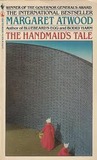
The Handmaid's Tale by Margaret Atwood

The Handmaid's TaleThe Handmaid's Tale by Margaret Atwood

March's read for my book club is themed "Back to School." As in, return to the books you read in (high)school and see how they hold up today.

I don't remember exactly what grade it was that I read The Handmaid's Tale. In fact, I don't remember any related projects or essays. And this is both surprising and disappointing. The themes expressed are ones that ought to have been discussed in a classroom - otherwise, why bother to have students read this book at all? But what I do recall of my highschool English class years, was that not many of my teachers were willing to address more serious issues. Not many of my teachers were willing to go beyond the course curriculum, which itself did not delve too deeply into 'dangerous' topics.

Rereading it now I can appreciate it more and suppose I am happy that the school at least introduced me to it and a few other books that I now also intend to reread. I realize that this was likely my first introduction to feminist literature. It takes place in a not so distance future where the feminist movement of the past has been turned inside out. Women are now subjugated, in body, and worse, in mind. The depth of the subjugation is made clear because the tale is told through the thoughts of Offred, who's life was stolen from her. She is now a handmaiden - a womb on two legs, existing only to provide offspring for a Commander and his Wife. The circumstances of this future are extreme, but not impossible to imagine, considering some of the things happening in our own world now.

Some might have issue with the writing style, but it was an element I really enjoyed. I've recently read a few books told in first person narrative and have found them unbelievable. No one can remember things so clearly in that way! Train of thought though. That I can handle. In this case, the style serves to enhance the character, not just to tell the story. At times, she chooses not to pursue a line of thinking because of how it affects her, she recalls her past and the things she took for granted, she speaks in tangents to avoid dealing with the situation at hand, or reconstructs details of events she was not privy to. These moments I liked most because she isn't just reconstructing to tell us what happened. Her reconstructions, sometimes told in two or three different versions, are her way of coping with not knowing about the people she's lost.

This is not a happy ending story. It's a story that has moments of hope, but for both the character and the reader, you're never quite sure if that hope will turn into something positive. You're forced to cling to the tiny moments and objects, as Offred does. This is, for me, one of the great strengths of this book. The reality of the events through Offred's narration sucked me into her plight.

The only thing I didn't like was the long, drawn out epilogue that takes place further into the future in the form of a lecture that is trying to piece together the events of the past. I felt it takes away from the mystery of the book by adding this clinical element.
4 of 5 stars

Friday, March 15, 2013

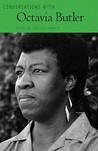
Conversations with Octavia Butler by Conseula Francis

Conversations With Octavia Butler (Literary Conversations Series)Conversations With Octavia Butler by Conseula Francis

I have to thank my friend Tracie for recommending Octavia E. Butler to me. I started with her Xenogenesis trilogy, and have been slowly building my collection since. Every time I read a book by Ms. Butler, I find myself wishing I could get inside the her mind. Her works are so far from the typical science fiction, dystopian stories and they share the constant theme of forcing us to question our humanity and society and the rules we adhere to and the many, many prejudices that we are never able to leave behind. With Butler’s passing in 2006, it seemed I wouldn’t have that opportunity, but apparently, Conseula Francis had the same idea and put together this collection of interviews.

Ms. Butler’s target readers are classified as Blacks, feminists and science fiction fans – but these are labels that people have stuck on her work. She did not like labels, though she appreciated their value, especially to a publisher, and understood the human need to categorize everything. Her works do fit into these very basic categories, but what fascinates me most about her books is the way they move so far beyond. “Thinking outside the box” does not even begin to cover it! Her books deal with so many issues and often do so in a way that crosses far into our comfort zones as they hold up a mirror to our humanity, warts and all. I recommend her books to many people, but warn not to expect a happy ending. Her books are realistic – perhaps too much so for some readers. I most recently read Parable of the Talents – a book some readers consider prophetic, though Ms. Butler stressed it was a cautionary tale – and couldn’t help comparing it to the volatile American political and religious situation at the time. Even when her books are dealing with aliens and vampires and mutation, I’ve found her approach to the subject matter makes it seem as though these things really could come to pass, if they have not already. But it is the honest and often harsh way she presents our humanity to us that is what really can get under your skin. Taboo topics like incest, slavery, racism, sexism, rape, pedophilia, religious fanaticism, addiction, hierarchy, genetic engineering, violence and more are often a part of the protagonists’ struggles.

Before this ends up as a “Why You Should Read Octavia E. Butler’s Books,” let me try to focus on this book, specifically. Conversations with Octavia Butler is a collection of interviews with the prize-winning author. There is a reasonable and expected amount of repetition from interview to interview, but some interviewers are more insightful and involved than others. Ms. Butler’s responses to some interviewers could be brief or even impatient in one case where the interviewer perhaps did not do his homework, but in others, she eloquently detailed various topics. I particularly enjoyed the interview with Charles Rowell where her responses to each question could go on for a page or more as she passionately spoke about writing, advice for writers, her inspirations and more.

Her words revealed her enthusiasm for writing and what she wrote revealed her passion for all sorts of topics. Her explanation of her writing process – which involved reading and listening to everything! – was fascinating. I respected how adamantly she defined science fiction and researched her own works accordingly. Simply put, she believed science fiction stories ought to involve actual science. A reader during a radio interview noted that Ms. Butler’s works touch on so many different forms of “science,” from biological, to technological to social to political science, but even when they involve fantastical elements, there is always a grounding that is a reflection of the research she put in.

Being, at the time, the only Black female author in the science fiction genre, writing about Black female characters in a genre that usually featured 30 year old White men, racism and sexism unsurprisingly came up with some of the interviews. Ms. Butler did address the topics, but it becomes clear that she never wrote with an agenda with the specific intent to deal with prejudice. She stressed that she simply wanted to write and initially, she did write about those 30 year old White guys until she realized those early writings were “garbage” and instead started writing herself for herself. The main characters are Black females because that’s what she was. From there, the personalities of the characters grew from her own feelings on certain issues or a desire to explore other issues.

This is something that I really love about Butler’s work. I can’t help but be pleased to find stories that I can relate to with characters that more accurately reflect my own multicultural environment and upbringing. I loved that none of the characters’ race or gender existed out of context or were a case of tokenism. Certainly there was prejudice against characters because of their race or gender, but the characters weren’t simply created Black and/or female specifically to address the topic of racism and/or sexism. Not even in Kindred , where a Black woman is transported to the past where she must deal with the reality of slavery and save her White slavemaster. This could be overlooked as simply “another book about slavery,” but it was fascinating to find out what inspired her to write Kindred. It’s one of the many tidbits I learned about Butler and her work by reading Conversations.

Most of the interviews in Conversations were one on one with Ms. Butler, but the MIT Cultural Studies Project was a highlight, as it featured several other prominent authors and covered some very interesting and still relevant thoughts within the topic of literacy and more.

My only disappointment is that the majority of the interviews focused on Kindred and Parable of the Sower, with some Xenogenesis and Patternmaster in the mix. I would have liked to learn more about Parable of the Talents and Fledgling . I also learned from this book that she had been working on a third part in the Earthseed series, Parable of the Trickster, which would have dealt with the Earthseed colonists struggling to survive their destiny in space. In one of the final interviews, Ms. Butler explained that she intended the colonists’ struggle to be with themselves, not with aliens or galactic conflict. In other words, no matter where humanity goes, the best and worst of us does not change.

I still have a few more of Ms. Butler’s books to read and this book certainly inspires me to get on with that. Reading this satisfied my desire to know more about Octavia E. Butler’s captivating mind, but, especially now that I know about Parable of the Trickster, it saddens me to know that there won’t be anymore conversations.
4 of 5 stars

Tuesday, November 22, 2011

Sorrows of Adoration by Kimberly Chapman


Sorrows Of Adoration by Kimberly Chapman
My rating: 4 of 5 stars

This is not a book I would have picked up of my own volition, but since it was written by a friend and lent to me by another and I initially started reading it out of that "obligation" of friendship.

At 2:00 Wednesday morning, I finally decided I needed to get to bed. And then I spent all of Wednesday in a melancholy book funk because I was so smitten with the characters and the what will happen next. That night, I was up until the wee hours again to finish it.

Sorrows of Adoration starts out in, what I assume, is a typical romance novel manner. (I say "what I assume," because I don't read that stuff. The only romance novel I've ever read is the one I snuck from my sister's collection... the one about sexy aliens...). I didn't mind the overindulgence of lovicuddles and kisses and proclamations of love, partially because I am a closet romantic, but mostly because I knew, based on the title and the blurb, that this wasn't going to last.

Plus I know Kimberly Chapman. There is no way she was going to give me a squishy romance novel!

Soon enough, the Big Bad ThingTM happens, and the results of that event is where this book takes a dynamic twist that removes it from the ranks of silly romance. It delves deep into the darkness of emotion and relationships, proving the phrase "you always hurt the ones you love." It even goes well beyond the feminist twist trope of a strong female who doesn't need a man to save her.
4 of 5 stars