The BiblioSanctum has moved!

You will be automatically redirected to the new address in 5 seconds. If that does not occur, please visit
http://www.bibliosanctum.com
and update your bookmarks. See you at our new home!

Showing posts with label Jo Fletcher Books. Show all posts

Thursday, May 22, 2014

Book Review: Gemsigns by Stephanie Saulter

Gemsigns by Stephanie Saulter

Genre: Science Fiction

Series: Book 1 of ®Evolution

Publisher: Jo Fletcher Books (UK: March 28, 2013/US: May 6, 2014)

Author Information: Website | Twitter

Mogsy's Rating: 4.5 of 5 stars

I seem to be reading a lot of social science fiction lately. Given the old “too much of anything” adage about excess, you’d think adding one more to the pile would have diminished my enjoyment or value of the experience. Now, with the average book that might be true. But then, Stephanie Saulter’s Gemsigns is anything BUT an average book.

Taking place over a period of about a week, the book plays out like a flurry of quick punches, with every shot finding its mark. And I have to say, Saulter got in a couple good ones to my gut, not to mention a few more jabs to my poor battered heart. Still, while most of it flew hard and fast, I find there’s also a strangely mesmerizing quality to the story. A lot of this is in the gradual reveal of the current state of affairs, as well as what’s at stake for everyone involved. There’s a sense of inevitably to the unfolding events, knowing that every act of violence that comes to light is yet another step closer to an explosive conclusion.

US cover
These kinds of books always get me for some reason. No doubt a lot of it can be chalked up to personal interest, as I’ve always been fascinated by stories that explore what it means to be human. Well before it became time to even think about college, I’d already known I wanted to go into Anthropology, that wonderful and broad discipline dedicated to answering this very question. Years later now, I still remember what one of my professors once told our class about human variation – that it is a thing so vast, any attempt to define “normal” is rendered kind of moot.

Gemsigns reminded me of that. The book is set in the not-so-far-off future, not long after humanity had suffered the effects of a devastating virus that almost wiped us out. To survive meant genetically modifying almost every new person born on this planet, but in order to repopulate and rebuild, the engineers went further. They created different kinds of genetically modified humans (“Gems”), tailoring them to specific duties that needed performing, with minimal thought to their quality of life or well-being. Gems were essentially nothing but humanity’s tools.

After a century of being perceived as nothing more than property, the Declaration finally freed gems from their servitude but didn’t translate or clarify their rights and status in the global legal system. To approach this issue, Dr. Eli Walker (an anthropologist, YAY!) has the task of putting together a proposal deciding whether gems are truly human. Meanwhile, certain factions want to take advantage of this period of instability, like the gemtech companies that would like to see everything return to the pre-Declaration days, or the godgangs who just want to see gems dead, period. Fortunately, the gems have Aryel Morningstar, their charismatic spokesperson who will do all she can to ensure that their voices will be heard.

What makes Gemsigns such a powerful novel is that despite its futuristic setting or its science fiction label, it is still utterly significant and relevant to the world today. Folks, this is what a great piece of social science fiction looks like. Each time I squirmed with discomfort over the nightmarish treatment of gems, or every time I pondered a question regarding an ethical issue, I knew it was the book doing its job. And it was good at it.

As I alluded to before, Saulter utilized a steady, measured approach when it came to laying out the novel’s situation. It’s a gripping story, though the suspense and intensity I felt here is more akin to that of a riveting courtroom drama, rather than say, an action-thriller. I appreciated this gradual, detail-oriented rise towards the climax, though at times I felt the pacing was a bit too restrained, resulting in a couple lulls in the story. But in the end, the author delivered the stunning ending I wanted. If I had been standing while I was reading the last few chapters, I think I would have needed to sit down. It was JUST. THAT. WHOA.

Well-written and thought provoking, Gemsigns is an all-around superb debut from Stephanie Saulter, and another winner from Jo Fletcher Books. I’m already anticipating great things for Binary, the second book in the ®Evolution sequence, which I will definitely be checking out soon.


 A review copy of this book was provided to me by the publisher in exchange for an honest review. My thanks to Jo Fletcher Books!

Tuesday, April 22, 2014

Book Review: Murder by Sarah Pinborough


Murder by Sarah Pinborough

Genre: Horror, Fantasy

Series: Book 2 of Mayhem

Publisher: Jo Fletcher (April 24, 2014)

Author Information: Website | Twitter

Mogsy's Rating: 5 of 5 stars
 

One of the most common things you'll hear about books these days is that everything seems to be a series. I know I myself have talked about series burnout on more than a few occasions and expressed a desire to see more stand-alones. However! Every once in a while the news of an unexpected sequel will make me jump up and down for joy! And this is most definitely one of those times.

Murder can be seen as the follow-up to Mayhem, the chilling paranormal horror novel by Sarah Pinborough that was published last year from Jo Fletcher Books. Sort-of-but-not-really about Jack the Ripper, the book and its clever combination of historical fact and fiction intermixed with supernatural elements quickly vaulted it onto my list of all-time favorites.

I should probably mention too that Mayhem works perfectly well as a stand-alone, but that I was also thrilled when I found out about Murder for reasons beyond the fact I am such a fan of its forerunner. Sarah Pinborough clearly had a lot more in store for Dr. Thomas Bond, the protagonist in these books. It should be noted that the real Dr. Thomas Bond was a very important figure in British crime history, best known for his work as the police surgeon on a lot of the Whitechapel murder investigations between 1887-1891. I’ve always believed that the best horror stories are rooted in reality, and being aware of the shocking turns in Bond’s career and later years also made me really excited to see what the author would do next.

Once again, Sarah Pinborough succeeds in bringing life and depth to her characters, several of whom were figures from history. A lot of the gruesome events described in this novel also actually happened, even the line in the description about bodies of children being pulled from the Thames (see the Victorian England baby farm murders). Pinborough flawlessly weaves a thread of supernatural into the story, but even then things can sometimes get too real. I think that’s why historical horrors are often so effective at terrifying me!

So now I’ll try my best to explain why I simply adored this book without giving away any spoilers for Mayhem: First, I love how these books aren’t about any one killer or murder case. Rather, all that serves as a backdrop in order to focus on something a lot more otherworldly and evil. Malevolence has settled upon London, and Dr. Thomas Bond is inextricably linked to it. Try as he might, he can’t escape the pull of the past. Because of this, Bond becomes an increasingly unreliable narrator, and having been familiar with his steadfast pragmatism up until this point, his downward spiral only makes the situation even more disconcerting. Like in Mayhem, Bond’s chapters are the only ones written in the first person, while others are in the third person. This point-of-view switching allows us to see a fuller picture, and it works even better here since our main protagonist’s credibility has been severely compromised.

Ms. Pinborough doesn’t hold anything back. Despite the kind of person Bond becomes, I felt for him; I really did. But clearly the author knows what needs to happen, and she carries out the plot with a cold eye and sees it all through mercilessly. And honestly? It made for an amazing book. There were some truly unexpected turns in the plot. At times, I couldn’t even believe it. You’ll be appalled and filled with hatred. Your heart will break. And you’ll also marvel at the amazing things the author has  accomplished here with character development.

This book was just so good. Dark, disturbing, and full of tension -- just the way I like my horror. It was not a fast-paced book, and yet...the story had this way of worming into my mind. This is definitely the kind of book you'll find yourself thinking about even when you’re not reading, and hoping that it won’t be long until you can pick it up again.


A review copy of this book was provided to me by the publisher in exchange for an honest review. My thanks to Jo Fletcher Books

Wednesday, April 9, 2014

Book Review: Irenicon by Aidan Harte


Genre: Fantasy

Series: Book 1 of The Wave Trilogy

Publisher: Jo Fletcher Books (March 29, 2012)

Author Information: Website

Mogsy's Rating: 4 of 5 stars 


The first time I heard about author Aidan Harte was last year when his novel Irenicon was shortlisted for the Gemmell Morningstar award for best debut. Talk about an impressive series starter. The book's historical overtones set in a fantasy world, along with a subtle touch of magic put me in mind strongly of the works by Guy Gavriel Kay, and if Harte's prose lacks Kay's poetic quality then he more than makes up for it with its boldness and intensity.

I also learned the meaning behind a new word: Irenicon, from the Oxford Dictionary "a proposal made as a means of achieving peace." The book's title is a reference to the river which cuts through the middle of the city of Rasenna, ironically named for so many reasons, least of all its brutal history. Blasted into existence by the Concordian Empire using Wave technology developed by their brilliant engineers, the new river effectively divided Rasenna both geographically and socially, sparking wars between powerful families and ensuring that the city will never be able to rise up against Concord. But the Wave also brought other unexpected consequences -- such as the river becoming sentient. And it doesn't seem to like humanity very much.

Central to the conflict is Sofia Scaligeri, future Contessa of Rasenna, brought up and trained by her mentor the Doctor Bardini. Her life changes forever with the arrival of Giovanni, the engineer from Concord tasked to build a bridge across Irenicon as a display of the empire's strength. Their meeting results in discord among all parties, and as the feuding between the different factions in Rasenna have always been at a fever pitch, the presence of a Concordian in their midst have not helped matters. But while the friction and dissension may be at the forefront of this narrative, what I also saw in it was a very twisty and poignant love story. Maybe I'm just a romantic at heart.

Sophia is a great protagonist. At first, I hadn't expected a teenage girl to be at the heart of this story; it just didn't seem to be that kind of novel. But I guess I should have taken a better look at the cover -- which is gorgeous and very dramatic, by the way -- which features a young female warrior at the head of a mounted army. I bring attention to it because it's a very accurate depiction of the character's personality -- strong, and a little stubborn perhaps, but also very skilled, having been groomed to become the leader of a city on the verge of tearing itself apart. But despite her age, this is still a very adult novel, full of complexity and deeper themes. I also wouldn't exactly call it fast-paced, taking a rather measured approach to setting the stage, but in so doing we get really well-rounded portrayals of all the characters involved.

I think the unique setting also bears mentioning. Very early on, we find out about book's world and its version of Christianity, where baby Jesus never escaped the clutches of Herod's forces and thus never grew to adulthood to spread his word. While the universe of Irenicon is home to magic and all sorts of uncanny technologies, there is a very powerful alternate history vibe. Take the names of the people and places, for example, which gave me a strong impression of Italy circa the medieval period. It's fascinating, and if anything I wish the setting could have been expanded further. There were several instances of characters contemplating religion, but those moments never extended very far, and I also wouldn't have minded even more world-building.

Nevertheless, the author did an incredible job providing a vivid backdrop for all the action and the emotion, deftly filling in the spaces with historical and cultural context. Harte has a very interesting biography, and no doubt his experiences in writing, art, and the media have given him a unique perspective with which to approach this trilogy. This first book is full of unexpected surprises, and how cruel is the last line, leaving me speculating! Distinctive and a little unconventional, this debut is a little tough to pin down, but I can also understand all the praise for it. I look forward to seeing how the writing evolves, along with how things will play out in the next book.


 A review copy of this book was provided to me by the publisher in exchange for an honest review. My thanks to Jo Fletcher Books!

Friday, March 21, 2014

Book Review: The Detainee by Peter Liney

The Detainee by Peter Liney

Genre: Science Fiction

Series: Book 1 of The Detainee

Publisher: Jo Fletcher Books (UK: July 4, 2013/US: March 11, 2014)

Author Information: Website | Twitter

Mogsy's Rating: 4 of 5 stars 

Dystopian fiction seems to be all the rage these days, but if you're hankering for a book that sets itself apart and that is not a Young Adult novel, then boy do I have a gem for you.

The Detainee is set the distant future, where society as we know it has essentially collapsed, the economy and infrastructure in tatters. The population is kept in line by security satellites in the sky, constantly watching. Do something against the rules and -- ZAP! -- you're either disabled, dying or dead, depending on the severity of your crime. But if you're a troublemaker, the authorities would sooner just throw you away than deal with you. Anyone who represents a burden is unwanted, dumped onto The Island like the rest of the Mainland's garbage.

But what makes this book stand out is the main character Clancy, also known as "Big Guy" on account of his huge size as a youth, a trait that gave him such an edge as a former mafia goon. He is also sixty-three years old. Now, with people living longer and longer these days, I don't know if I would really call that old ... but the point is, Clancy certainly identifies himself as elderly. So, that's a bit different. I don't often come across stories told from the point of view of someone "aged" (for the entire duration of the book) and I thought Clancy's position offers a very unique perspective, as someone who has watched the "good old days" turn gradually into the hell they live in now -- piece by piece and slippery slope by slippery slope.

Because of his age, Clancy is also an involuntary resident of the Island, because those who are past their prime are seen as nothing more than takers and freeloaders. Elders in this society are not revered but instead treated like scapegoats for the system's collapse -- along with the sick, the poor, and even children. There are many young people at the Island too, many of whom ended up there because their parents chose abandoning them over being cast off themselves. These kids are rounded up and manipulated by the island's Wastelords who use a regime of drugs and abuse to create a brutal child army, which they use to set against the old people who live in the village.

Like I said, this is not your teenager's YA dystopian. In an ironic twist, the youth are the enemy, the face of death to Clancy and his friends. Their village becomes a bloody battlefield whenever the fog rolls in, because that's when the kids come raiding, knowing full well their activities are obscured from the gazes of the uncompromising satellites.

Powerful and provocative, you can practically feel the weight in Peter Liney's writing. The Detainee paints a hollow, painful existence for everyone living on the Island, for while the book is told in first person from Clancy's point of view, we find out later on that things are just as bad (if not worse) for the young people at the Camps. Instead of focusing on a single age group, the author has taken things further to explore the unpleasant effects of a dystopian society across multiple generations. But the novel is also hopeful and inspiring; even in a world of misery, the protagonist Clancy forges several unlikely relationships that give him reason to carry on. In time he learns when it comes to love and suffering, age is just a number, and that everyone longs for freedom the same way.

What you'll find here is a compelling story about adaptability, compassion and courage. Clancy is a very interesting narrator, with the experience of his years behind his character, and who ultimately discovers you are never too old to surprise yourself. I could be wrong, but I think The Detainee is a stand alone novel (EDIT: seems that I am wrong, I'm told there is a book 2 in the works YAY!) It reads perfectly fine as one, in any case. I would have liked to see more from the story about its world's history and background, but I found the book thoroughly enjoyable. Perfect for fans of dystopian fiction who are looking for an exceptional novel to dive into.


A review copy of this book was provided to me by the publisher in exchange for an honest review. My thanks to Jo Fletcher Books!

Friday, March 14, 2014

Book Review: The Tower Broken by Mazarkis Williams

The Tower Broken by Mazarkis Williams

Genre: Fantasy

Series: Book 3 of Tower and Knife Trilogy

Publisher: Jo Fletcher (UK: November 21, 2014)

Author Information: Website | Twitter

Mogsy's Rating: 4 of 5 stars 

Finishing a series is always a little bittersweet, isn't it? I find this is absolutely the case with Mazarkis Williams' Tower and Knife trilogy. Of course, I'm thrilled to have finally reached the stunning conclusion to find out how it all ends, but I also know I'm going to miss this world and its characters.

It is also a wonderful thing to see an author's skills grow and evolve as time goes on. Though I think I'll always be a little in love with Williams' beautiful writing, I was admittedly much more taken with these last two books in the trilogy than I was with The Emperor's Knife. All three novels had their own individual strengths, but in general I found Knife Sworn and The Tower Broken to have much better flow and greater complexity than the first book.

In fact, I now find myself at a dilemma. The last two books have both been very strong, and I really can't decide which one I liked better. The Tower Broken, having a much darker plot and effectively raising the stakes, obviously appealed to me a lot. After the events of Knife Sworn, the fate of the world is teetering on the edge, threatened by a malignant force moving itself across the land and devouring everything it touches. The storm moves ever closer to the city of Cerana, and Emperor Sarmin finds he is powerless to do anything to stop its path of destruction. Things are definitely heating up in this one.

On the other hand, I LOVED the chapters about Grada, Nessaket, and Rushes from the last novel. Having the narratives of these three female characters was one of the best things about that book, but in this one they have once again faded back into the background, giving other characters the chance to step into the spotlight. Mesema and of course Sarmin both have their own chapters, but this time we also meet the fruit-seller-turned-mage Farid as well as Duke Didryk, whose point of view adds even more mystery to the already shadowy plot line.

While these new perspectives brought a heightened sense of intrigue and tension to the table, I still missed Grada, who has become the Emperor's royal assassin, and even found myself wondering after Nessaket, Sarmin's mercurial mother. But most of all, I missed following Rushes, the poor slave girl who has gone through such an ordeal in the course of these two books. I won't deny I was a little disappointed to see so little of the three of them in this novel, but fortunately I was able to get over it quickly, because Williams does such a good job making all her characters interesting. Much like the series, I felt that many of the protagonists especially Sarmin and Mesema have finally come into their own. The transformation of their relationship was the highlight for me in this one; by the end I could see where the author had wanted to go with the two of them all along.

I also think I would be remiss if I ended this review without making mention of the magic in the Tower and Knife world. The first book introduced us to the complex dynamic between mages and spirits, with the former harnessing their abilities by imprisoning the latter into their bodies, then sucking them dry of the energy required to power magic spells. We get to see a lot more of that here, as well as insight into the concept of "pattern magic" which is central to this entire trilogy. I think it's great how the last book ends with a much more detailed look into the mechanics of this system, because I'd always felt the story needed it.

So the the trilogy may be over, but I would read any future books by Mazarkis Williams in a heartbeat! Pulling off the final installment of a series is always a doozy, but it was done well here, even if everything wrapped up a little too neatly. I would still take a "complete" and satisfying ending like this over an open-ended one any day. Ultimately I think Williams made all the right calls, and at the end of the day served up an impressive conclusion.


A review copy of this book was provided to me by the publisher in exchange for an honest review. My thanks to Jo Fletcher Books!

Wednesday, March 12, 2014

Waiting on Wednesday 03/12/14

"Waiting On Wednesday" is a weekly meme hosted by Breaking the Spine that lets us feature upcoming releases that we can't wait to get our hands on!

Mogsy's Pick

Murder by Sarah Pinborough: May 1, 2014 (Jo Fletcher Books)

This week I'm really hankering for this sequel to Mayhem by Sarah Pinborough, a great supernatural horror novel I read last year about the Whitechapel murders...which actually didn't turn out to be a story about Jack the Ripper! Some of the killings between 1888 and 1891 were different enough that investigators theorized that they could have been committed by another person other than Jack. The idea of a separate "Torso Killer" in these "Thames Mysteries" is what formed the basis for that book. Now Dr. Thomas Bond, Police Surgeon, is back on the case, because true evil never takes a break. 

I love these UK covers too!

"Dr. Thomas Bond, Police Surgeon, is still recovering from the event of the previous year when Jack the Ripper haunted the streets of London - and a more malign enemy hid in his shadow. Bond and the others who worked on the gruesome case are still stalked by its legacies, both psychological and tangible.

But now the bodies of children are being pulled from the Thames... and Bond is about to become inextricably linked with an uncanny, undying enemy."

Wednesday, March 5, 2014

Graphic Novel Review: Cemetery Girl by Charlaine Harris and Christopher Golden

Cemetery Girl: The Pretenders by Charlaine Harris, Christopher Golden

Genre: Graphic Novel, Paranormal

Series: Volume 1 of The Cemetery Girl Trilogy

Publisher: Jo Fletcher Books (January 2, 2014)

Author Information: Charlaine Harris | Christopher Golden

Mogsy's Rating: 4 of 5 stars 

Despite reading my fair share of comics and graphic novels, I usually leave the reviewing of them to Wendy and Tiara. Theirs are always really good, whereas I wouldn't even have any idea where to begin! So, you're going to have to bear with me here. This will be my first ever comic review for the site, but I'm also really excited because it is for none other than Charlaine Harris and Christopher Golden's Cemetery Girl from Jo Fletcher books. Come to think of it, it's a first for JFB too. This title is the first ever graphic novel published by them, and I was pretty thrilled when they sent me a copy.

The summary of it is as follows: the body of a young nameless woman, presumed dead, is dumped from the trunk of a car into a cemetery. But oh, actually she was still very much alive! In the rough landing, she hits her head and wakes up with no memory of who she was, or anything about her past. All she knows is that someone tried to kill her. Lost and alone, the girl decides to take shelter in a mausoleum, and as the days pass the place eventually becomes home. Combining the names from different tombstones and from the cemetery itself, the girl comes up with a new identity: Calexa Rose Dunhill.

The main plot of Cemetery Girl really gets going when Calexa witnesses a murder but is unable to go to the police, fearing that it would draw attention to herself, especially since her unknown would-be killer is still somewhere out there. But there's a bigger mystery arc here too, invoking questions like, Who is Calexa, really? Who's out to get her and why? On top of that, she seems to have developed a strange ability to see things, ever since waking up not-dead from her brutal attack. Basically, this volume contains a wonderful self-contained story, but you can also tell that the best has yet to come.

Anyway, you might think, oh what's the big deal, Mogsy! Just review a graphic novel like you would a regular novel! But I don't know. Being presented with a story visually, particularly in sequential art form, really changes things for me, especially since I have had experience penciling comic art in the past. In comics, there's of course the added factor of how well the art meshes with the writing. So when it comes to questions I ask myself while writing a review, I have to reference them to the effectiveness of the illustrations as well. You gotta check this out, though:

From: http://www.jofletcherbooks.com/2013/11/cemetery-girl
From this awesome panel alone, you can tell that Kramer's art and Rudoni's colors definitely "click" with the tone of the story. Cemeteries are a tricky setting to pull off in art, since they are places of such emotion. You could say getting the atmosphere just right here is very important, since that's where most of the story takes place. I think the artwork does the setting justice though, and the night time and stormy scenes are especially well done. The art in general is quite easy on the eyes.

As for the story, I felt it fit nicely with the format. With graphic novels, you could arguably get away with rushing the pace a little. Still, even as the days fly by for Calexa (Night one, Night two, Night twenty-six, Night sixty-eight, etc.), the story never loses sight of its goals. Sometimes, just a panel or two and a few lines of dialogue are enough to convey the more complex feelings, not to mention the writing makes use of quite a few silences as well, to good effect. I was most impressed by the way both writers and artists were able to develop the minor characters, like the cemetery caretaker or old Lucinda, and make them stand out for the reader.

Can graphic novels can have a "young adult" feel? If so, then Cemetery Girl definitely has a bit of that. Most likely this is due to the apparent age of the protagonist, not to mention the story also involves a group of trouble-making teens. The plot is relatively straightforward and character development may on the lighter side, but for a first volume this was extremely well done. Quite promising, too. Like I said, there are still many questions that need answering, and I find myself eager for news of the next volume!


A review copy of this book was provided to me by the publisher in exchange for an honest review. My thanks to Jo Fletcher Books!

Tuesday, February 25, 2014

Book Review: Astra by Naomi Foyle

Astra by Naomi Foyle

Genre: Science Fiction

Series: Book 1 of The Gaia Chronicles

Publisher: Jo Fletcher (February 6, 2014)

Author Information: Website | Twitter

Mogsy's Rating: 4 of 5 stars


If there's one thing I learned from reading Seoul Survivors and now Astra, it is that author Naomi Foyle has a remarkable way of making me feel. I have been shocked and disturbed by some of the ideas in her books, but likewise there have been times where the touching beauty of her writing has bought me to tears. Her stories might not necessarily read like heart-pounding thrillers or page-turners, but no matter what, they always pack a powerful punch.

That most certainly describes Astra, a bold dystopian tale about a girl growing up in a closed and isolated nature-worshiping community called Is-Land. The novel is divided into three parts, detailing the journey of its eponymous heroine as she ages from a child to young adulthood. Because of the format in which her story is told, it's probably going to be easier for me to summarize and give my thoughts and opinions on each part separately.

The first part begins when Astra is only seven years old. In this section, we learn a lot about the nation of Is-Land from her perspective. Life seems wonderful and perfect in her little town of Or, where the social structure is highly fluid and everyone lives as naked as the day they are born in harmony with Gaia's creatures. At the same time, advanced technology exists in his world, used to do things like engineer alt-meat for consumption, or to allow children to learn the ways of Is-Land and Gaia on devices called "tablettes". Starting with Astra's generation, children will also be getting the Security Serum, a shot that would make the subject physically stronger, but would also give them a more obedient and pliable personality.

Not surprisingly, many of the details we read about in this section are filtered through the lens of Astra's youth and innocence. She's lively, curious, and not just a little bit impish. It's challenging to write young characters, but I believe Naomi Foyle nailed it perfectly. Astra is good at driving her caregivers up the wall with her unending questions, quick temper and silly antics -- in other words, she thinks and acts like a very active and bright seven-year-old. Just thinking about the possible loss of that precociousness really hits home, which is what I think the author intended. Receiving the "Sec Shot" would be the end of everything that makes Astra who she is, and so her Shelter-Mother Hokma devises and carries out a plan to help the young girl avoid getting it.

Then the book skips ahead to when Astra is twelve years old. This is probably the longest section, but it was also the one I found the most interesting. While the previous part amazed me with the depth of the world-building, this part blew me away with its character development and unique take on the classic coming-of-age tale. All sorts of changes are happening to Astra at this point, both physical and emotional. The theme of sexuality also features heavily in this section, and I felt Foyle's bold and fearless writing style did an excellent job of describing this stage of Astra's life, conveying all the excitement and poignancy that comes with it. Once again, she gives her main character a voice that is both age-appropriate and believable.

This section also introduces Lil, an orphaned child rescued from the woods who comes to live with Astra in her community. An uncannily realistic "frenemy-like" relationship is forged between the two girls, one of friendship but also rivalry. Astra, who has always felt like an outcast knowing that she has not received her Sec Shot like the rest of her peers, takes an immediate fascination to Lil, who also doesn't seem to quite fit in. Eventually, the latter's ideas of the world begin to bleed into Astra's view of the world, and as everything Astra thought she knew begins to crumble, that's when things start getting very interesting...

The final part, which is also the shortest, focuses on Astra when she is seventeen. This is the section where everything comes to a head. For the last decade, she has grown up seeing the world differently than her "Sec Gen" friends, and that fateful decision Hokma made with her all those years ago finally leads to some widespread repercussions. A lot of dystopian novels come to a point like this, where the main protagonist's worldview is shattered by a life-changing event. I can honestly say, however, that there was no way I could have foreseen what happened afterwards. Indeed the conclusion may come as quite a shock.

Like I said, this book isn't exactly a page-turner, and don't go in expecting too much action or a grand adventure because that's not what it is about. But by following Astra through all three life stages, I feel like I've come to know her very well, and the author has managed to make me care deeply about her character. I didn't even realize how completely immersed I'd been until I reached the end, and tears started coming to my eyes while reading a scene that was particularly touching. I don't know if that would have hit me so hard emotionally if the book hadn't been so well-written overall.

The sequel will no doubt focus more on the bigger world, now that Astra has discovered some truths about herself and Is-Land. This book, however, was an intensely deep, complex and thought-provoking narrative of the main character's life. It's a beautiful story, unique and daring, which serves as a solid foundation for everything else to come.


 A review copy of this book was provided to me by the publisher in exchange for an honest review. My thanks to Jo Fletcher Books!

Tuesday, February 18, 2014

Book Review: Traitor's Blade by Sebastien de Castell

Traitor's Blade by Sebastien de Castell

Genre: Fantasy

Series: Book 1 of Greatcoats

Publisher: Jo Fletcher Books (March 6, 2014)

Author Information: Website | Twitter

Mogsy's Rating: 5 of 5 stars


Oh my, this one was SO MUCH FUN. Unexpectedly so. Even when the earliest descriptions came trickling in calling this book a bold, dashing adventure and pure, swashbuckling entertainment, I had no idea! I figured those were just buzzwords, right? Ah, no. In this case, Traitor's Blade really does deliver the great time that all those descriptions promise.

There are so many things I love about this book, but most of all I love how it doesn't take itself too seriously. It was lighter in tone than I expected, which was a huge plus because I always appreciate a bit of humor with my fantasy! The only thing sharper than main protagonist Falcio val Mond's rapier is his own clever wit, and if you don't believe me, all you have to do is read the prologue. (Edit: actually, Tor has an excerpt here!) It had me hooked, not to mention earning a few chuckles from me by page 3.

What strikes me about this book is how well it presents itself. To me, it reads like a medieval fantasy told in the tone of an urban fantasy, mainly due to the narrative style and the of the snappy pace of storytelling. Falcio and his companions Kest and Brasti are the last remnants of late King Paelis' mighty force of Greatcoats, quite possibly the only ones still dedicated to upholding the laws of the land despite their order being labeled as traitors. Before the Dukes took the kingdom and killed the king, however, Falcio was given one last mission. And trying to fulfill it is probably going to get him killed, if his silver tongue doesn't manage to do it first.

A natural born smooth talker (the other characters in the novel even poke fun at this), Falcio's narrative is as delightful as they come. He will endear himself to you with his fierce loyalty and moral compass, but also keep you on your toes with his unpredictability. Here is a protagonist who would just as soon vanquish his foes using his words and cunning, despite his strength and skill with a sword. As Falcio is quick to remind everyone, above all the Greatcoats value justice, not honor, and therefore he shows no qualms about certain unsportsmanlike behaviors such as, er, kicking a lady between the legs (trust me though, that character totally deserved it -- justice, remember!) There is also a darkness within Falcio, and I thought one of the more interesting aspects about him is his goodness warring with that inner pain.

So brace yourself, this is a very fast-paced book filled with non-stop action and tons of obstacles thrown at the characters, one right after another. The humor throughout keeps things nice and light, making this the perfect choice for readers looking for a story with traditional fantasy elements -- like heroes, magic, and epic quests -- but also with the added flair of dash and panache. In other books that have a lot of fight scenes, I'm always tempted to skim, but not so with this one. First of all, as a former fight choreographer, the author knows what great action looks like! And like I said, with Falcio's devil-may-care ways and the unpredictability of his fighting style, you really don't want to miss a thing!

As we all know, very few books are perfect but some stories have a way of bringing you to a point where you're just having too much fun to care. That's the place Traitor's Blade took me. I thought the ending and the revelations therein were a bit predictable, but honestly, that was my only quibble and it is a teensy tiny one at that, considering how much overall enjoyment I got from this book and how much I adored these characters. I cannot wait for the sequel.

In short, I loved loved loved Traitor's Blade. I would recommend it to everyone, and I think fencing and sword fighting types will especially get a kick out of it. Seriously, this is one excellent and remarkably entertaining book! Read it.


A review copy of this book was provided to me by the publisher in exchange for an honest review. My thanks to Jo Fletcher Books!

Thursday, February 13, 2014

Book Review: Redemption in Indigo by Karen Lord

Redemption in Indigo by Karen Lord

Genre: Re-imagined Folk Tales

Publisher: Jo Fletcher Books

Publication Date: August 2010

Author Info: merumsal.wordpress.com

Wendy's Rating: 4 of 5 stars

Based on a Senagalese folk tale, Redemption in Indigo follows a similar quirky story telling style to weave an intricate and sweet little story about a woman named Paama. Paama is the elder of two daughters, married to a not-overly-impressive lord. The match seemed like it would work well enough, though, since Paama is an exceptional cook and Ansige loves food. But after ten years of feeding his insatiable maw, Paama has had enough and returns home to her family. Ansige follows with his moronic bumbling, but Paama reveals her true character by never once trying to make him look bad (though he does it well enough on his own). When they finally part ways, the djombi see her true heart as worthy of the Chaos Stick, but the indigo lord disagrees and demands she return his power. What happens next is both surprising and bittersweet.

This originally popped up as a Goodreads recommendation and I quickly grabbed it, though I ended up reading and loving Lord’s second book, The Best of All Possible Worlds, first. The two books are very different in many ways – the latter being more of a subtle science fiction story that sneaks in romance – but both books share Lord’s artful storytelling. It’s something that I can only describe as “comfortable,” because that’s how it makes me feel when I read her books. Her words flow so smoothly and unobtrusively, quietly sucking you into the story and characters before you even realize it. Lord is, quite simply, a master storyteller.

Re-imagined fairy tales and folk tales are not uncommon, but it is rare to find ones that aren't based in European lore. Some might recognized the trickster spider, Anansi, making an appearance in Redemption in Indigo, but otherwise, this is a refreshingly different tale. And different is very, very good.

Wednesday, January 29, 2014

Waiting on Wednesday 01/29/14

"Waiting On Wednesday" is a weekly meme hosted by Breaking the Spine that lets us feature upcoming releases that we can't wait to get our hands on!

Wendy's Pick 

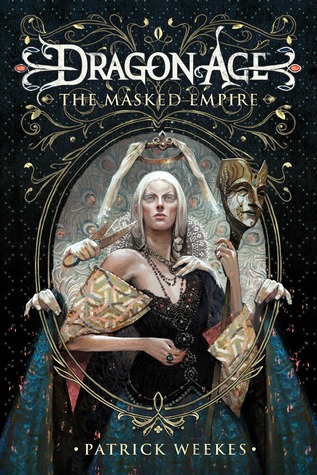
It's 2014 and the countdown continues for Bioware's third installment of their Dragon Age video game series, Inquisition. The previous book, Asunder, set the stage for the mage/templar war, which is definitely going to have dire consequences within the world of Thedas, but Asunder also hinted at some significant problems for the Orlesian empress, Celene.

Dragon Age #4: The Masked Empire by Patrick Weekes - April 2014 (Tor Books)


Empress Celene of Orlais rose to the throne of the most powerful nation in Thedas through wisdom, wit, and ruthless manipulation. Now, the empire she has guided into an age of enlightenment is threatened from within by imminent war between the templars and the mages, even as rebellion stirs among the downtrodden elves To save Orlais, Celene must keep her hold on the throne by any means necessary.

Fighting with the legendary skill of the Orlesian Chevaliers , Grand Duke Gaspard has won countless battles for the empire and the empress But has he fought in vain? As the Circle fails and chaos looms, Gaspard begins to doubt that Celene’s diplomatic approach to the mage problem or the elven uprisings will keep the empire safe. Perhaps it is time for a new leader, one who lives by the tenets of the Chevalier’s Code, to make Orlais strong again.

Briala has been Celene’s handmaid since the two of them were children, subtly using her position to help improve the lives of elves across Orlais. She is Celene’s confidante, spymaster, and lover, but when politics force the empress to choose between the rights of Briala’s people and the Orlesian throne, Briala must in turn decide where her true loyalties lie.

Alliances are forged and promises broken as Celene and Gaspard battle for the throne of Orlais But in the end, the elves who hide in the forests or starve in the alienages may decide the fate of the masked empire.

Mogsy's Pick

Traitor's Blade by Sebastien de Castell - March 6, 2014 (Jo Fletcher Books)
 
"Falcio is the first Cantor of the Greatcoats. Trained in the fighting arts and the laws of Tristia, the Greatcoats are travelling Magisters upholding King’s Law. They are heroes. Or at least they were, until they stood aside while the Dukes took the kingdom, and impaled their King’s head on a spike.

Now Tristia is on the verge of collapse and the barbarians are sniffing at the borders. The Dukes bring chaos to the land, while the Greatcoats are scattered far and wide, reviled as traitors, their legendary coats in tatters.

All they have left are the promises they made to King Paelis, to carry out one final mission. But if they have any hope of fulfilling the King’s dream, the divided Greatcoats must reunite, or they will also have to stand aside as they watch their world burn…"

Thursday, January 23, 2014

Book Review: Empress of the Sun by Ian McDonald

Empress of the Sun by Ian McDonald

Genre: Young Adult Science Fiction Fantasy

Series: Book 3 of Everness

Publication Date: January 2014 (Jo Fletcher)

Author Information: Website | Twitter

Mogsy's Rating: 5 of 5 stars


It's no exaggeration when I say these books in the Everness series just seem to get better and better. The adventure that started with Planesrunner only intensified with Be My Enemy, and now the third installment has taken things even further. Seriously -- I really wish there were more young adult novels like this out there.

Empress of the Sun continues the story of Everett Singh and the crew of the Earth 3 airship Everness. Spoilers for books one and two will likely be unavoidable in this review when discussing the third book, though if you haven't read the previous novels you can still probably pick up on the story and follow along, if you don't mind missing out on some of the nuances. Nothing will beat starting this great series from the beginning though, and obviously I highly recommend it!

Because Everness is about alternate dimensions and the Multiverse, you just never know where the story might take you next! That's what I love most about these books. And true to form, Ian McDonald starts this one off by dropping us into most bizarre and incredible parallel universe yet. In order to track down and rescue his father, Everett and his friends have taken to world-hopping. Armed with a jump gun and the Infundibulum, they now have the ability to go anywhere on any one of the 10 to the power of 80 worlds in the Panoply. Something goes seriously wrong with their last jump though, and the airship ends up on a strange version of earth which does not appear to follow the rules of astrophysics.

It turns out that the alternate earth they are on is actually an Alderson Disk. Not being very well-versed in my science fiction megastructures, this was the first time I've ever heard of such a thing. This is some cool stuff! And not only that, the world they are on is one where dinosaurs never went extinct. Instead, they have evolved over the eons to become the dominant species on this "discworld" (Pratchett fans, eat your heart out!) called the Jiju, whose civilization is 65 million years ahead of ours.

Not only is their technology frighteningly advanced, as the main bad guys in this book, the Jiju make the other villains that we've seen so far in this series look like peanuts. What is Charlotte Villiers or even the Nahn compared to these lizard people who have the ability to make the sun dance to their tune? The author sure pulled out all the stops with this one. Blown, my mind is.

I also can't decide what I love more about this book: the world building or the character development. The former has clearly impressed me, but as ever, the people in the stories are the most important to me when I read. With every book in this series, I feel closer and more amiable towards Everett and the crew. The relationship between him and Sen is moving forward nicely, and we're getting to the point where their feelings for each other are starting to come to the surface. This book also explores the friction between Everett and Sharkey. The two have not gotten along since the weighmaster suggested selling Everett out to the enemy in order to save the ship, but there is clearly a lot more to this precarious friendship than meets the eye.

The members of the crew aren't the only ones getting further developed in this novel. In Be My Enemy, readers were introduced to an alternate Everett, a version of him from another earth who was kidnapped and forced to take the place of real Everett, in order to spy and report to the nefarious factions in the Plenitude of Known Worlds. This doppelganger played a somewhat antagonistic role in the last book, but this one humanizes him and lets us see that deep down he is just like any other boy, with feelings and fears like everyone else. We also get a part of the story told in Charlotte Villiers' perspective, and even though she is the main villain, we are shown that there is a reason for all the things she does. To sum it up, this book just does a fantastic job all around at fleshing out everyone. As someone who places such high importance on characters, I couldn't be happier.

Action, adventure, and rollicking good fun! Empress of the Sun has all of that. And of all the books so far, I also have to say this one was the most humorous. There are some sections of dialogue that just made me laugh out loud, especially when it came to the conversation between Everett and Kax the Jiju about human reproduction. Oh my, I still can't stop chuckling when I think of that scene.

I'm so glad to see that there will be more of these books. The crew of the Everness still has much to do, and there are still so many worlds out there to explore. I can't wait to see where they will go next.


 A review copy of this book was provided to me by the publisher in exchange for an honest review. My thanks to Jo Fletcher Books!


Friday, January 17, 2014

Book Review: Seoul Survivors by Naomi Foyle

Seoul Survivors by Naomi Foyle (Jo Fletcher)

Genre: Science Fiction

Series: Stand Alone

Publication Date: February 6, 2014 (Paperback)

Author Information: Website | Twitter

Mogsy's Rating: 4 of 5 stars

It's only January, but already I have a feeling that this is going to be one of the more "out there" books I'll read this year. As usual, Jo Fletcher Books continues to push the envelope and explore beyond the boundaries of traditional adult speculative fiction with novels like Seoul Survivor.

I wasn't sure what to expect when I first read the description. With the impending destruction of earth by a meteor called Lucifer's Hammer providing the backdrop for the story, I wouldn't have been surprised to find something along the lines of an apocalyptic science fiction thriller. What I actually got, however, was something all together different. Strange, too -- but in a good way.

The book follows the lives of four characters: Sydney Travers, a former escort from Canada who hopes to start over with a modeling career in a new country; her boyfriend Johnny Sandman, a vicious, sociopathic and just all around disgusting corporate executive and a sorry excuse of a human being; Damien Meadows, so down on his luck and desperate to leave England that he reluctantly agrees to be a drug mule; and finally Lee Mee Hee, a North Korean peasant woman who is smuggled away from death and famine in the false bottom of a foreign aid truck. Their separate paths all lead them to Seoul, Korea where the brilliant Korean-American scientist Dr. Kim Da Mi is the mastermind behind a plan to redesign humanity with genetic engineering and social experiments, in spite of the killer asteroid hurtling earth's way. 

Beyond these basics, the book gets more complex and difficult to describe. At times it falls into seriously outrageous and bizarre territory. It also may not be for everyone, and indeed it's not for the faint of heart; there are parts that made me feel downright queasy while reading, especially some of the scenes that depicted acts of a deviant nature as well as the few instances which involved graphic descriptions of sexual violence. I didn't expect it from its cover or description, but this novel is dark and at times twisted, containing some disturbing themes. 

At the same time, I couldn't help but be drawn to the characters, and be enthralled by the way their individual dramas unfolded. Confoundingly, none of them are even all that likeable as people, but for some reason their lives are like a car wreck I can't seem to tear my eyes away from. Take the shallow and insecure Sydney who so easily gets manipulated, for example, or timid Mee Hee with the personality meeker than a lamb. Neither of them possess particularly admirable traits, but all the same, their fears and desires make them feel very human. Even megalomaniac Johnny whom I consider to be more monster than man has his part to play, and then of course there is the geneticist Dr. Kim and her eerie charisma worthy of a cult leader.

The setting itself feels like a world in a not-too-distant future, one that feels familiar but also exotic in part due to some of the advanced technology but also because of the foreign culture. From her author's bio, Naomi Foyle spent many years in Asia and it is clear that she drew upon her experiences in Korea to paint a clear picture of the people and places of Seoul. As a reader, you can easily become completely immersed in this milieu.

I also thought the crisis and spectacle of Lucifer's Hammer would feature more prominently in this novel, but aside from Damien no other character takes the meteor all that seriously, and as such it is always in the background but not discussed to a great extent. I wish there had been more; though nonetheless, the all-pervasive undertones of worldwide tension are so strong they are practically palpable. It's interesting because while I wouldn't technically classify this book as apocalyptic fiction, so few novels actually take this "countdown to doomsday" angle. 

To put it simply, Seoul Survivors is a book that defies all expectations. Just sitting back and letting the story be what it is can lead to some pleasant surprises amidst the dark twists and turns. The true nature of it can take a while to unravel, but the never-seen-before ideas and diverse cast of characters make this one an intriguing read. It touched me, and it also shook me to my core.


A review copy of this book was provided to me by the publisher in exchange for an honest review. My thanks to Jo Fletcher Books.

Wednesday, January 8, 2014

Book Review: Be My Enemy by Ian McDonald


Genre: Young Adult Science Fiction Fantasy

Series: Book 2 of Everness

Publisher: Jo Fletcher

Date of Publication: June 6, 2013 (ed.)

Author Information: Website | Twitter


Mogsy's Rating: 4.5 of 5 stars - "When it comes to delivering excitement and adventure, Ian McDonald knows his stuff; take everything that made Planesrunner great, dial it all up and you get this book"

With its intriguing application of quantum physics and topic of parallel earths, Planesrunner secured its spot as one of the most unique young adult novels I read last year. And of course, who could forget the heart-pounding airship battles? When it comes delivering excitement and adventure, Ian McDonald knows his stuff, and I could not wait to get my hands on the next book. Seeing as the third installment of the Everness series is already on the horizon, I thought it best to get right on that post-haste.

But first, bear in mind that this review may contain spoilers for book one, since Be My Enemy immediately picks up where Planesrunner left off. Last time we saw Everett Singh, he had managed to escape his enemies by transporting himself and his new Airish friends to another parallel earth. His computer device holding the Infundibulum and the key to the multiverse is safe for now, but it's only a matter of time until their pursuers catch up. Plus, Everett still needs to figure out a way to rescue his father, a seemingly impossible task, seeing as Tejendra Singh is now stranded somewhere on any one of the possible parallel worlds -- 10 to the power of 80 of them, to be exact. Yep, it's a big multiverse. 

Everett's search for answers eventually leads him to E1, the first Earth to develop a way to jump between parallel universes. It's also the only world amongst the ten known Earths that is sealed off, quarantined, nothing going in and nothing coming out. I won't deny it, I was thrilled that the characters ended up here. The speculations drove me insane in the first book, leaving me wondering and guessing what could have happened to E1 to make everyone so afraid, and now thanks to this sequel, I finally know why. And the reasons are hair-raising indeed! I doff my hat to you, Mr. McDonald.

But wait, that's not all. One thing about this book is that it simply does not stop with the surprises, and not least of them is the lengths the bad guys will go to in order to get what they want. Everett's enemies have some wily tricks up their sleeves, stopping at nothing to gain control of the Infundibulum. All I'll say is that in time, the perplexing introduction to Be My Enemy, not to mention that curious title, will be explained. I can't even begin to ponder the future implications of everything that happened here. Take everything that made Planesrunner so great, dial it all up and you get this book:

Action? Check. In fact, this story has it in spades.

Cleverness? Check. No doubt the book fudged a lot of the science, but it's done for the sake of top-notch storytelling. In spite of that, this book does not patronize the reader, which makes me think this series would appeal to adults and young adults alike. 

Interesting characters? Check. This book gave me a more in-depth look into Everett's personality, in the most unexpected and unique way possible. As for the supporting cast, I feel like I finally have an idea of who they are. I never gave much thought to Sen in the first book, but now I find her to be a delight. I loved the brief glimpses of the story told from her perspective, and couldn't help but think how awesome an entire novel in her point of view would be. I can dream, can't I?

And what about the world building, you ask? Big check. Absolutely fantabulosa.

After all, anything can happen when it comes to a story about parallel earths. I was impressed with Ian McDonald's imagination at work in Planesrunner, the way he brought the Airish culture to life and the incredible way he described the world of E3. True to form, he does not hold back for the sequel either, giving the same creative treatment to settings like E1 or the frozen wasteland at the beginning of the novel, despite these being much bleaker and darker worlds. 

You never know where the story might take you, or what amazing things you'll see next, and that's one of the main reasons why I'm having so much fun. Bring on the third book, I'm ready!

 4.5 of 5 stars

A review copy of this book was provided to me by the publisher in exchange for an honest review.

Monday, December 23, 2013

Book Review: Mage's Blood by David Hair

Mage's Blood by David Hair

Genre: Epic Fantasy

Series: Book 1 of The Moontide Quartet

Publisher: Jo Fletcher

Date of Publication: September 27, 2012

Author Information: Website


Mogsy's Rating: 4.5 of 5 stars - "Both the setting and story are vast and detailed, everything and everyone is connected; the author has woven an intricate epic that has it all"

Books like Mage's Blood are extremely hard for me to review, and not least of all because the many comparisons of this to A Song of Ice and Fire are mostly appropriate; this first book of the Moontide Quartet is a sprawling epic indeed! Still, I'm of the mind that George R.R. Martin's epic series stands uniquely on its own...but then so does David Hair's. It would be impossible for me to go into every single thing I liked about this book without having to talk about why, because that would just lead to lengthy explanations into the details of the plot, and if I did that this review will end up being thirty pages long with half of it made up of spoilers. Obviously, we can't have that.

Suffice to say though, this book has it all: nations at war, clashing religions, political intrigue, mages and sorcery, multiple points of view. Yuros and Antiopia are two lands long separated by vast ocean. But every Moontide, the seas part to reveal the magnificent mage-crafted Leviathan Bridge, allowing trade and communication between the two continents. Unfortunately, the passage is also a source of much bitterness and conflict. The last two Moontides have involved crusades of conquest, thanks to the lofty ambitions of the Magi.

Now another Moontide is at hand. As the time draws nearer, the people on both sides prepare for war. Antonin Meiros, a mage of great renown (in fact, it was he who was the intellect behind the Leviathan Bridge) seeks a new wife, and travels to Lahk to wed Ramita. Ramita, however, is already betrothed to the hotheaded Kazim. In another part of the world, Elena Anborn has pledged her life to protect the royal family of Javon, fighting off the assassination attempts and conspiracies masterminded by her former lover Gurvon Gyle, who works for powerful political enemies. Meanwhile in Noros, Elena's nephew Alaron prepares for his mage finals. But during the presentation of his thesis, he unwittingly proposes a dangerous topic that could mean the end to his hopes and dreams.

Everything and everyone is connected in this massive and intricate web that David Hair has woven. The scale of both setting and story are vast. The continents involved here encompass various nations, many of which are described here with great thought and detail. Their populations, including their cultures, languages, religions, rituals and even food and styles of dress are given the same exacting care. This is a world where both magic and theology form a strong basis for society, and it is diverse.

At the same time, readers will find there is much that is familiar in this fantasy world of Urte. Most of the nations and cultures in this book bear marked resemblances to those in our reality -- even when it comes to religion and geography. The nature of this brought to mind a recent discussion I had with a friend, regarding settings in various epic fantasies and how he usually preferred fictional worlds that he can imagine as our own earth, whereas I tended to prefer the opposite. Needless to say, a book like Mage's Blood can appeal to both camps. As well, even I can admit that real-world historical and cultural influences in a fantasy setting can add a lot to a story, a prime example being Jacqueline Carey's original Kushiel's Universe trilogy which remains one of my favorite series of all time.

With a book so massive which features a cast so big, it was perhaps no surprise that the first quarter of Mage's Blood is the most demanding of the reader. The different characters and their story lines are cleanly organized and separated by chapters, which is why this is my favorite format for epic novels. Nevertheless, it makes for a slower start, when an author has to cycle through the perspectives while introducing all the main players, and the first couple hundred pages were dedicated to this task. Patience pays off though, as the book finishes setting the scene and gradually builds up momentum in the middle chapters. This is the meat of the story, and it is amazing how David Hair manages keep all the plates spinning at once, giving each character and plot thread the attention they deserve, while also meticulously bringing them all together so that they eventually form a much bigger picture.

As Mage's Blood features an ensemble cast, obviously I had my favorites (the notable example being Ramita and her story with Antonin Meiros) while others were not as interesting to me. Each person has an important role to play though, and this was made clear by the climax and the ending, which is in a word incredible. It is a conclusion that is positively incendiary, leaving me wondering what else the author has in store. As the series name implies, Mage's Blood is only the first in what is meant to be series of four books, and as such there is much left wide open for huge things to come. However, at the same time David Hair has wrapped things up in a way that is straightforward and satisfying, without any abruptness. I think this is a far rarer skill than people realize.

I have a feeling a lot will be happening in The Scarlet Tides. Mage's Blood may have been encumbered by a lengthy introduction and a slow build-up to the story, which I honestly don't think could have been avoided. I suspect, however, that we will jump right into the action with the sequel. I'm excited, and can't wait to see where things will go.

4.5 of 5 stars

Tuesday, December 3, 2013

Book Review: The Language of Dying by Sarah Pinborough

The Language of Dying by Sarah Pinborough

Genre: (Fantasy)
Publisher: Jo Fletcher Books
Publication Date: December 5, 2013
Author's Info: sarahpinborough.com

Wendy's Rating - 4 of 5 stars:  With thanks to Jo Fletcher Books for the opportunity to read this beautiful, beautiful book in exchange for an honest review.

From the moment this book arrived in my mailbox, I knew I was in for something very special.

There is a tiny thread that binds this book to the fantasy genre, but otherwise, it is firmly ground in the harrowing reality of death, the pain of love and loss, and the struggles of family. It is told in the first person by the middle daughter of a man dying of cancer - and it is told directly to you, the reader, as she speaks to her father. Recollections of events in the past are told in the same present tense as current events, leaving raw, open wounds as her train of thought flows through these traumatic experiences.

This is not a long book, yet it took me a very long time to read it because it is not an easy book. Anyone who has watched a loved one wither away to disease will break to this book, if they are able to read it at all. Anyone who has not had such an experience will come to understand. But death is not just about dying, it is an opportunity to deal with the living and the lived, which Pinborough carefully unpacks through the narrator and her interactions with siblings. But ultimately, in the language of dying there are no happy endings.

Monday, November 18, 2013

Book Review: Knife Sworn by Mazarkis Williams

Knife Sworn by Mazarkis Williams

Genre: Fantasy

Series: Book 2 of The Tower and Knife Trilogy

Publisher: Jo Fletcher

Date of Publication: October 25, 2012

Author Information: Website | Twitter


Mogsy's Rating: 4 of 5 stars - "Gorgeous writing and strong characters in this intriguing sequel; you won't want to miss this"

The Tower and Knife series continues with Knife Sworn, and the second book is as full of magic, intrigue and beauty as the first -- if not even more so! One might be tempted to stop with The Emperor's Knife, its story having wrapped up so nicely at the end after all, with Sarmin coming into his own and the Pattern Master vanquished forever. But trust me, you won't want to miss this.

The events at the end of The Emperor's Blade saw Prince Sarmin free at last, taking his place on the throne after years of being locked up in a tower. Mesema, the girl sent from the horse tribes is now his wife and empress, and has just given birth to a boy. However, Sarmin's own mother the Empire Mother Nessaket has also just recently borne a son, throwing the matter of succession into question. And as the first book has shown, too many boys with royal blood at the palace has always led to bad news.

On top of this, Sarmin has been suffering from memory lapses and getting pressure from his advisers to name a new royal assassin, or a knife-sworn. He's also just received an unwanted gift of a harem of concubines, which he suspects is actually harboring a spy. There are only a few people close to Sarmin he can trust, and with the births of the princes and the arrival of a Yrkman peace convoy, they become more important to him than ever before.

First and foremost of these characters is Grada, whom we met in The Emperor's Knife and has since become one of Sarmin's closest companions and his trusted investigator. I mentioned in my review of the first book that out of all the points-of-view featured, my favorite one was Mesema's. In Knife Sworn, she takes on a less central role, but in her place Mazarkis Williams has given us the narratives of three other women, all strongly characterized and well-written. I've already mentioned Grada, whose complex past and warring emotions made her the most interesting person in the book. There's also Nessaket, who was almost a villain in my eyes in The Emperor's Knife, but in Knife Sworn I actually sympathized with her. And finally, my favorite character in this book was Rushes, the slave girl who instantly endeared me to her with her good heart.

Mazarkis Williams' writing is also in a league of its own, invoking such powerful and vivid imagery. It has been many, many months since I read The Emperor's Knife, but I still remember a certain scene involving blooming flowers in the desert, which Williams had brought to life with exquisite attention to detail. The writing was simply beautiful, and it is even more so now in Knife Sworn since the storytelling has become cleaner and more robust. It's the prime reason why I enjoyed this sequel even more than the first book; in The Emperor's Knife I sometimes found myself lost in terms of which character I was supposed to be following or trying to figure out where I was. I experienced none of that here, in the smooth flowing pace and structure of Knife Sworn.

The author has also ramped up the intrigue. If that was your favorite part of the first book, you will not be disappointed here. Conspiracies, secret agendas and betrayals abound, with twists thrown in. Almost everyone can be seen as a friend or a foe, depending on whose perspective you're following. I read this book much faster than I expected, because I wanted badly to see what certain characters would do. 

The only thing I would have liked to see more of in Knife Sworn is the magic. Specifically, I wouldn't have minded a bit more about how it works; the first book introduced a very interesting system involving relationships between mages and spirits, and it was one of the coolest ideas I've ever come across in fantasy. Mages didn't play as big a role in this one, though with the emergence of a new magical threat to the empire, I hope the third book will offer a deeper and more detailed look at the magic of this world. 

On that note, The Tower Broken will be coming out very soon! I wouldn't miss it for the world.

 4 of 5 stars

A review copy of this book was provided to me by the publisher in exchange for an honest review.