The BiblioSanctum has moved!

You will be automatically redirected to the new address in 5 seconds. If that does not occur, please visit
http://www.bibliosanctum.com
and update your bookmarks. See you at our new home!

Showing posts with label epic fantasy. Show all posts

Friday, June 6, 2014

Book Review: The Crimson Campaign by Brian McClellan

The Crimson Campaign by Brian McClellan

Genre: Fantasy

Series: Book 2 of The Powder Mage Trilogy

Publisher: Orbit (May 6, 2014)

Author Information: Website | Twitter

Mogsy's Rating: 4 of 5 stars


I find myself thoroughly enjoying the Powder Mage series. Brian McClellan’s star continues to rise, following up last year’s debut Promise of Blood with a strong sequel. While there were some parts I thought he did better in the first book, others that were better in the second, overall I can’t be happier with the direction this trilogy is taking.

The book starts out by easing readers back into the setting. With the help of an angry god, the Kez invasion into Adran territory is in full swing, after crushing Tamas’ ambitious strike. Stranded behind enemy lines with only a small remnant of his army left to aid him, the indomitable field marshal begins to lead his soldiers back across the mountains to warn and defend his country. Meanwhile back in Adro, Inspector Adamat is frantic with desperation and fear for the fate of his wife and son, held captive by the depraved Lord Vetas.

In yet another part of the world, Tamas’ son Taniel recovers from his injuries sustained in the pitched battle at the end of book one. While both Tamas and Adamat’s plot lines are marked by their very clear and concise goals, Taniel’s journey is a bit more complicated – but this also makes his character and story the most compelling, and more on that later.

But first, this “catch up” period at the beginning of the novel admittedly made for a slightly disjointed and slower start. However, I don’t think The Crimson Campaign is alone when it comes to this; I find many sequels – and especially middle books of a trilogy – have to manage this balancing act of setting up the stage for the next phase of the story while still trying to hold the reader’s attention and keep the momentum going. McClellan established a particular wide scope to begin with, following multiple characters all in separate parts of the world, so he had his work cut out for him. Considering everything that was happening, I think he did an impressive job. And once the story found its stride around the halfway point, I have to say there were no more issues with pacing.

Like I’d mentioned earlier, Taniel was the one who really shone in this one (and I find this interesting, since Adamat was my favorite in the first book, and I have to wonder if the third will be Tamas’ turn). Both Tamas and Adamat had story lines that followed a logical progression – the former had to make his way back to Adro, while the latter needed to rescue his family – and while they were engaging in their own way, neither had the ups and downs that made Taniel’s chapters so unpredictable and gripping.

The young powder mage first had to deal with the shock of awakening from a coma. Then struggle through a drug addiction that was the result of emotional trauma. Then come to terms with the news that his father might be dead. Then he had to go and get tangled up in the politics and infighting of the army. It was one big roller coaster ride with Taniel, and every turn had me wondering what would happen next. I loved everything about his story, which includes a deepening relationship between him and the mysterious woman Ka-poel, his ever loyal companion. I’m also intrigued by the changes in Taniel as a result of what happened to him at the end of Promise of Blood. This books hints at much greater and more intense developments to come on that front.

Another thing I would expect from a sequel is more world-building, and character development. In this, The Crimson Campaign did not disappoint. I’m still blown away by the hierarchy of magic users in his Powder Mage universe, and McClellan made sure to expand our knowledge of Marked, Privileged, and Knacked powers alike. I also noticed much more “screen time” in here for the female characters. Vlora, Nila and Ka-poel were all characters I wanted to learn more about, and I got my wish here. I was especially thrilled about Nila, who didn’t get much attention in Promise of Blood, but a huge bombshell dropped about her at the end of this book has me very excited about the future of her role.

What more can I say but, bring on The Autumn Republic! Something tells me that the third and final book of the trilogy will have just as much energy and impact, if not more. It’s so great to see this series going strong, and the way things are going I can only see things ending with a bang.


A review copy of this book was provided to me by the publisher via NetGalley in exchange for an honest review. My thanks to Orbit Books!

Sunday, May 18, 2014

Book Review: Blood Song by Anthony Ryan

Blood Song by Anthony Ryan

Genre: Epic Fantasy

Series: Book 1 of Raven's Shadow

Publisher: Ace (July 2, 2013)

Author Information: Website | Twitter

Mogsy's Rating: 4 of 5 stars


The story of Blood Song is about a young boy who trains and grows up to become a leader and one of the greatest warriors in the kingdom. It's a tried-and-true formula in epic fantasy which by all rights I should be sick to death of by now, but Anthony Ryan manages to pull it off without making me feel like I'm getting the same old, same old.

Take how the book starts, for example, opening on an encounter between a scribe and a prisoner who is being transported across the sea to answer for his crimes. A duel to the death is the only end left for Vaelin al Sorna, also known as "Hope Killer". With a sobriquet like that, I couldn't help but wonder at his character, but I was also intrigued by his soft spokenness and eloquence. More puzzling is the fact that everyone seems to be treating him with respect and deference, in spite of his chains.

Vaelin's story is recounted by the scribe, a mode of storytelling which is not uncommon even outside other mediums of fantasy, but in this case it is deftly executed, providing a deeply immersive experience for the reader. As a child, the main character is sent to the Sixth Order to train in the martial ways of the Faith. It's a harsh life fraught with peril, as Vaelin and his peers are driven relentlessly by their instructors to learn everything from doctrine and history, to survival methods or ways to wield a sword.

In general, I'm not a big fan of this trope. More often than not, I find the training and "growing up" phase of the hero's story to be the most tedious part, and so I'm usually looking forward to getting it over with. Not so with Blood Song, though. Imagine my surprise when these sections of the book turned out to be the most rewarding aspect. I loved reading about Vaelin's experiences in the Sixth Order, especially some of the more challenging trials. I very much enjoyed the bonds he shared with his fellow brothers of the Faith, the fact that any conflicts between the boys are negated by the knowledge that they are all in this together.

In fact, I liked this section a lot more than the later parts of the book, in which we see Vaelin go off to fight big battles and become embroiled in political plots and magic. Normally that would be the kind of stuff I live for in my epic fantasy, so you can see just how much I enjoyed the first half of the novel to consider it my favorite. Not that the second half is a slouch -- I think most people would find it more interesting, actually. For myself, I just couldn't help but develop a soft spot for Vaelin back when he was just a boy, when he still retained some of his innocence.

As you've probably guessed, I have nothing but good things to say about the portrayal of Vaelin and the other characters in this novel. You will see the relationships forged early on between him and his brothers evolve as they face their hardships together year after year. And when enemies become friends or friends become enemies, the transformations are both a surprise but also believable. Vaelin himself is a good and honorable person, and his desire to transcend the expectations of his order and be a better person for those around him is an engrossing study into the themes of sacrifice, morals and personal beliefs.

Highly recommended. I can just imagine the thrilled reactions of readers who picked this book up back when it was still independently published. A gem like this doesn't come along every day, and I'd say it stands out even beside some of the major epic fantasy novels today.


Wednesday, May 7, 2014

Waiting on Wednesday 05/07/14

"Waiting On Wednesday" is a weekly meme hosted by Breaking the Spine that lets us feature upcoming releases that we can't wait to get our hands on!

Mogsy's Pick: 


The Shadow Throne by Django Wexler: July 1, 2014 (Roc)

Okay, high time I featured this one for a Waiting on Wednesday. The Shadow Throne is the sequel to The Thousand Names, one of the best books I read last year. Apparently, I like military and flintlock fantasy more than I thought! I can't recommend that book highly enough. Anyway, if you have it on your list and have been thinking of getting to it, DON'T WAIT. (Yes, I'm addressing a few certain people reading this with that one *wink*) Book two will be upon us before you know.

I can't wait to add the hardcover of this to my shelf to go with my copy of the first book. By the way, it appears the US covers are going for the mysterious "back to the viewer" look.

"Anyone can plot a coup or fire an assassin’s bullet. But in a world of muskets and magic, it takes considerably more to seize the throne.

The ailing King of the Vordan lies on his deathbed. When he dies, his daughter, Raesinia Orboan, will become the first Queen Regnant in centuries—and a ripe target for the ambitious men who seek to control her. The most dangerous of these is Duke Orlanko, Minister of Information and master of the secret police. Having meticulously silenced his adversaries through intimidation, imprisonment, and execution, Orlanko is the most feared man in the kingdom.

And he knows an arcane secret that puts Raesinia completely at his mercy.

Exposure would mean ruin, but Raesinia is determined to find a way to break herself—and her country—out of Orlanko’s iron grip. She finds unlikely allies in the returning war hero Janus bet Vhalnich, fresh from a brilliant campaign in the colony of Khandar, and his loyal deputies, Captain Marcus d’Ivoire and Lieutenant Winter Ihernglass.

As Marcus and Winter struggle to find their places in the home they never thought they would see again, they help Janus and Raesinia set in motion events that could free Vordan from Orlanko’s influence—at the price of throwing the nation into chaos. But with the people suffering under the Duke’s tyranny, they intend to protect the kingdom with every power they can command, earthly or otherwise."

Sunday, April 20, 2014

Book Review: The Way of Kings by Brandon Sanderson

Words of Radiance by Brandon Sanderson

Genre: Epic Fantasy

Series: The Stormlight Archives #2

Publisher: Gollancz

Publication Date: March 2014

Author Info: www.brandonsanderson.com

Wendy's rating: 4 of 5 stars
"Want what you need. Embrace it. Desire it.
And bring it to you."
I am giving this epic fantasy a grudging four stars. I gave the previous book the same, teetering towards five stars because of the exciting finale, but this book is a much slower burn and there were many elements that I did not enjoy.

First of all, I will remind you that I am not a fan of epic fantasy for the sake of epic fantasy. This book is HUGE. The previous book was HUGE. And I expect the next books to be—wait for it—HUGE. I have no idea how Sanderson fits all of his worlds, theologies and magics in his head. Each of his realms are richly detailed and complete, to the point of perfectionism, and Sanderson works hard to deliver ALL of that information to the reader. It goes against the “show, don’t tell” writing policy, especially when pages are spent on things like how-to magic, back story, or the tiniest bug is described in detail. Once again, I mostly listened to this as an audiobook, narrated by Michael Kramer and Kate Reading, and I believe that helped me get through what may well have been too much for me to handle, what with my constant distractions of late.

Words of Radiance follows directly on the heels of The Way of Kings, with Kalladin and Bridge Four now firmly in place as the bodyguards of Dalinar Kholin and his family, including the whiny king of Alethcar. Dalinar’s former BFF continues to harry Dalinar’s efforts to unify Alethcar against the Parshendi, bringing an end to the greedy squabbles between the highprinces and ultimately ending the war that was originally intended to avenge the death of their previous king, Dalinar’s brother.

While I enjoyed some aspects of the internal politics, a lot more of it was just annoying because of how childlike it was. I certainly understand that it is intended to be so, as the nobility fight over baubles and pride, but this became most disappointing when it came to Sadeaus using such childish means to undermine Dalinar. I felt that Sadeaus’ character was done a great disservice in this book. He went from a stalwart general, fighting alongside Dalinar, and eloquently expressing his grievances when they did not see eye-to-eye, to a man who didn’t want to share. That can be an understandable transition for many reasons, but I felt that his stubborn refusal to consider Dalinar’s proposal and his juvenile attempts to discredit Dalinar were not well portrayed in a character that initially was better written and seemed above such pettiness. I suppose that is a true enough reflection of reality, but, as with many things in the book, the repetition of Sadeaus’ foils grew tedious and ultimately disappointing.

I will also add Shallan’s tongue to my collection of annoyances. She is a young woman with a sharp mind who, against protocol, tends to speak it, often in witty commentary. Only, her commentary is not particularly amusing, and as she keeps pointedly using it to spar, it just became an irritation, especially when dealing with Kalladin, who seems to have been set up as a potential second love interest for Shallan, as they bicker in true kindergarten playground fashion.

I also got tired of Shallan’s back story. I didn’t enjoy this form of interjecting pieces of the life altering moments of Kalladin’s life in The Way of Kings, and I liked Shallan’s back story even less as it dragged on and on. It is meant to give the characters depth, and help us understand why they come to certain pivotal decisions, or undertake certain actions, but I find this storytelling process tedious. More so because the climax of these past events had become glaringly obvious several hundred pages earlier.

I ought to be subtracting points for what I want to proclaim are extra pages, but damn it, I can’t. Because, while there is more than necessary and it does bog the book down, all the detail comes back around to serve a purpose. Nothing is forgotten. There are no loose threads left dangling in the storm, and no meandering subplots to be excised when the author (looking at you, GRRM) can’t figure out what to do with them. Sanderson seems to know exactly where everything is going, and has everything neatly packaged in his mind. For this reason, I am cautiously willing to forgive all of the things I complained about above, and even the introduction of a few characters over the course of the two books, who appear and seem to be of importance, but are not mentioned again for a long time, if at all. I’m sure they will return, but perhaps their introduction would have been better served later. Ultimately, I’m sure that in the next however many books the Stormlight Archives will take, Sanderson will unravel and connect everything for us.

Plus, any of the blah blah blah is balanced by these rich characters and plots. I particularly loved being able to see this war from the side of the Parshendi in this book and to better understand why they are fighting against the humans. There is still much to be revealed there, but I was pleasantly surprised to be offered the opportunity to meet the “enemy” so soon, and I loved the insight into their sing-song forms of communication (which, incidentally, reminds me of elcor—because Bioware ruins everything…).


Monday, April 14, 2014

Book Review: The Lascar's Dagger by Glenda Larke

The Lascar's Dagger by Glenda Larke

Genre: Fantasy

Series: Book 1 of The Forsaken Lands

Publisher: Orbit (March 18, 2014)

Author Information: Website

Mogsy's Rating: 3.5 of 5 stars 


The word "spy" has such heavy undertones, especially when it comes to genres in fiction. When I first picked up The Lascar's Dagger by Glenda Larke, everything I knew about it came from its description, so I was surprised when it turned out not to be the kind book I thought it'd be. Not that I had an inkling of how a story about a cleric-intelligencer was going to play out in a fantasy setting in the first place; still, if not a gripping page-turner, I expected at least something faster paced. But at the same time, I wouldn't exactly call this book slow, though it definitely had its ups and downs.

Case in point, it took a week to read the first third of the book, but the rest only took me about a few days. and I'd actually polished off the second third in a single sitting. For me The Lascar's Dagger was the type of novel with an ending much stronger than its intro; it may take its sweet time finding its momentum, but when it does, you'd better watch out. I know I could hardly put it down once the story got going.

The novel follows Saker Rampion, a priest who also serves as a spy for the Pontifect of the Va-Faith. On a routine information gathering assignment, he unwittingly stumbles upon Ardhi, a lascar up to no good. After a brief tussle, Saker comes away with the lascar's dagger, and its magical properties are revealed when multiple attempts to discard the weapon prove unsuccessful. Even after throwing it into the harbor, the dagger always seems to make its way back to Saker Rampion's side! 

Not long afterward, the Pontifect reassigns Saker on a new job to act as new spiritual adviser for the prince and princess of Ardrone. Meanwhile in another place, a young woman named Sorrel Redwing is on the run, charged with the murder of her husband. She ends up at the royal court too, after the Princess Mathilda takes Sorrel under her wing and offers her protection. At this juncture, the story is still in the process of evolving and has not reached its tipping point. However, once it becomes clear that Mathilda also has a larger role to play, the situation ramps up into a new and irreversible development.

In fact, for a spoiled princess, Mathilda had a lot to offer as a character, and was the one who stole the show for me, not least because the story might not have ever taken off if not for her actions. She also had by far the most interesting personality, even if at times she was a self-absorbed brat or even an airheaded ninny. Sorrel takes second place, impressing me with her strength and loyalty, and the fact she appears to have the patience of a saint. It's the female characters that really shine in this book, and they were the ones who drew me in despite Saker Rampion being the most prominent character. As it turned out, the fact that he was a spy didn't even play into the story all that much, at least not in the ways one would expect, and at times some of his shortcomings and naivete were positively cringe-worthy.

While I would not call this book action-filled or even an adventure, readers who love epic fantasy for the political intrigue and all that entails would find lots to like in The Lascar's Dagger. There are scandals, betrayals and plays for power, cleverly used to raise the stakes. Then there's the magic, an intriguing element that adds a sense of mystique and danger. There's not just one avenue of magical power in this world but several systems, one form of it being a "witchery" which relates to the spiritual sphere. I like that different people can be granted different kinds of abilities, as well as the idea of how a witchery power comes to a person in the first place. It's a very unique way of looking at magic, and raises plenty of questions about the evil and good forces of the world.

A while ago, I contemplated books -- especially firsts of a series -- that are slower to get started and realized that I don't mind a putting in a little investment if I think the payoff will be worth it. I have been pleasantly surprised like this before in the past, so I'm always reluctant to put aside a novel even if the introduction doesn't grab me right away. In this case, I'm glad I decided to stick with The Lascar's Dagger because the story eventually grew on me, and the ending presented a very tense situation in which the implications for the next novel are mind-boggling. I have to praise this book for its originality; there are ideas in here never seen before, and with really no way to predict what's coming next, I'm definitely on board with continuing this series.


A review copy of this book was provided to me by the publisher via NetGalley in exchange for an honest review. My thanks to Orbit Books!

Sunday, April 6, 2014

Book Review: Sunstone by Freya Robertson

Sunstone by Freya Robertson

Genre: Epic Fantasy

Series: The Elemental Wars #2

Publisher: Angry Robot Books

Publication Date: March 2014

Wendy's Rating: 3.5 of 5 stars
As always, Robertson’s world and character building is incredible. Anguis continues to enthrall me with its beauty and its many realms and unique people.
The events that occurred in the previous book, Heartwood, resulted in significant losses, but also in a greater understanding of the mysterious Arbor, the great tree that is the centre of the world of Anguis. Saving the Arbor brought the rival factions of Anguis together to serve and protect the tree and for a time, there was peace.

But everything changed when the Fire Nation attacked.

Now, 22 years after the Dark Water Lords rose up against the Arbor a new threat looms and heroes across time must do their part to stop the Incendi from razing the world with fire.

Readers of Heartwood will recognize many characters, including Procella, the noble military woman and former Dux and protector of the Arbor. Sadly, her husband, Chonrad, responds to a summons from the Arbor which brings about his death shortly before the book begins. But this story belongs to Procella and their three children, Orsin, Jolen and Horada, who each have their own roles to play in the events. We are introduced to several other new characters, including a young prince who is escorted to the Arbor as the Selected sacrifice, and a group of rebels seeking escape from their underground captivity.

As always, Robertson’s world and character building is incredible. Anguis continues to enthrall me with its beauty and its many realms and unique people. It is also interesting to see how Anguis differs as the separate time lines flow together. It still amazes me how Robertson can manage so many characters and their respective quests, without losing the depth and purpose of either.

Unlike the previous book, the undertaking of the three major quests is a much more organic process. Robertson’s video game – particularly (MMO)RPG – influence was far more evident in Heartwood, and proved a detriment to the storytelling when it came to the parcelling out of details and quests. I didn’t find that to be an issue in Sunstone, and particularly liked the implication of the Arbor’s sentience and manipulation of events (without it being an elaborate case of the tree orchestrating everything like Littlefinger). With the realm of Anguis and the Arbor mostly established, there is less need for the excessive detail Robertson provided previously. That said, Sunstone still suffers from an excess of tell over show, with the reader not being permitted to discern things on their own, or inner monologues that go on a bit too long. This makes the book a bit more pedantic than I’d like, though not enough for me to dislike the series over all. I am still very much intrigued by the Elemental Wars and am looking forward to what mysteries the Arbor will reveal next.

With thanks to NetGalley for the opportunity to read an advanced copy of this book in exchange for an honest review.

Wednesday, March 26, 2014

Waiting on Wednesday 03/26/14

"Waiting On Wednesday" is a weekly meme hosted by Breaking the Spine that lets us feature upcoming releases that we can't wait to get our hands on!
Mogsy's Pick: 

The Leopard by K.V. Johansen: June 10, 2014 (Pyr Books)

The Leopard is the first book of a two-series, set in the same world but can be read apart from K.V. Johansen's Blackdog. I have an ARC so I'm not technically waiting, but I'm still really looking forward to it and also wanted to feature that lovely cover. And if you think that's pretty, check out the equally stunning cover to book two, The Lady, coming out this winter (and will be featured in a future WoW too, no doubt!)

"Part one of a two-book epic fantasy, set in a world as richly drawn as J.R.R. Tolkien's Middle Earth, but with Mideastern and Eastern flavors.

In the days of the first kings in the North, there were seven devils…

Ahjvar, the assassin known as the Leopard, wants only to die, to end the curse that binds him to a life of horror. Although he has no reason to trust the goddess Catairanach or her messenger Deyandara, fugitive heir to a murdered tribal queen, desperation leads him to accept her bargain: if he kills the mad prophet known as the Voice of Marakand, Catairanach will free him of his curse. Accompanying him on his mission is the one person he has let close to him in a lifetime of death, a runaway slave named Ghu. Ahj knows Ghu is far from the half-wit others think him, but in Marakand, the great city where the caravan roads of east and west meet, both will need to face the deepest secrets of their souls, if either is to survive the undying enemies who hunt them and find a way through the darkness that damns the Leopard.

To Marakand, too, come a Northron wanderer and her demon verrbjarn lover, carrying the obsidian sword Lakkariss, a weapon forged by the Old Great Gods to bring their justice to the seven devils who escaped the cold hells so long before.
"

Wednesday, March 12, 2014

TV/Book Review: Legend of the Seeker and Wizard's First Rule by Terry Goodkind

Wizard's First Rule (Sword of Truth, #1)Wizard's First Rule by Terry Goodkind

Legend of the Seeker (2008)

A while back, I had myself a Legend of the Seeker marathon. The show was tastefully cheesy, fantasy fun and I enjoyed it enough to finally read its source material. Consequently, this will be as much a review of The Wizard’s First Rule, as it is a comparison to Legend of the Seeker.

Both book and show begin in much the same way, with a beautiful woman escaping the clutches of nasty soldiers. Woodsman Richard Cipher witnesses this and comes to her rescue, only to learn that she really isn’t a mere damsel in distress. Though he doesn’t know her true nature, when she touches one of her attackers and he turns on his companions, Richard realizes that Kahlan Amnell is no ordinary woman. From there, Richard takes her to see his old friend Zed, whom Richard believes can help Kahlan find the wizard she seeks. Low and behold, Zed has been that wizard all along, and as identities and destinies are partially unravelled, Richard accepts the Sword of Truth and becomes the Seeker, destined to join Kahlan and Zed to stop the evil Darken Rahl from taking over the world.

The TV interpretation of these three main characters is more or less the same, save for Richard, who is a little larger and prone to anger in the book, something the Sword feeds off of. The show didn’t go very deeply into the magic of the Sword of Truth and its connection to Richard, so this became a very interesting topic for me as I read on. The book, unsurprisingly, delves much deeper into the magic of Goodkind’s world, with each form, each type of user, and each use of the particular forms having very specific details.

One thing that I really loved about the show was the romance between Kahlan and Richard. Richard is the perfect gentleman who respects the fact that Kahlan cannot be with him in a full romantic capacity due to the nature of her powers. In the show, I appreciated that they didn’t drag out the reason behind her shying away from him, and when she does confess that she is a Confessor and why she can’t be with him physically, he simply accepts it and lets her know that simply being with her is enough. The bond they form along their journey becomes very real, and, while the final result is super lovey-dovey, gag-me-with-a-spoon, it makes sense.

The show lifted this aspect of their relationship straight from the book, with the only differences being that Goodkind did drag out the secret keeping, with Kahlan not telling Richard about her abilities until somewhere near the end.

When I first mentioned that I wanted to read this series, a fellow book blogger commented on the role women play in Goodkind’s world. Initially, I thought his negative assessment was wrong. Kahlan is a great character and stands as Richard’s equal. She’s more than just a love interest and she’s no damsel in distress, though I appreciate that the show places more emphasis on her fighting ability, showing that she can hold her own as a human being, and not just a person endowed with magic. Kahlan’s significant role in the story and her place as Richard’s apparent equal lulled me into a sense of acceptance over the role of women in general. But toward the end, I realized the error of my ways. When Kahlan goes full Mother Confessor, the evil queen and her spoiled kid are confronted, and the man-hating Mord Sith appear to work their dominatrix goodness over Richard. I realized that the females in Goodkind’s story, while seeming to be empowered, are really just an exercise in misogyny disguised as misandry.
The Confessor’s power can be used on anyone, yet the examples of its use are most often males, with emphasis on how it subjugates them, turning them into mindless slaves to the Confessor’s will. While Kahlan is at least developed as a character beyond her power, the only female whose purpose isn't to dominate males is Rachel, who, with a little encouragement, proves herself to be the bravest and strongest of all of them. But Rachel is only a little girl when we meet her. By the precedent set, she'll grow up to rule over men too. If she's really lucky, she'll be tortured and raped and made into a Mord Sith.

Kahlan’s return to full on Mother Confessor status seemed to be a major turning point in the book, not only in terms of plot, but in terms of where my rating started to fall and my feminist rage started to rise. It's good that I watched the show first because the creators clearly found the better aspects of the book and did a much better job of tempering the far more disgusting ones. The female aspect in particular was handled much better in the show, with Confessors shown to deal with both males and females equally. The Mord Sith still exist and are still a source of man-hating torture, but the show’s decision with the characters of Denna and the introduction of Cara softened the blow and made for much more interesting and justifiable reasons for Richard’s subsequent actions after meeting them. The show did continue on to introduce a group of witches and there were a few other dangerous sorceresses along the way, but at least it did a better job of leveling the playing field and making some of the women a bit more than just angry archetypes.

In the book, the Mord Sith and then a dragon and finally, the attempted rape of Kahlan were jarring additions to what had otherwise been a pretty good story. But these elements were kind of crammed into the end in a manner that made them feel like they were last minute decisions in order to get the characters to their final conflict through literal torture and pain.

Thankfully, Kahlan’s assault is not needed in the show for the purpose it serves in the book, and the show could take the time and liberty to make the introduction of other elements, such as the Mord Sith, much more organic and much less...ugh.

I’m not sure how much more story Goodkind tells of Kahlan and Richard in the Sword of Truth series, but I went from wanting to know more, to quickly shelving the rest. I’ll stick to my much more enjoyable TV memories.
Wizard's First Rule

Legend of the Seeker


Monday, March 10, 2014

Book Review: Words of Radiance by Brandon Sanderson

Words of Radiance by Brandon Sanderson

Genre: Epic Fantasy

Series: Book 2 of The Stormlight Archive

Publisher: Tor (March 4, 2014)

Author Information: Website | Twitter

Mogsy's Rating: 5 of 5 stars 


I don't know what was more intimidating, the size of Words of Radiance when I first beheld it, or the thought of having to write the review when I finished. I took me about seven days to read this giant tome, and then five more just to let everything sink in. So many emotions. So amazing. Even now, I don't know if I can completely separate my subjective feelings for this novel, simply because of the MAJOR soft spot I harbor for this particular series. See, I wasn't always a fan of epic fantasy. I was the type to take one look at the page count and run the other way! Of course, that was before The Way of Kings became one of my favorite books. I guess you could say that I credit Brandon Sanderson and that book for being my gateway into this genre, and I've always been glad for that.

To finally read Words of Radiance was like fist-pumping excitement and all my restless giddiness rolled into one. In this second volume, the world of The Stormlight Archive becomes even more incredible and captivating. My favorite thing about Sanderson's stories are his magic systems, and I know everyone always says that but I don't care! It bears saying again because it's true. Here I thought he was done laying down the ground rules for his world's magic in The Way of Kings, but clearly he was just getting started. It's actually getting so elaborate that part of me is beginning to worry this could become too confusing before long. But if you love Surgebinding, rest assured the storyline continues to build upon basic principles regarding stormlight and its uses in the various types of surges. When it comes to beefing up his magic systems, Sanderson never ceases to amaze.

I've also noticed he has a way of writing inherently good people in the roles of main protagonists. This certainly applies to the important characters here -- Kaladin, Shallan, Dalinar, Adolin, etc. -- all decent folks with decent intentions, natural leaders who always in the end succeed. It took tension out of the story at times, but it's also nice to feel exultant when a character gets ahead. That said, there were still plenty of twists and a couple of big surprises in this book, and of course when bad things happened, the impact of those setbacks felt all the more powerful. Sanderson knows how to pull me in and make me care, even when it comes to his more minor characters.

From Tor.com
Illustration by Ben McSweeney
But what I really didn't expect was how things turned around when it came to the major ones. Kaladin pretty much made the first book for me, so I was shocked to see that his chapters in this one failed to hold my attention the same way. Kaladin himself, the ex-soldier and former bridgeman who has become a Knight Radiant, spirals into self-pity, anger, and impulsion because of his new powers and responsibilities, and I just didn't like the man he was for most of this book. On the other hand, Shallan (who didn't really impress me in The Way of Kings) comes into her own, literally becoming a new woman.

While Kaladin shrank into himself, Shallan branched out, becoming more adventurous and daring. Every time the story focused on her again, I was completely rapt, drawn into her research and personal journey to find the mythical city of Urithuru. I was also impressed by the way Sanderson handled her different relationships with other characters, especially the surprising one developing between her and Adolin. There's no question, Words of Radiance is where Shallan steals the show and gets a lot more of her background filled in, plus the illustrations of "her drawings" do add so much to the narrative (and I agree, Shallan, Adolin is totally *sigh*). I just have to cheer for a fellow artist too, you understand.

As for the story, what can I say? It's moving along, and in a big way. Everything is now converging in on the Shattered Plains, with all the main characters and their plot threads finally weaving together to become more cohesive. There's a countdown to something huge, and while this is the main source conflict in the novel, I like how the side themes continue to play a role. Factors like the infighting between the Highprinces or the social class disparities between Lighteyes and Darkeyes or humans and parshmen only add to the immersion and world building.

I have to say that with Sanderson, you don't often get "epicness for the sake of being epic". Others may disagree, of course, but all I know is with 1000+ pagers like these I always tend to forget a lot due to information overload. However, three and a half years after The Way of Kings, I still find myself remembering almost all the details of Roshar, of its peoples and cultures, lore and magic, the different creatures and spren. My memory's not the best either, so the fact I can remember even the little things means that they really stuck with me, and that simply does not happen with fluff or filler. It tells me the details in The Stormlight Archive are there for a reason, and not just to pad a book. Even the Interludes, which I don't really care for, I can still appreciate because something tells me they will be important at a later stage.

Honestly, sometimes I still have a hard time wrapping my head around the idea that I'll probably be well into my fifth decade by the time the last book of this vast, sweeping series comes out. It's an accepted reality for epic fantasy fans I'm sure, but you can bet your spheres that I'm in this one for the long haul. Premature as it is to say, but I think things are shaping up real nicely, and if you enjoyed the first book then picking up this one will be a must as well. Needless to say, Words of Radiance gets 5 hearty stars from me. Really, was there ever any doubt?


 A review copy of this book was provided to me by the publisher in exchange for an honest review. My thanks to Tor Books!

Wednesday, February 5, 2014

Waiting on Wednesday 02/05/14

"Waiting On Wednesday" is a weekly meme hosted by Breaking the Spine that lets us feature upcoming releases that we can't wait to get our hands on!

Wendy's Pick


N.K. Jemisin's books are emotional rides that I have to take in very small doses. I own all of her books, but have been reading through them very slowly because it takes me so much time to recover from each. This will definitely be added to my shelves, and I will prepare myself for all the flails and tears that will go with it.

The Fifth Season by N.K. Jemisin - August 2014 (Orbit Books)

This is the way the world ends. Again.

Three terrible things happen in a single day. Essun, a woman living an ordinary life in a small town, comes home to find that her husband has brutally murdered their son and kidnapped their daughter. Meanwhile, mighty Sanze -- the world-spanning empire whose innovations have been civilization's bedrock for a thousand years -- collapses as most of its citizens are murdered to serve a madman's vengeance. And worst of all, across the heart of the vast continent known as the Stillness, a great red rift has been been torn into the heart of the earth, spewing ash enough to darken the sky for years. Or centuries.

Now Essun must pursue the wreckage of her family through a deadly, dying land. Without sunlight, clean water, or arable land, and with limited stockpiles of supplies, there will be war all across the Stillness: a battle royale of nations not for power or territory, but simply for the basic resources necessary to get through the long dark night. Essun does not care if the world falls apart around her. She'll break it herself, if she must, to save her daughter. - See more at: http://www.hachettebookgroup.com/titles/n-k-jemisin/the-fifth-season/9780316229296/#desc

Mogsy's Pick

I can think of no situation that cannot be improved with dragons. Throw in magic, love, and adventure, and you have a winning combination. Just a couple more weeks until this book releases!

Moth and Spark by Anne Leonard - February 20, 2014 (Viking Adult)

"A prince with a quest. A commoner with mysterious powers. And dragons that demand to be freed—at any cost.

Prince Corin has been chosen to free the dragons from their bondage to the Empire, but dragons aren’t big on directions. They have given him some of their power, but none of their knowledge. No one, not the dragons nor their riders, is even sure what keeps the dragons in the Empire’s control.

Tam, sensible daughter of a well-respected doctor, had no idea before she arrived in the capital that she is a Seer, gifted with visions. When the two run into each other (quite literally) in the library, sparks fly and Corin impulsively asks Tam to dinner. But it’s not all happily ever after. Never mind that the prince isn’t allowed to marry a commoner: war is coming to Caithen.

Torn between Corin’s quest to free the dragons and his duty to his country, the lovers must both figure out how to master their powers in order to save Caithen. With a little help from a village of secret wizards and a rogue dragonrider, they just might pull it off."


Sunday, January 26, 2014

Book Review: The Stormcaller by Tom Lloyd

The Stormcaller by Tom Lloyd

Genre: Epic Fantasy

Series: Book 1 of Twilight Reign

Publication Date: October 21, 2008 (Pyr)

Author Information: Website | Twitter

Mogsy's Rating: 4 of 5 stars 


I have to say I did things a little bit backwards when it came to this series. It all started with The God Tattoo, Tom Lloyd's anthology of stories from the Twilight Reign that I read last year. Needless to say, I enjoyed it very much. Furthermore, it made me want to explore everything else this world had to offer, so when Pyr gave me the opportunity to read and review The Stormcaller, the first book of the series that began it all, I very enthusiastically accepted.

That collection of tales had given me a taste of the Twilight Reign universe, and piqued my interest with its promise of a dark and epic fantasy. Here was the world I had been introduced to, one of white-eyes, ancient deities and terrible magic. Now I was finally able to see the wider context, getting the full depth of the story filled with gods and demons, clandestine politics and violent clashes between warring peoples. I feel like what I'd gotten from the anthology was just a nibble. And here, this was the whole cake.

Born into a life of poverty, our main protagonist Isak is a white-eye, a genetic rarity known to make those with the condition bigger, stronger, and more aggressive. Feared and mistrusted by those around him, Isak had resigned to the fact that he would never be accepted, until fate intervenes and raises him to a position of power as the heir to the Lord of the Fahlan. In some ways, I feel the book comprises of several distinct parts, and this section of the story would be the first of them, focusing on Isak's transition from a simple peasant to someone with status.

Now, while it's true that a lot of fantasy stories begin this way, I thought Isak's background was a big part of what set his tale apart. For one thing, I find the lore and history behind white-eyes fascinating. Purported to be stronger, faster and more charming than normal men because they are god-touched and divinely chosen to be leaders, white-eyes are still no less shunned and despised by many. Because of this, Isak has to prove himself twice over to satisfy his detractors.

Regrettably, I also think this part of the book was the most difficult to get through. As Isak learns the ropes, this section of the story is mostly filled with descriptions of the things he learns and the people he meets, and it's the most slow-moving part of the story. Add to that, the writing style took some time for me to get used to. I thought the prose came across rather stark and ponderous, and while I wouldn't say I disliked the writing, it still felt like it was missing something -- lightness or emotion, perhaps, though to be fair, the story is meant to be quite dark and heavy. To get through this first part of the book, I did feel I had to work at it.

The action didn't come until later, but I have to say the plot picks up considerably once we follow Isak and his people into war against the elves. This section of the story is driven by several pitched battles, and here the author also starts fleshing out his world in earnest, giving it history and depth. As the layers were filled in one by one (culture, religions, politics, etc) I finally began to feel the full weight of the Twilight Reign universe.

I ended up loving the second half of this novel. It encompassed the final section of the story, in which Isak travels to Narkang with his retinue, and they meet the celebrated King Emin. I won't deny this probably had to do with having read The God Tattoo first; Emin was a character that featured prominently in a couple of the stories in the anthology, and so in a way, I felt like I already knew him and had a good grasp of the setting of Narkang. And lastly, this part of the book also featured the climax of the final battle, which was a great way to bring everything to a close.

All told, it took me a while to read The Stormcaller, partly because it's such a long book but also because I had to settle in to the writing style. Still, I enjoyed this one. I may have come to this series in a roundabout way, but further exploring a world that fascinated and intrigued me was so worth it.


A review copy of this book was provided to me by the publisher in exchange for an honest review. My thanks to Pyr Books!

Tuesday, January 21, 2014

Book Review: Theft of Swords by Michael J. Sullivan

Theft of Swords by Michael J. Sullivan

Genre: Fantasy

Series: Riyria Revelations vol.1

Publisher: Orbit

Publication Date: November 2011

Author Info:  www.riyria.com

Wendy's Rating: 3 of 5 stars

Riyria means “two” in elvish and the two in question are Hadrian Blackwater, the master swordsman, and his shadow partner, Royce Melborn, the brooding master thief. The reputation of Riyria precedes them such that even the local guildsmen know not to cross paths with them, and their skills are so great, that their resume boasts many references from lords and ladies who have used their subterfuge and even assassination services. But when Hadrian falls for a big score that goes against all their rules, unsurprisingly, they end up on the wrong end of a sword. Blamed for the murder of the king, they are set for execution, until the princess gives them a way out: kidnap the prince and take him to a mysterious prison to find a mysterious prisoner.

Theft of Swords collects the first two books in Riyria Revelations series, The Crown Conspiracy and Avempartha. These stories contain a lot of possibility, but as you can tell by my three star rating, they fell short for me. The plot and characters are set up to be amazing, but some how, they failed to truly cross the line into the realm of being memorable. They are missing the “something more” that should make them truly spectacular.

Every time I felt like we were getting somewhere with character building or plot transition, things sped up to the end and/or glossed over what should have been the meat of the development. For example, Hadrian and Royce kidnap the prince, who is a petulant creature that ends up figuring himself out in order to prove himself worthy of taking his father’s place. But there was not really a strong interaction to show us the transition. Instead, we got a long inner monologue where he realized that he had to grow up. And that’s a major problem in Theft of Swords – a reliance on too much exposition. There are a lot of moments spent divulging a lot of information that, while relevant to the overall world, do not hold any immediate importance to the events, or even slow down the momentum of the story. For example, when Royce is teetering on the edge of a step about to collapse within a tower set to fall apart and kill him and the princess he’s trying to rescue, the tension of the moment is completely lost because the dwarf goes into complete schematic detail on how he manufactured the elaborate trap. And as much as I want to know about Royce’s shadowy past, I didn’t need him to meet up with a group of bad guildsmen who’s only purpose seemed to be to detail Royce’s shadowy past. Oh and to deliver a message about a girl who needed Riyria’s help.

Hadrian and Royce disappointed me the most. They should have been a dynamic duo, but instead, I found myself wondering what the elvish word for “one” was. The characters aren’t interchangeable, but I felt that their personalities weren’t clearly defined well enough beyond “charming warrior” and “shadowy thief” to actually require both of them, save in moments when they were needed to be in two different places at once, being warriory and thiefy, respectively. Fortunately, by the end of the second book, things got a little bit better and the female characters, Princess Arista and the commoner, Thrace, likewise became a bit more interesting.

Still, I did really like the way Sullivan included fantasy standards of elves, dwarves, magic and mythical beasts, but did not place them at the forefront of the story. Here, elves are a downtrodden race and there are some enticing hints of future conflicts and interactions that I hope will be fully realized.

Esrahaddon, the maimed and imprisoned wizard, is also an intriguing character. Though he too often gets to reveal the answer to all the riddles, rather than letting our heroes do so, I look forward to learning more about him. He is a man with plans within plans that promise a lot more intrigue ahead.

Tuesday, January 7, 2014

Book Review: Kushiel's Mercy by Jacqueline Carey

Kushiel's Mercy by Jacqueline Carey

Genre: Epic Fantasy, Romance, Erotic Fantasy

Series: Kushiel's Legacy #6, Imriel's Trilogy #3

Publisher: Grand Central Publishing

Publication Date: June 2008

Author Info: www.jacquelinecarey.com

Wendy's Rating: 3 of 5 stars 

Kushiel’s Mercy is the sixth book in Carey’s Terre d’Ange adventures, and the third book in the Imriel de la Courcel’s story. It is the conclusion of his trilogy and honestly, I only read it for the sake of completion. Thus far, neither of the two trilogies that followed Phédre no Delauney’s own have been nearly as good, mostly because of the main characters.

Prince Imriel de la Courcel is the son of the beautiful traitor, Melisandre Sharizai. He was kidnapped into slavery, rescued and later adopted by Phédre and her consort, Joscelin, and has since gone off on his own adventures. In the last book, he was betrothed to a woman he didn’t love, but then perhaps matured with the brutal murder of his wife and unborn son and the subsequent vengeance he enacted upon the culprit. And within that all of that, he fell in love with Sidonie de la Courcel, the dauphine of Terre d’Ange, and daughter of the queen whom Imriel’s mother sought to depose. Unsurprisingly, there are those who are quite opposed to their union, in spite of the precepts of blessed Elua: “Love as thou wilt.” Queen Ysandre will only allow them to be married, if Imriel brings his long missing mother to justice. But before he is able to do so, Prince Astagal of Carthage orchestrates an incredible piece of magic that ensorcels half of Terre d’Ange, even convincing Sidonie that she not only has never loved Imriel, but that Imriel does not even exist.

This wasn’t a bad story. It contained all of Carey’s epic, world hopping fantasy, her beautiful people, intriguing characters, wonderful mythology and theology that touches on our reality, while still being wholly hers, sweeping political intrigue and more. The problem is that, at the centre of all this are Imriel and Sidonie and their cloying romance. I can be as hopelessly romantic as the next person, but it gets tiresome when it’s the main plot and purpose. The beauty of Phédre and Joscelin’s romance was that they didn’t spend the whole time pining for each other, even when they were together. But Imriel and Sidonie’s story is made to be a fairy tale romance (and is repeatedly referred to as such). I suppose it doesn’t help that the characters have never endeared themselves to me. I appreciate them, but they lack the depth of their predecessors. And Imriel spent the last two books being an annoyingly self-centred teenager.

One thing I do find annoying about the subsequent books in this series is the constant and repeated reference back to past events. It’s usually quite unnecessary, though perhaps it might be less so for someone who has not read the previous books. However, I do appreciate the scope of the history Carey creates with each new epic addition to her world.

Monday, January 6, 2014

Book Review: The Emperor's Blades by Brian Staveley

The Emperor's Blades by Brian Staveley

Genre: Fantasy

Series: Book 1 of Chronicle of the Unhewn Throne

Publisher: Tor

Date of Publication: January 14, 2014

Author Information: Website | Twitter

 Mogsy's Rating: 3.5 of 5 stars - "Minor hitches notwithstanding, plenty of action and character development in this great debut made me a new fan of the author; looking forward to more of this epic series"

Looks like epic fantasy in 2014 is off to a running start with The Emperor's Blades, a novel by Brian Staveley featuring an intricate plot about a murdered sovereign and his trio of offspring who survive him. As debuts go, it was a great book despite a few hitches in the story that tripped me up. Still, I don't doubt for a second that Staveley will be winning himself a lot of fans with this one, and you can count me in amongst those who are looking forward to his future work.

From the very beginning, the author has my undivided attention with introductions to Emperor Sanlitun's two sons and daughter. First things first: take those images you have of pampered princesses and princelings living in luxury in a cushy decadent palace and throw them out the window, for the lives of Sanlitun's children are about as far removed from that as you can imagine.

Kaden the heir has spent the last eight years sequestered in a remote monastery in the moutains, learning the mysteries of the monks who live there. It's also where he gets beaten bloody on an almost daily basis, for not grasping his lessons quickly enough. Meanwhile, younger son Valyn trains with the Kettral (an elite group of the empire's warriors -- think of them as the emperor's special forces) but leads a life no less brutal for all the dangerous tests he is made to go through before earning his place on a Wing. Finally, back at the capital Sanlitun's only daughter Adare fights treachery, conspiracy and political unrest in order to maintain stability in the heart of the empire in the wake of her father's murder.

The scope of the story turned out to be not as vast or immense as I'd expected, maintaining a tight focus on the perspectives of these three characters for much of the novel. That's not a bad thing at all, especially if character development is as important to you as it is for me; narrowing down the interest and activity to Kaden, Velyn and Adare allowed me to get acquainted with them more closely.

If the three plot lines have a common thread, it's that nothing ever seems to go right for the siblings. Kaden can't seem get anything right in his mentor's eyes, Valyn comes off almost as incompetent in his failures during training while simultaneously trying to root out a plot against him, and Adare is mostly helpless and unable to take action. For much of the novel it's almost painful to read about how each of them are outmaneuvered, outsmarted, outgunned. But you know what they say about experiences that are upsetting, humiliating, or distressing: it builds character! That's literally the case in this book. And really, there's plenty enough action and excitement in Kaden, Valyn and Adare's lives to keep things interesting, certainly enough to keep the novel's pace up and maintain its level of epicness even when following just a handful of characters.

To be honest though, something never quite sat right with me when it came to their situations. It's one thing to send your royal children away to pick up new skills, see the world, or learn of what real life is like outside the palace, but it's quite another to expose your only (and therefore presumably precious) heirs to such terrible risk and brutality. In the book, we are told that Kaden and Valyn were victims of a kidnapping or assassination attempt when they were very young, but the perpetrators were caught and executed summarily for their troubles. However, Sanlitun is apparently happy enough to let monks and the Kettral do any more would-be assassins' jobs for them, by sending his sons to places where the punishments equate to child abuse and torture in Kaden's case, while Valyn is made to go through the type of training exercises where a single mistep could snuff his life out at any second.

I'm also a bit mystified by all the people around Kaden and Valyn who have the guts to treat the emperor's sons so poorly, knowing full well that these young men are only a heartbeat or two away from the Unhewn Throne and being the supreme ruler of your land able to order your head lopped off from your shoulders on a mere whim. Maybe it's just me, but crown princes aren't exactly people I'd want to offend, let alone bully, because payback would be a real bitch in this case. Adare also has her own troubles with garnering respect in the capital, and here I'm also a little frustrated that her character was not given as much attention. Her chapters make a few brief appearances between long stretches, but for the most part she is underrepresented in this story. It's a shame since I get the feeling she possesses just as much strength and intelligence as either of her two brothers, and that needs to come to the forefront.

The truth is, Kaden and Valyn take center stage here, and the story heats up even more when the two finally reunite for a showdown against their enemies. As endings go, the novel finishes off in style, wrapping up the major threads while leaving plenty more to tease the next installment. You can be sure I'll be picking it up and continuing this epic series, with high hopes for more action, a deeper look into the world's magic and history, as well as a larger role for Adare. Several parts of The Emperor's Blades may exhibit the type of rawness not uncommon in debut novels, but it's certainly still a hit in my eyes.

3.5 of 5 stars

 A review copy of this book was provided to me by the publisher via NetGalley in exchange for an honest review.

Sunday, January 5, 2014

Authors Just Wanna Have Fun: Freya Robertson

It's one thing to love an author's books, especially when you recognize how much of themselves they put into their written worlds. It's something more when you realize that these authors are actually *gasp* real human beings with hopes and dreams and even similar interests!

Freya Robertson isn't shy about her love of gaming and it's no secret that one of her favourite past times has snuck into her epic fantasy, Heartwood. I love the gorgeous world of Anguis she has created and the epic sense of adventure she has packed into the quests her characters undertake. I could certainly feel that MMORPG influence and was very excited to discover that she counts Guild Wars 2 as one of her many influences. She even writes fanfic about the adventures of Freya Wildstorm for the Chronicles of Tyria.

I love doing author interviews and digging beyond the story they've written, but this time, I just wanted to have fun with someone who clearly shared my love of a wonderful game. Freya indulged my whims and voila! We ended up running around Tyria completing hearts, poking at strange objects, exploring...
And, in honour of our uncoordinated gaming club, we even dared to try a jumping puzzle or two, making it almost all the way to the top before we crashed and burned!
We had such enormous fun, that we called for everyone to come! That is, we invited my co-bloggers Tiara and Mogsy to hop on board for the Winterfest Infinitarium dungeon. After overcoming obstacles that included overheating laptops and chicken wings, we successfully completed the dungeon.
Many thanks to Freya, her husband and Mogsy and Tiara. Gaming is always that much better with friends and it was fantastic to get to spend the time with you!

Wednesday, January 1, 2014

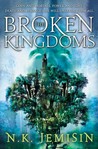
Book Review: The Broken Kingdoms by N.K. Jemisin


The Broken Kingdoms (The Inheritance Trilogy, #2)The Broken Kingdoms by N.K. Jemisin

Genre: Epic Fantasy, Magic

Series: The Inheritance Trilogy #2

Publisher: Orbit

Publication Date: November 2010

Author Info: www.nkjemisin.com

Wendy's Rating: 5 out of 5 stars


"Why do you think they bother with us? We teach them life's value.
So I would live, if only to spite them."

The first book in the Inheritance Trilogy was told by its main character, Yeine, in recollection. I read it a second time almost immediately and was blown away by all the clues to the slowly, deliciously unravelled mystery that Jemisin so carefully and subtly wove into the story. You’d think reading a book a second time within that many months would mean boredom, but instead, it was an eye opening experience.

The Broken Kingdoms is a similar and yet entirely different experience that takes dramatic irony to an entirely new level. Oree Shoth, like many of the other inhabitants of this world, has no idea what went on ten years ago in Sky. She knows only that politics and worship has changed by the say-so of the powers that be. No longer is Bright Itempas the "All Father." There are now two mysterious others. And the godlings have returned, though only in Shadow, the city beneath the World Tree that grew when the Gray Lady was born ten years ago. While curious, none of this is a surprise to the reader, not even the strange, mute man whom Oree has jokingly named “Shiny” because of the way his aura glows at dawn.

I am too emotionally involved in this trilogy now to determine this, but I would be curious to know if this book could stand alone. I would be curious to see how a reader reacts, reading this first, then going back and reading it again after reading The Hundred Thousand Kingdoms. Would they see it all with entirely new eyes?

Eyes. Sight. Seeing. This is a fascinating aspect of this book because Oree is blind. She is not merely unable to see, but her eyes are actually deformed. She is, as she is told, a very beautiful woman, but for this deformity that she refuses to hide. Jemisin establishes her blindness from the beginning, but makes it very clear that it is not a disability. She is not coddled by those around her and her other senses have done their duty and taken up the slack and Jemisin skilfully paints words of scent and sound and feel to help us see the world that Oree cannot.

But Oree is not completely without sight. She is able to see magic, which draws her to Shadow, which is filled with magic and with godlings. Unsurprisingly, she becomes very much involved with them. Jemisin uses this sixth sense to further paint the scenes and people, even including emotions and expressions. Painting is a very important part of this story, with each chapter named as if it were a painting or sculpture, complete with the kind of mediums used. Lee Moyer so perfectly brings Oree and her world to life in this image:
And with this image, the rational part of my review - as written within the first one hundred pages of the book - comes to an end, but I will spare you the flail and possible reaction GIFs this book elicits. Just assume that the rest of my review dissolves into the tears and emotional twirling that ought to explain why it's taken me a year to read The Broken Kingdoms, after the emotionally draining experience of its predecessor.

Monday, December 30, 2013

Book Review: Ice Forged by Gail Z. Martin

Ice Forged by Gail Z. Martin

Genre: Fantasy

Series: Book 1 of Ascendant Kingdoms

Publisher: Orbit

Date of Publication: January 8, 2013

Author Information: Website | Twitter


Mogsy's Rating: 4 of 5 stars - "An epic fantasy with good old fashioned down-to-earth elements which felt comfortable and familiar, but it also holds many surprises that will set this story apart"

I've long been curious about Ice Forged. Though I also own The Summoner from her Chronicles of the Necromancer series, for some reason I just knew I wanted this one to be my first Gail Z. Martin book. They're both stories set in high fantasy worlds, but lands of ice and snow have always fascinated me, I don't know why. Maybe because I think these harsh settings are often fertile ground for exceptional protagonists, driven to be harder in an environment marked by extreme temperatures and scarcity. I love to read about characters becoming shaped by those experiences and overcoming those challenges.

So it was a pleasant surprise when the book began by throwing its main protagonist into a situation that was even more harrowing than I'd expected. Blaine McFadden is convicted of murder, and though his reasons for the killing were honorable, the young nobleman is sentenced to live out the rest of his days in a penal colony on Velant, an icy wasteland at the edge of the world. Six years later, Blaine (now known as "Mick") is a new man, emerging as a natural leader in the eyes of the other convicts and colonists. Still, they are kept under the thumb of an oppressive governor, and are at the mercy of the mages who are always too keen to administer their swift and often cruel discipline.

But one day, the supply ships stop coming. War has torn Blaine's former home of Dondareth apart, and the magic that civilization had always depended upon has been lost. It changes everything. Without the mage's power holding them back, the colonists of Velant take back their freedom but afterwards they too must decide their own fate. For many, this frigid land has become home, and they would like nothing more than to stay. Blaine, however, still has a far greater destiny to fulfill.

This is good old fashioned down-to-earth epic fantasy. And I use that description as a compliment. In many ways, this book reminds me of the pure delight and enjoyment I felt when I read Michael J. Sullivan's Riyria Revelations series, which I also loved; both share that same easy, straightforward writing style with story elements and character-types that won't be anything new to the avid fantasy reader, and yet I felt warm and comfortable wrapped in their familiarity.

I was also glad to see I was right about the strong characters, all of whom are wonderful and likeable in this novel. They are what drives this story, and makes the reader care about what happens in this book. When the magic went away, I found myself completely gripped by the consequences, shocked by certain deaths I never expected or kept on edge about what characters would do in response to such a big change in their world. Despite how I described the novel in the previous paragraph, scenes like these are what sets Ice Forged apart and makes it special.

I'm particularly impressed with the world which Gail Z. Martin has created, with emphasis on the background of the lore and magic. Not that the descriptions and details of the places in Velant or Dondareth weren't rendered well either, but I was much more drawn in by the histories of the land and people that she has woven. I love stories that establish a long, vivid past, because then the effects on the present and the future feel more impactful. That is the case here.

All in all, Ice Forged is a solid start to a new series. I eagerly await the next Ascendant Kingdoms novel to continue following Blaine on his quest to restore stability to his world.

4 of 5 stars