The BiblioSanctum has moved!

You will be automatically redirected to the new address in 5 seconds. If that does not occur, please visit
http://www.bibliosanctum.com
and update your bookmarks. See you at our new home!

Showing posts with label magic. Show all posts

Friday, June 6, 2014

Book Review: The Crimson Campaign by Brian McClellan

The Crimson Campaign by Brian McClellan

Genre: Fantasy

Series: Book 2 of The Powder Mage Trilogy

Publisher: Orbit (May 6, 2014)

Author Information: Website | Twitter

Mogsy's Rating: 4 of 5 stars


I find myself thoroughly enjoying the Powder Mage series. Brian McClellan’s star continues to rise, following up last year’s debut Promise of Blood with a strong sequel. While there were some parts I thought he did better in the first book, others that were better in the second, overall I can’t be happier with the direction this trilogy is taking.

The book starts out by easing readers back into the setting. With the help of an angry god, the Kez invasion into Adran territory is in full swing, after crushing Tamas’ ambitious strike. Stranded behind enemy lines with only a small remnant of his army left to aid him, the indomitable field marshal begins to lead his soldiers back across the mountains to warn and defend his country. Meanwhile back in Adro, Inspector Adamat is frantic with desperation and fear for the fate of his wife and son, held captive by the depraved Lord Vetas.

In yet another part of the world, Tamas’ son Taniel recovers from his injuries sustained in the pitched battle at the end of book one. While both Tamas and Adamat’s plot lines are marked by their very clear and concise goals, Taniel’s journey is a bit more complicated – but this also makes his character and story the most compelling, and more on that later.

But first, this “catch up” period at the beginning of the novel admittedly made for a slightly disjointed and slower start. However, I don’t think The Crimson Campaign is alone when it comes to this; I find many sequels – and especially middle books of a trilogy – have to manage this balancing act of setting up the stage for the next phase of the story while still trying to hold the reader’s attention and keep the momentum going. McClellan established a particular wide scope to begin with, following multiple characters all in separate parts of the world, so he had his work cut out for him. Considering everything that was happening, I think he did an impressive job. And once the story found its stride around the halfway point, I have to say there were no more issues with pacing.

Like I’d mentioned earlier, Taniel was the one who really shone in this one (and I find this interesting, since Adamat was my favorite in the first book, and I have to wonder if the third will be Tamas’ turn). Both Tamas and Adamat had story lines that followed a logical progression – the former had to make his way back to Adro, while the latter needed to rescue his family – and while they were engaging in their own way, neither had the ups and downs that made Taniel’s chapters so unpredictable and gripping.

The young powder mage first had to deal with the shock of awakening from a coma. Then struggle through a drug addiction that was the result of emotional trauma. Then come to terms with the news that his father might be dead. Then he had to go and get tangled up in the politics and infighting of the army. It was one big roller coaster ride with Taniel, and every turn had me wondering what would happen next. I loved everything about his story, which includes a deepening relationship between him and the mysterious woman Ka-poel, his ever loyal companion. I’m also intrigued by the changes in Taniel as a result of what happened to him at the end of Promise of Blood. This books hints at much greater and more intense developments to come on that front.

Another thing I would expect from a sequel is more world-building, and character development. In this, The Crimson Campaign did not disappoint. I’m still blown away by the hierarchy of magic users in his Powder Mage universe, and McClellan made sure to expand our knowledge of Marked, Privileged, and Knacked powers alike. I also noticed much more “screen time” in here for the female characters. Vlora, Nila and Ka-poel were all characters I wanted to learn more about, and I got my wish here. I was especially thrilled about Nila, who didn’t get much attention in Promise of Blood, but a huge bombshell dropped about her at the end of this book has me very excited about the future of her role.

What more can I say but, bring on The Autumn Republic! Something tells me that the third and final book of the trilogy will have just as much energy and impact, if not more. It’s so great to see this series going strong, and the way things are going I can only see things ending with a bang.


A review copy of this book was provided to me by the publisher via NetGalley in exchange for an honest review. My thanks to Orbit Books!

Monday, June 2, 2014

Book Review: Thief's Magic by Trudi Canavan

Thief's Magic by Trudi Canavan

Genre: Fantasy

Series: Book 1 of Millennium's Rule

Publisher: Orbit (May 13, 2014)

Author Information: Website | Twitter

Mogsy's Rating: 4 of 5 stars


I was very excited when I first heard about Trudi Canavan’s Thief’s Magic, and doubly more so when I discovered it was going to be an introduction to a brand new universe we’ve never seen before. I’m not completely unfamiliar with the author’s work, having read The Magician’s Guild, book one of her Black Magician trilogy, but knowing that she has two series and a couple more novellas based in that world of Kyralia which I haven’t even yet come close to finishing, I was glad to have a fresh start in Millennium’s Rule.

Magic and magic users seem to feature strongly in Canavan’s books, and that’s no exception here. At the beginning of this novel we meet Tyen, a young archaeology student (though calling what he and his professor and fellow students do “Archaelogy” might be a bit of stretch…they’re more like tomb robbers) who discovers a sentient book while excavating an ancient tomb. The book can read the minds of anyone who makes physical contact, communicating through text appearing on the pages. Calling herself Vella, the book claims to have once been a sorcerer-woman, until she was transformed into her current form by one of the greatest sorcerers of history. She has been gathering and storing information through the ages ever since. Sensing bad things to come if Vella were to ever fall into the wrong hands, Tyen decides to keep her to himself for now, but as we all know, a secret this big is always bound to come out sooner or later.

Meanwhile in another world, a dyer’s daughter named Rielle harbors a secret of her own. From a young age, she has had the ability to sense magic – and hence the potential to use it. However, Rielle’s society could not be any more different from Tyen’s, where magic is used freely (and some might say TOO freely) to power their fantastical machines. Instead, the priests of Rielle’s world teach that to use magic is the equivalent to stealing from the Angels themselves. Anyone caught committing this crime is published severely then cast out from the city to live out the rest of their lives in a prison. Rielle is therefore all too happy to just keep her head down, hoping to also to do what her family wants of her and find a prospective husband. But then she meets and falls in love with a local artist named Izare, which is patently NOT what her parents had in mind. Oh, hello, Forbidden Love.

What do these two plot lines have to do with each other? Very little, actually. Reading Thief’s Magic felt essentially like reading two-books-in-one. The novel’s structure can be a little jarring if you’re not expecting it. We first start with Part I which follows Tyen’s story, and several chapters after that Part II begins with Rielle’s. The novel continues like this, alternating back and forth between their narratives. Actually getting the hang of this perspective-jumping isn’t all that difficult, but Canavan likes to tease, and she seems to have this knack for choosing the most suspenseful moments to make the switch between characters. Often, I would find myself pulled away into Rielle’s story just as I was getting completely drawn into Tyen’s, or vice versa. This format was both simultaneously addicting and frustrating, though I have to admit I kind of liked it.

When it comes down to it, I’m just completely hooked by these two characters and their respective worlds. Both Tyen and Rielle are written very well, even though occasionally their naiveté would grate on my nerves. However, their decisions – misguided as they are sometimes – always led to interesting things happening. I’m fascinated by the differences in their cultures and how each of them view magic. I love that their own personal conflicts take them on completely disparate adventures, so that the individual challenges they face differ profoundly as well. I’m especially intrigued by Rielle and her struggles in a society where unauthorized use of magic is treated as the greatest sin, where women like her have very little choice and practically no future when they are discovered to possess magical abilities.

I don’t know if Tyen and Rielle’s paths will ever cross, though something tells me that they will – but that particularly story is not for this book to tell. At this point, I feel I’ve been given enough information to formulate a tenuous theory on how the two characters’ worlds are linked, but for the most part we don’t get too many answers on that front. I really enjoyed following both story lines, but if you’re the kind of reader who prefers self-contained story arcs or at least some closure at the end of a novel, you won’t really find it here. It’s a factor to think about, though I already know I will be picking up the next book in spite of it. Thief’s Magic may have all the hallmarks of a “Book One”, but Canavan has crafted a very fine beginning (technically, TWO very fine beginnings) and I want to find out what happens to both Tyen and Rielle.


A review copy of this book was provided to me by the publisher in exchange for an honest review. My thanks to Orbit Books!

Thursday, May 1, 2014

Tough Traveling: City of Wizards


The Thursday feature "Tough Traveling" is the brainchild of Nathan of Review Barn, who has come up with the excellent idea of making a new list each week based on the most common tropes in fantasy, as seen in The Tough Guide to Fantasyland by Diana Wynn Jones. Nathan has invited anyone who is interested to come play along, so be sure to check out the first link for more information. Compulsive list-maker that I am, I'm very excited to take part!

This week's tour topic is: City of Wizards
 
Something tells me this should be one of the easier themes for this feature, but I still had a tough time of it, especially coming up with only books I have read. After combing my shelves, here are my five I came up with:

The Black Prism by Brent Weeks - The Chromeria

Based on chromaturgy, the magic system in this series is one of the more interesting and unique ones I've come across in fantasy. In this world, the "wizards" or magic users can draft a substance called luxin which takes on different physical properties depending on their color in the light spectrum. The heart of the government is located at the Chromeria, also the seat of education and regulation for all color magic.

When the character Kip first visits the Chromeria in order to be trained as a drafter, he is amazed with the huge, impressive colorful structures made of luxin. I'll be honest -- to me this city was a bit hard to visualize. I kept thinking of those multicolored plastic hamsters cages, you know the ones with all those tubes you can add to it to make it a nice rodent funhouse? Yeah, I pictured a whole city like that.

The Magician's Guild by Trudi Canavan - Imardin

Imardin is the capital of Kyralia, home of the Magician's Guild, and as such that is where all magicians go to learn magic and also where most Kyralian magicians live. According to the wiki, because Kyralian blood is so high with magical potency compared to other countries, Kyralia also has a tendency to produce more magicians! Oh how I love learning interesting new things about my books. This Tough Traveling feature rocks.

They're real asshats in Imardin, though. Each winter, the capital gives the boot to all its "undesirables" like the poor and the homeless. In an attempt to protest this Purge, a young vagrant named Sonea somehow manages to pierce the magician's shield and bean one of them on the head, kicking off the chaotic events of this novel.

Harry Potter and the Prisoner of Azkaban by J.K. Rowling - Hogsmeade

Okay, I realize calling the quaint little village of Hogsmeade a "city" is a bit of a stretch. I know that. But I just can't not include this one, if you think about it. I mean, considering how places like Diagon Alley or Godric's Hollow that are really just pockets of the magical community hidden inside established Muggle settlements, Hogsmeade's pretty much the only place they have to themselves and all to themselves. The only all-wizarding community in Britain!

While Hogsmeade was actually first mentioned in the first book, it doesn't have its first appearance until this one.

Elantris by Brandon Sanderson - Elantris

Elantris, capital of Arelon, was once known as the "City of the Gods", where anyone who was "chosen" went to live. Ordinary people touched and transformed by the power of the Shaod go through physical and mental changes that give them special abilities. The city was literally radiant, a place of power where the Elantrians used their magical abilities for the benefit of all.

Lovely place, really, until all of a sudden the magic failed and everyone there lost their powers, leaving Elantris a contaminated prison city. The magic users became powerless, wretched creatures, and the city itself crumbled into oblivion.

Jaina Proudmoore: Tides of War by Christie Golden - Dalaran

I'm totally cheesing it a bit here by including this one, but what can I say, I'm a gamer at heart. When I heard that "City of Wizards" was this week's theme, my mind immediately went to World of Waracraft's renowned city of mages: Dalaran.

Dalaran is a "magocratic" city-state with a turbulent history. Destroyed in the Third War, the mages of the city refused to abandon their home and instead erected a huge glowing force field-like dome around the ruins in order to rebuild. After that, they moved the whole damn city by floating it to another continent by magical means. Now that's dedication! Dalaran plays a pretty big role in this novel, which is why I chose it.

Friday, April 18, 2014

Book Review: Nightmare Ink by Marcella Burnard

Nightmare Ink by Marcella Burnard

Genre: Urban Fantasy

Series: Book 1 of Living Ink

Publisher: InterMix (April 15, 2014)

Author Information: Website | Twitter

Mogsy's Rating: 3.5 of 5 stars


Whenever I encounter cool, interesting new concepts in urban fantasy, it's always like a breath of fresh air. I mean, I love vampires, werewolves, wizards and such, but it's also nice to see something different every once in a while. And with this book, the idea of magical tattoos most definitely fits into the "that's not something I see every day" category.

The unique properties of "Live Ink" is what serves as the foundation for the magic system in Marcella Burnard's newest novel, in a world where tattoos are more than just body art. If integrated well, a Live Ink tattoo can enhance a person's life and augment their skills. But when things go wrong, they can also turn on their wearers and even wind up killing them.

Protagonist Isa Romanchzyk and others like her who have the ability to manipulate Live Ink can either use that power to create or destroy, making her tattoo shop a destination for both the cops and the mob alike -- or anyone who needs to get rid of a Live Ink tattoo gone bad. Isa's approach has always involved "binding" the tattoo, effectively killing it in order to save the life of the victim. Until one day a desperate friend turns to her for help, and for the first time in years Isa works Live Ink, fixing the tattoo instead of destroying it. But what she doesn't realize is that by interfering, she might as well have just painted a target on her back.

It goes without saying, when you take an interesting idea and throw in compelling characters, you get a winning combination. Nightmare Ink has this going for it. Isa's enigmatic past and her connections with both the law and the gangs of Seattle make her interesting to me. I thought I'd seen and heard it all when it comes to urban fantasy protagonists and their shady backgrounds, but I guess not! Information about Isa's history is doled out sparingly so you don't get to learn everything about her straight away, and I found myself being surprised by the darker revelations of her past even once I was well into the final chapters of the book.

However, the uneven way details are revealed also presents a bit of an issue. I noticed the introductory chapters are heavier on the info-dumps, going so far as to have a character ask Isa about Live Ink so that she can not-so-subtly explain all the ins-and-outs. But information becomes sparser after this, leaving me with a lot of questions about tattoo magic. For example, why does Live Ink only take to certain people and not others? There's also not much about the "etheric" world where a lot of Isa's interactions with Live Ink tattoos take place. It makes some of the later scenes in the novel involving her relationship with her own Live Ink very confusing. It is also implied that the Living Tattoos come from another realm, but again we don't get a lot of detail on that. There are many instances like this, and while it's a very interesting world I only wish I knew more about it!

At the time of reading, I wasn't sure if this was going to be a series, but I see now that there is at least one future book planned. In any case, Nightmare Ink works very well as a stand alone. Isa and her friends are a fantastic group of people I wouldn't hesitate to read about again, and the concept of Live Ink magic could definitely do with some expanding, fine-turning and polish that another book could provide. Despite some holes in the world building, this was overall a very entertaining read.


  A review copy of this book was provided to me by the publisher via NetGalley in exchange for an honest review. My thanks to InterMix/Penguin Group!

Monday, April 14, 2014

Book Review: The Lascar's Dagger by Glenda Larke

The Lascar's Dagger by Glenda Larke

Genre: Fantasy

Series: Book 1 of The Forsaken Lands

Publisher: Orbit (March 18, 2014)

Author Information: Website

Mogsy's Rating: 3.5 of 5 stars 


The word "spy" has such heavy undertones, especially when it comes to genres in fiction. When I first picked up The Lascar's Dagger by Glenda Larke, everything I knew about it came from its description, so I was surprised when it turned out not to be the kind book I thought it'd be. Not that I had an inkling of how a story about a cleric-intelligencer was going to play out in a fantasy setting in the first place; still, if not a gripping page-turner, I expected at least something faster paced. But at the same time, I wouldn't exactly call this book slow, though it definitely had its ups and downs.

Case in point, it took a week to read the first third of the book, but the rest only took me about a few days. and I'd actually polished off the second third in a single sitting. For me The Lascar's Dagger was the type of novel with an ending much stronger than its intro; it may take its sweet time finding its momentum, but when it does, you'd better watch out. I know I could hardly put it down once the story got going.

The novel follows Saker Rampion, a priest who also serves as a spy for the Pontifect of the Va-Faith. On a routine information gathering assignment, he unwittingly stumbles upon Ardhi, a lascar up to no good. After a brief tussle, Saker comes away with the lascar's dagger, and its magical properties are revealed when multiple attempts to discard the weapon prove unsuccessful. Even after throwing it into the harbor, the dagger always seems to make its way back to Saker Rampion's side! 

Not long afterward, the Pontifect reassigns Saker on a new job to act as new spiritual adviser for the prince and princess of Ardrone. Meanwhile in another place, a young woman named Sorrel Redwing is on the run, charged with the murder of her husband. She ends up at the royal court too, after the Princess Mathilda takes Sorrel under her wing and offers her protection. At this juncture, the story is still in the process of evolving and has not reached its tipping point. However, once it becomes clear that Mathilda also has a larger role to play, the situation ramps up into a new and irreversible development.

In fact, for a spoiled princess, Mathilda had a lot to offer as a character, and was the one who stole the show for me, not least because the story might not have ever taken off if not for her actions. She also had by far the most interesting personality, even if at times she was a self-absorbed brat or even an airheaded ninny. Sorrel takes second place, impressing me with her strength and loyalty, and the fact she appears to have the patience of a saint. It's the female characters that really shine in this book, and they were the ones who drew me in despite Saker Rampion being the most prominent character. As it turned out, the fact that he was a spy didn't even play into the story all that much, at least not in the ways one would expect, and at times some of his shortcomings and naivete were positively cringe-worthy.

While I would not call this book action-filled or even an adventure, readers who love epic fantasy for the political intrigue and all that entails would find lots to like in The Lascar's Dagger. There are scandals, betrayals and plays for power, cleverly used to raise the stakes. Then there's the magic, an intriguing element that adds a sense of mystique and danger. There's not just one avenue of magical power in this world but several systems, one form of it being a "witchery" which relates to the spiritual sphere. I like that different people can be granted different kinds of abilities, as well as the idea of how a witchery power comes to a person in the first place. It's a very unique way of looking at magic, and raises plenty of questions about the evil and good forces of the world.

A while ago, I contemplated books -- especially firsts of a series -- that are slower to get started and realized that I don't mind a putting in a little investment if I think the payoff will be worth it. I have been pleasantly surprised like this before in the past, so I'm always reluctant to put aside a novel even if the introduction doesn't grab me right away. In this case, I'm glad I decided to stick with The Lascar's Dagger because the story eventually grew on me, and the ending presented a very tense situation in which the implications for the next novel are mind-boggling. I have to praise this book for its originality; there are ideas in here never seen before, and with really no way to predict what's coming next, I'm definitely on board with continuing this series.


A review copy of this book was provided to me by the publisher via NetGalley in exchange for an honest review. My thanks to Orbit Books!

Thursday, April 3, 2014

Book Review: Mistborn by Brandon Sanderson

Mistborn: The Final Empire by Brandon Sanderson

Genre: Fantasy, Magic

Series: Mistborn #1

Publisher: Tor

Publication Date: July 2007

Wendy's Rating: 3 of 5 stars

Anyone familiar with Brandon Sanderson's prolific writing knows that he puts a lot of time and energy in to his world building. It's truly amazing how detailed his worlds are and how he can possibly keep it all straight with all the books that he writes. He also has a penchant for magic and each of his realms has its own unique form of magic. In this case, it is Allomancy, the ability, unique to only a precious few, to use certain metals to produce certain effects.

Most Allomancers are only able to burn one of the eleven metals, but Kelsier, the survivor of the deadly mining caves of Hathsin, and Vin, the young thief, are Mistborn, able to utilize all of the metals to deadly effect. As members of the downtrodden race, the Skaa, they will use their abilities, Kelsier's persuasive skills, and his reputation as the only survivor of Hathsin, they set about with an elaborate plan to free the Skaa from the god-like Lord Ruler.

Sanderson spends a lot of time on his world building and on detailing his magic. I'm usually able to forgive the tell don't show - and am mostly able to do so here, but the over indulgence on these details is usually balanced out by interesting characters and a more intriguing plot - both of which are missing here. Kelsier and Vin simply failed to endear themselves to me. I felt nothing for their inner monologues and their pain and loss of loved ones, or for their ultimate goal.

I was somewhat interested in the logbook entries that precede each chapter, detailing the Lord Ruler's journey to save the planet. That was an interesting character with depth and a story that intrigued me, though we only got to see him in sparse moments, and only through the point of view of Vin and Kelsier.

Still, I do own the other two books in the series, and am curious to see what happens next, despite most of the story being surprisingly tide up at the end Mistborn.

Tuesday, March 25, 2014

Tour Review: Stone Cold by Devon Monk


Genre: Urban Fantasy

Series: Book 2 of Broken Magic

Publisher: Roc (April 1, 2014)

Author Information: Website | Twitter

Mogsy's Rating: 4 of 5 stars
 

Last year I read Hell Bent by Devon Monk, not realizing before I started that it is actually the first of a two-book spin-off series set in the world of the author's Allie Beckstrom novels. This book Stone Cold is the second. While the description for this Broken Magic duology says it can be read on its own without reading the Allie books, my own personal experience has shown that unless you have, it can be quite a struggle to keep track of the characters' histories and the series backstory. Don't get me wrong, I still had a great time reading. But I'm positive your experience would be richer and you'd feel a lot less lost if both series are read. Just something to consider.

At least I was more prepared this time around, having done most of the necessary catching up during the last novel. Shamus "Shame" Flynn is back and he is now even more damaged from the events at the end of Hell Bent. The book's main villain, a rogue magic user named Eli Collins is still out there, and Shame is determined to hunt him down and make Eli pay for the deaths of loved ones. Feeling angry and full of guilt, Shame's already unstable control of Death magic is threatening to slip away from him, which could mean great danger to everyone around him, even his friends and allies.

When all's said and done, I'm really glad I decided to read this book, and not just because it's the second half of a two-parter and I always hate to leave things hanging. I'm also glad because I liked Stone Cold much more than I did Hell Bent, and there are several reasons for this. Firstly, this book contains a conclusion that finishes things off with a bang. Secondly, that conclusion not only provides an ending for Shame's story, it provides one for Allie Beckstrom as well. Even though I've never read her character's series, I still could tell that this was a pretty huge deal. 

But thirdly and most importantly, I liked Stone Cold because I felt Shame finally stepped up to take the reins to his own series. In the first book, his character was really hard to get into; even though that was my first exposure to Shame and this entire Allie Beckstrom universe, he always felt like a guest in someone else's world, which was why color me totally unsurprised when I eventually discovered that Hell Bent was a spin-off. It also didn't help that Allie and Zayvion made such frequent appearances making it obvious that they were still quite central to the story, and that Shame himself was such a curmudgeony character. However, in losing control of his Death magic in this book, he became a lot more interesting to me by turning into a very different kind of Urban Fantasy anti-hero protagonist.

I actually felt sympathy for Shame. Don't his friends realize just how volatile his powers are? You can't demand help from a person who can't control Death magic and then blame him when horrible things happen, especially when they are exactly what he'd warned them about! Give him a break! Geez, everyone was so hard on poor Shame in this one, I found myself on his side just because it was all so unfair.

Anyway, how sad it is that the series ends just as I was getting into the character. At the same time, I wouldn't have had it any other way. I'm actually glad this is only two books because I don't know if I would've continued if this was an ongoing series. With books, shows, etc. I always much prefer it if the spin-off character actually moves to a new locale and make new friends so we get to start off fresh. He or she deserves a chance to move out of the shadow and shine. That's probably my only beef with Broken Magic. I wanted more Shame, but it was also clear that Devon Monk wanted to hold on to the characters in her other series (the first half dozen or so chapters of this book was about Allie's baby shower, for example). I just don't know if I could take that, but two books is absolutely fine.

If you've kept up with the Allie Beckstrom novels, then picking this series up is probably a no-brainer. You'd have the advantage over me as well, and no doubt enjoy it even more. For readers who are new to the world but don't mind feeling like they've stepped into the middle of an ongoing saga, this is a good opportunity to discover Devon Monk's writing and these two books are actually a pretty decent choice for the urban fantasy enthusiast.


A review copy of this book was provided to me by the publisher in exchange for an honest review. My thanks to Roc Books!

Monday, March 17, 2014

Book Review: Cold Magic by Kate Elliott


Genre: Fantasy

Series: Book 1 of Spiritwalker

Publisher: Orbit (September 2, 2010)

Author Information: Website | Twitter

Mogsy's Rating: 3 of 5 stars


The positive things I've heard about Kate Elliott's books, especially praise for her Crossroads trilogy, have always piqued my curiosity and made me feel like I'm missing out for not having read any of her work. So when I saw the Cold Magic ebook on sale a few months back, I snapped it up and didn't even hesitate for a second.

From its description, the book sounded like it would be right up my alley. Dawn of a new age? An Industrial Revolution which heralds inventions and technologies never seen before? Throw in a young, educated heroine caught up in the middle of this movement, and I thought it was going to be a winner for sure.

In many ways, I was correct. This is undoubtedly a good book. The story is an intricate web of political intrigue and hidden truths, taking place in a world that is practically overwhelming with its multiple facets. And Catherine "Cat" Hassi Barahal is a headstrong protagonist, embarking on a perilous adventure to find out who she really is. All in all, I was quite enchanted by this novel and all the wondrous magic, people and creatures Cat encountered on her journey.

And yet, I can't shake the feeling that this book could have been so much more. I wanted it to be great; I wanted to be amazed, but something always stopped me just short of getting to that point. After a while, I was finally able to pin down why I felt this way. Essentially, everything I mentioned before -- the fascinating characters, setting, and plot -- all started out on the right track, but ultimately never seemed to reach their potential.

Perhaps the most frustrating of those for me is the setting, which had everything going for it with its steampunky flavor and even an alternate spirit realm. I was intrigued by the idea of a clash between magic and science, between the old and the new, but unfortunately what I'd hoped for never really materialized. Don't get me wrong; it's a complex and imaginative world, but it somehow lacked coherence. Incidentally, I felt much the same way about the story, which started losing its momentum after a strong introduction, in part due to the lack of clear direction.

I also felt ambivalent towards Cat. I didn't dislike her but I didn't like her either, and therein lies the problem. It's hard to fully appreciate a book when the protagonist fails to interest me. Even now I can think of very little to say about her, except that I didn't really care for the way she was drawn to Andevai. Among my biggest pet peeves is when heroines fall for men who treat them badly, and Cat dances dangerously close to that line. Here's a man who snatches her from her home, speaks to her gruffly, and is an all around cold, arrogant jerk. By all rights she should want nothing to do with him, and yet he is shaping up to be the love interest.

I guess I'll just have to wait to find out what happens. Though I liked this book well enough, I'm also not in any hurry to pick up the sequel. I'm certainly not writing this series off yet, but I have a feeling my next Kate Elliott book will probably be something else. After all, I have heard that her Spiritwalker series is very different from her previous work, and who knows, perhaps I'll check out the Crossroads trilogy first.


Friday, March 14, 2014

Book Review: The Tower Broken by Mazarkis Williams

The Tower Broken by Mazarkis Williams

Genre: Fantasy

Series: Book 3 of Tower and Knife Trilogy

Publisher: Jo Fletcher (UK: November 21, 2014)

Author Information: Website | Twitter

Mogsy's Rating: 4 of 5 stars 

Finishing a series is always a little bittersweet, isn't it? I find this is absolutely the case with Mazarkis Williams' Tower and Knife trilogy. Of course, I'm thrilled to have finally reached the stunning conclusion to find out how it all ends, but I also know I'm going to miss this world and its characters.

It is also a wonderful thing to see an author's skills grow and evolve as time goes on. Though I think I'll always be a little in love with Williams' beautiful writing, I was admittedly much more taken with these last two books in the trilogy than I was with The Emperor's Knife. All three novels had their own individual strengths, but in general I found Knife Sworn and The Tower Broken to have much better flow and greater complexity than the first book.

In fact, I now find myself at a dilemma. The last two books have both been very strong, and I really can't decide which one I liked better. The Tower Broken, having a much darker plot and effectively raising the stakes, obviously appealed to me a lot. After the events of Knife Sworn, the fate of the world is teetering on the edge, threatened by a malignant force moving itself across the land and devouring everything it touches. The storm moves ever closer to the city of Cerana, and Emperor Sarmin finds he is powerless to do anything to stop its path of destruction. Things are definitely heating up in this one.

On the other hand, I LOVED the chapters about Grada, Nessaket, and Rushes from the last novel. Having the narratives of these three female characters was one of the best things about that book, but in this one they have once again faded back into the background, giving other characters the chance to step into the spotlight. Mesema and of course Sarmin both have their own chapters, but this time we also meet the fruit-seller-turned-mage Farid as well as Duke Didryk, whose point of view adds even more mystery to the already shadowy plot line.

While these new perspectives brought a heightened sense of intrigue and tension to the table, I still missed Grada, who has become the Emperor's royal assassin, and even found myself wondering after Nessaket, Sarmin's mercurial mother. But most of all, I missed following Rushes, the poor slave girl who has gone through such an ordeal in the course of these two books. I won't deny I was a little disappointed to see so little of the three of them in this novel, but fortunately I was able to get over it quickly, because Williams does such a good job making all her characters interesting. Much like the series, I felt that many of the protagonists especially Sarmin and Mesema have finally come into their own. The transformation of their relationship was the highlight for me in this one; by the end I could see where the author had wanted to go with the two of them all along.

I also think I would be remiss if I ended this review without making mention of the magic in the Tower and Knife world. The first book introduced us to the complex dynamic between mages and spirits, with the former harnessing their abilities by imprisoning the latter into their bodies, then sucking them dry of the energy required to power magic spells. We get to see a lot more of that here, as well as insight into the concept of "pattern magic" which is central to this entire trilogy. I think it's great how the last book ends with a much more detailed look into the mechanics of this system, because I'd always felt the story needed it.

So the the trilogy may be over, but I would read any future books by Mazarkis Williams in a heartbeat! Pulling off the final installment of a series is always a doozy, but it was done well here, even if everything wrapped up a little too neatly. I would still take a "complete" and satisfying ending like this over an open-ended one any day. Ultimately I think Williams made all the right calls, and at the end of the day served up an impressive conclusion.


A review copy of this book was provided to me by the publisher in exchange for an honest review. My thanks to Jo Fletcher Books!

Thursday, March 6, 2014

Book Review: The Magician's Apprentice by Trudi Canavan

The Magician's Apprentice by Trudi Canavan

Genre: Fantasy, Magic

Series: The Black Magician Trilogy

Publisher: Orbit

Publication Date: February 2009

Wendy's Rating: 2.5 of 5 stars

The Magician's Apprentice is considered #0.5 in Trudi Canavan's The Black Magician Trilogy. It was written after, but serves as a set up for The Magicians' Guild, which I have not read. It mainly follows the story of Tessia, a young healer apprenticed to her father, who discovers her magical abilities when she deflects the advances of a Sachakan mage. She becomes apprenticed to Lord Dakon, joining his apprentice Jayan, who initially disdains the fact that he must share his education with a woman.

There are two other characters who occasionally get to tell their story, namely Stara, a Sachakan noble daughter who is forced into an unwanted marriage in order to produce an heir for her father, and Hanara, the slave of the Sachakan mage who tried to take Tessia. While I appreciated the effort to reveal the other sides of the story, these characters weren't particularly strong enough in their telling. I'm not sure where Hanara's story is supposed to lead, though Stara is obviously meant to connect this prequel to Canavan's other series, The Traitor's Spy.

The use of magic is one of the most interesting aspects of this book. Through Tessia's training, we get a peek into the process of how magic works in Canavan's world. I was surprised by the idea of magical wars entirely fought by mages. Unfortunately, when the battles are fought in the story, they are very anti-climactic. In fact, I had to reread several of them, believing I must have missed something because they were so brief. Something happens, mages on one side or the other die, but despite all the descriptions that go into Tessia's training, we get no insight on the battle magic. Then certain magical items and practices - that I assume have significance in the future books - are introduced like deus ex machina.

As the war with the Sachakans rages on, things really started to unravel for me. Characters suddenly seemed to be forced into certain roles with no previous indication of why that would be so. Along with the magical elements, several guilds and factions are mentioned, and several relationships are forced awkwardly into place. All of this comes piling in toward the end in a jumble that made me feel like I should have read the other books in order to at least appreciate the significance of these things within the greater picture. I didn't need to read the other books to understand what they were or understand what was going on in this book, but things might have held more meaning, rather than feeling like a sudden rush of elements meant to connect the past to the present.

I'm sure the rest of the series is quite interesting and I did appreciate the glimpse I got of it here, but I sense that this backstory would have better served as a wiki entry instead.


Monday, February 10, 2014

Book Review: Shadow Ops: Control Point by Myke Cole

Shadow Ops: Control Point by Myke Cole (Ace)

Genre: Science Fiction, Fantasy

Series: Book 1 of Shadow Ops

Publication Date: January 31, 2012

Author Information: Website | Twitter

Mogsy's Rating: 4 of 5 stars


Shadow Ops: Control Point is military science fiction, but definitely not the kind I had been expecting. And honestly, if I'd known earlier just what kind of excitement I was going to be in for, I probably wouldn't have let this one hang out so long on my to-read list.

Not long ago though, I was in a bit of a reading funk and was in dire need of a book to pick me up, and Control Point sure did the trick. The book follows protagonist Oscar Britton, an Army officer who suddenly manifests a power which allows him to summon portals between and within worlds. In a time when people with such magical abilities are strictly regulated and under surveillance, those who run from the government are immediately labeled renegades and hunted down. Panicked and overwhelmed, Oscar chooses to flee but in time realizes there is a lot more to this world of magic than he's ever known.

The first chapter was like a pure shot of adrenaline, laying out everything I needed to know about this book and what I saw pleased me. It pleased me greatly. Sorcery and spec-ops tactics? Soldiers with superhero-like powers and codenames? This is a marriage of science fiction and fantasy made in heaven, where magic and futuristic technology co-exist in harmony with the unadulterated action of a military sci-fi novel, from an author who obviously knows what he's writing about. 

The cover? Totally does not do this book justice. I wouldn't had a clue what was waiting for me within these pages if I hadn't dug deeper. Even the description belies the true nature of the world in this novel, which is unlike any setting I've ever encountered. An entire civilization has been altered, the existing social structure upended because of people waking up with magical talents, and Myke Cole does a great job showing this in is storytelling. A whole other realm also exists on another plane, home to a race of goblin-like creatures who are in constant war with the military base there. The magic system is also fleshed out and presented well.

I was also surprised to see that the story is not just nonstop action. Between the hectic battles and covert military operations, there is a real attempt at character building and exploration of the relationships between the main protagonist and the others around him. Britton is a much deeper character than I'd expected, a thoughtful man who struggles with his own feelings a lot, constantly asking questions and evaluating his situation. 

Like most other reviewers, I've also noted Britton's indecision and his frequent switching of sides. To tell the truth, I didn't find it as extreme as some make it out to be, though my issue with this has less to do with his wishy-washiness and more to do with the fact that his inability to make up his mind often seems like a tactic to drive the story forward. It's obvious from his constant self-analyzing that Britton is a smart, introspective person, and yet on several occasions he will do things without thinking, and always much chaos and loss of life would be a direct result of his actions. He would be sick with guilt afterwards, but it's hard to feel for him after the first time it happens, especially when he doesn't learn from his mistakes. It's a very small gripe though, considering the pile of positives that more than made up for it.

This book offered me a side of the genre that I haven't seen much of before, and as such the author has my attention. I'm looking forward to see how the rest of this series will unfold; something tells me the next book will be just as much fun and full of surprises.


Wednesday, February 5, 2014

Book Review: Crown of Midnight by Sarah J. Maas

Crown of Midnight by Sarah J. Maas

Genre: Young Adult, Fantasy, Magic

Series: Throne of Glass #2

Publisher: Bloomsbury USA

Publication Date: August 2013

Author's Info: sarahjmaas.com

Wendy's Rating: 3 of 5 stars

As much as I enjoyed Throne of Glass, one thing that bugged me (other than Celaena’s arrogance) was the fact that Celaena is supposedly the renowned and feared Adarlan’s Assassin, but beyond her own boasting, she didn’t do anything assassiny. Crown of Midnight initially made me believe I was finally getting to see what I wanted to see, but we quickly find out otherwise. The King’s Champion proves herself conniving, with questionable negotiations, but she certainly doesn’t prove herself deadly. It made me wonder if Maas was having trouble truly associating her character with the more negative aspects of being known as Adarlan’s Assassin – namely, the assassin part. This is remedied half way through the book when she unleashes her darkness in a way that I can only describe as Mary Sue the Ninja. The scene, which I could probably re-enact with Catwoman in a Batman: Arkham Asylum challenge map, was a bit too over the top for my liking.

My second problem with this book (other than Celaena's arrogance), is the heavy focus on cloying romances. Celaena, now moved on from her romance with Prince Dorian, is paying more attention to the captain of the guard, Chaol Westfall, which, on top of her arrogance, results in a book that spends far too long being the kind of YA book that I don’t particularly enjoy.

Having to deal with all of this for half the book made it very difficult to continue, but I generally try to finish what I start. Fortunately, the actual plot picked up and started to move along at the half way point with Princess Nehemia’s plotting, the slow, seeping return of magic, and Queen Elena’s mysterious absence. We finally get to focus on the dark past Celaena is running from and the destiny she is trying her hardest to avoid.

The big revelation at the end still has Mary Sue smatterings, no matter how often Maas reminds us of what Celaena has lost and what she suffered as a slave in the mines, but it is still interesting enough for me to consider continuing. At the very least, circumstances seemed to have caused her to mature a bit. While I don’t want her to lose her arrogance completely, as it is part of her coping mechanisms, I do hope the swagger is toned down a bit for future installments - which I still am intrigued enough to want to read.

Wednesday, January 1, 2014

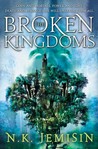
Book Review: The Broken Kingdoms by N.K. Jemisin


The Broken Kingdoms (The Inheritance Trilogy, #2)The Broken Kingdoms by N.K. Jemisin

Genre: Epic Fantasy, Magic

Series: The Inheritance Trilogy #2

Publisher: Orbit

Publication Date: November 2010

Author Info: www.nkjemisin.com

Wendy's Rating: 5 out of 5 stars


"Why do you think they bother with us? We teach them life's value.
So I would live, if only to spite them."

The first book in the Inheritance Trilogy was told by its main character, Yeine, in recollection. I read it a second time almost immediately and was blown away by all the clues to the slowly, deliciously unravelled mystery that Jemisin so carefully and subtly wove into the story. You’d think reading a book a second time within that many months would mean boredom, but instead, it was an eye opening experience.

The Broken Kingdoms is a similar and yet entirely different experience that takes dramatic irony to an entirely new level. Oree Shoth, like many of the other inhabitants of this world, has no idea what went on ten years ago in Sky. She knows only that politics and worship has changed by the say-so of the powers that be. No longer is Bright Itempas the "All Father." There are now two mysterious others. And the godlings have returned, though only in Shadow, the city beneath the World Tree that grew when the Gray Lady was born ten years ago. While curious, none of this is a surprise to the reader, not even the strange, mute man whom Oree has jokingly named “Shiny” because of the way his aura glows at dawn.

I am too emotionally involved in this trilogy now to determine this, but I would be curious to know if this book could stand alone. I would be curious to see how a reader reacts, reading this first, then going back and reading it again after reading The Hundred Thousand Kingdoms. Would they see it all with entirely new eyes?

Eyes. Sight. Seeing. This is a fascinating aspect of this book because Oree is blind. She is not merely unable to see, but her eyes are actually deformed. She is, as she is told, a very beautiful woman, but for this deformity that she refuses to hide. Jemisin establishes her blindness from the beginning, but makes it very clear that it is not a disability. She is not coddled by those around her and her other senses have done their duty and taken up the slack and Jemisin skilfully paints words of scent and sound and feel to help us see the world that Oree cannot.

But Oree is not completely without sight. She is able to see magic, which draws her to Shadow, which is filled with magic and with godlings. Unsurprisingly, she becomes very much involved with them. Jemisin uses this sixth sense to further paint the scenes and people, even including emotions and expressions. Painting is a very important part of this story, with each chapter named as if it were a painting or sculpture, complete with the kind of mediums used. Lee Moyer so perfectly brings Oree and her world to life in this image:
And with this image, the rational part of my review - as written within the first one hundred pages of the book - comes to an end, but I will spare you the flail and possible reaction GIFs this book elicits. Just assume that the rest of my review dissolves into the tears and emotional twirling that ought to explain why it's taken me a year to read The Broken Kingdoms, after the emotionally draining experience of its predecessor.

Tuesday, November 12, 2013

Audiobook Review: The Way of Kings by Brandon Sanderson

The Way of Kings (The Stormlight Archive, #1)
The Way of Kings by Brandon Sanderson

Genre: Epic Fantasy

Series: The Stormlight Archive #1

Publisher: Tor Books

Publication Date: August 31, 2010

Author Info: brandonsanderson.com 


Wendy's Rating: 5 of 5 stars - It is evident that Sanderson has this entire world perfectly detailed in his head, and he seems determined to make sure the reader sees it exactly as he does... 

With three hours left on the audiobook and constant interruptions at work where I usually listen to my audiobooks, this happened:

I got through the work day, running home to read the rest because the narrators just weren't reading fast enough, dammit! I now am suffering from severe book hangover, knowing that I have to wait until March 4, 2014 to find out what happens next in Words of Radiance. You'd think with all this, that I'd throw all the stars at this book, but I had to deliberate on that a bit. My bookflail showed up in the last 200 pages of a massive book. But I'm just not sure I could have made it through the first 3/4 if I'd not opted to listen to the audiobook.

The world Sanderson has built is immense and his lore covers everything from fashion, to theology, to weather, to magic, to politics, and more. A lot more. A. LOT. MORE. It is incredibly impressive, but the interjection of lore building exposition and flashbacks became disruptive after a while. It is evident that Sanderson has this entire world perfectly detailed in his head, and he seems determined to make sure the reader sees it exactly as he does by including full descriptions of even the smallest element, rather than allowing the reader to use a bit more of their own imagination.

Considering the intended length of the series, weighing in at twenty books, I assume the information dumps will become less of an issue as it progresses (save it for the wiki, please). And fortunately the lore influx is also balanced by the depth of the characters, which is what helped me pull through. In other epic fantasies, you don't really get to know the characters, and in some cases you can't even tell them apart. Here, there is as much time spent with the development of the major characters and the supporting cast important to them. Perhaps more of Kaladin’s backstory is told than is necessary, but I can excuse this because of how vivid and interesting the character is, such that you actually come to care about him and the others, rather than merely liking him because he's cool.

The audiobook was read by Michael Kramer and Kate Reading, the same people who narrated Robert Jordan’s unimpressive The Eye of the World, which inspired my post on epic storytelling for the sake of epicness. With this in mind, I should have been daunted by this book’s information overload and the twenty book series, but this is Brandon Sanderson. I’ve actually only read 2.1 books by him (though I own several) and completely subscribe to the well-earned hype. His world building *is* truly amazing. His unique and varied approach to the use of magic in each of his stories is fascinating (in the case of Warbreaker, it’s specifically what attracted me). And his characters are very real and very endearing. If Sanderson gets carried away sometimes with too much lore, I can forgive him because it feels like him eagerly inviting you into his head, rather than him just unnecessarily padding out a book and/or killing time till he figures out what the story is supposed to do next.

As for the story itself, it was really impressive. A pointless war for vengeance is at the heart of everything, with mysteries stemming from this core in all directions. The last 200 pages of the book are so intense because those vines of mystery, along with all of these intriguing characters, start to come together in the end, creating all new mysteries that demand that you continue the journey.

Saturday, November 2, 2013

Book Review: The Night Circus by Erin Morgenstern

The Night CircusThe Night Circus by Erin Morgenstern

Genre: Magic, Fantasy, Romance
Publisher: Double Day
Publication Date: September 2011
Author Info: erinmorgenstern.com

It was fascinating to see the characters and events slip in and out of the chapters in such a graceful and sensual dance.
5 of 5 stars

Open the pages of the Night Circus and you are immediately absorbed into a mesmerizing world that leaves you hoping La Cirque des Rêves will visit soon so that you may experience its wonders for yourself. The simplest explanation of this circus is to have you imagine your favourite incarnation of Cirque de Soleil, only, on a more subtle scale, its grandeur hidden within the elegance of its black and white world under the stars. Like other circuses and fairs, you will still find acrobats and contortionists and fortune tellers… And you will find illusionists.
Cirque du Soleil
Within the setting of the circus, a competition plays out that is reminiscent of books like The Prestige, where two skilled magicians constantly try to one up each other. The difference here is that the magic is real, and that the “illusionists” in question do not directly compete against each other. Instead, they find and raise gifted children. The children are raised knowing their purpose, but not the venue or even their competitor. In this case, Celia Bowen and Marco Alexander end up intricately entwined within La Cirque des Rêves and they fall in love – something their callous fathers cannot fathom.

The lovers’ story is beautiful and tragic, but while they are at the heart of The Night Circus, theirs is not the only story being told. Everyone – from the clockmaker who’s love for the circus inadvertently forms the circus’ elite fan club, to the young boy wishing for a fairytale ending, to the red-haired twins born auspiciously on opening night, to the circus’ founders, to the fortune teller and the contortionist – is so intricately bound together within the circus. It was fascinating to see the characters and events slip in and out of the chapters in such a graceful and sensual dance. Somewhere along the way, I realized that even Time and the circus itself were like living, breathing characters.

The true magic of The Night Circus is that, like the circus itself, it cannot be pinned down. It cannot be easily lumped into any particular genre. It is all and it is none and its wonders and mysteries must simply be experienced…

Tuesday, October 15, 2013

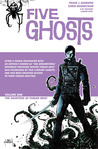
Graphic Novel Review: Five Ghosts vol.1: The Haunting of Fabian Gray by Frank J. Barbiere

Five Ghosts, Vol. 1: The Haunting of Fabian GrayFive Ghosts, Vol. 1: The Haunting of Fabian Gray by Frank J. Barbiere

Genre: Pulp Fiction, Adventure
Series: Collects Five Ghosts #1-5
Publisher: Image Comics
Publication Date: September 18, 2013

...the story has a lot of potential to go places, with lots of opportunity for exciting adventures.
3 of 5 stars

A tragic turn of events resulted in a Dreamstone embedding itself in adventurer Fabian Gray's chest. On the plus side, he now can call upon the abilities of the five literary ghosts trapped within the Dreamstone to aid him in his treasure hunting.
The comic is written and drawn in a retro pulp fiction style and when Fabian Gray is first introduced, we immediately get to see his ghosts in action, conveniently aiding him in his daring feats. My first real introduction to pulp fiction was A Princess of Mars, where readers are frequently reminded of how awesome the manly main character is. I feared I'd be subjected to the same with Fabian Gray, but after the dashing introduction, we discover Gray might not be so awesome and that his exceptional powers come with a heavy price. Gray's connection to the Dreamstone means that others, including the Nazis, know of him and are now hunting him.

The art took some time to grow on me. I liked the pulp style and layout, though the art itself wasn't as clean as it could have been. Eventually, both story and art settled in to a comfortable groove. I appreciate the depth Barbiere attempts to give to the character, though the lessons Gray learns during his trials do take a bit of a leap. Still, with everything now established in the first volume, I think the story has a lot of potential to go places, with lots of opportunity for exciting adventures. Hopefully we'll learn why these particular ghosts have manifested for Gray and what his personal connection is to them.

With thanks to NetGalley and Image Comics for the opportunity to read an advanced copy of this graphic novel in exchange for an honest review.

Monday, October 14, 2013

Book Review: Mister Monday by Garth Nix


Mister Monday by Garth Nix

Genre: Fantasy, Adventure, Children
Series: The Keys to the Kingdom #1
Publisher: Scholastic Books
Original Publication Date: July 2003
Author Info: www.garthnix.com

Nix has so many wonderful and unique ways of presenting magic and technology in his stories.
3 of 5 stars

Twice I picked this book up from the library, and twice I returned it, unable to get much further than Arthur Penhaligon’s step into the mysterious house. However, because I did like the concept behind the Keys to the Kingdom series, I took advantage of the audiobook and finally managed to get through it. As a result, I can’t say I’m overly impressed, but I am intrigued and am not opposed to continuing the series through the full “week.”

This is a story about The Will of the Architect and its attempt to free itself from the hold of the seven days, each of whom hold a key that binds it. When Mister Monday attempts to exploit a loophole in the Will by giving his key to a dying Arthur, his plans are foiled because, with the help of The Will, Arthur does not succumb to his severe asthma after all. Now the keeper of the lesser key, Arthur becomes a target of Monday’s minions and his neighbourhood falls victim to a strange illness. Arthur must venture into the world of The Will to retrieve the greater key from Monday and get rid of the illness.

Nix has so many wonderful and unique ways of presenting magic and technology in his stories. In his Abhorsen Trilogy, which is where I first came to know the author, necromantic powers were connected to a series of bells. Shade's Children is technology-based, and A Confusion of Princes combines technology and various psionic abilities. In The Keys to the Kingdom, magic is based on time and words have power. In fact, The Will initially appears as words magically printed in the air and the kingdom beyond is heavily focused on anything and everything to do with writing.

This is all very unique, but Nix sometimes goes too far with it by making it too easy for the characters to solve problems with conveniently written in magical plot devices. The deus ex machina mentality is troubling for me as an adult, but as this is aimed at a much younger audience, I can appreciate and accept the fun results.

So why did I have such trouble getting into the book? Perhaps Arthur was the problem. He’s not a particularly interesting character and his motivations are not keenly defined beyond the typical “no I don’t want to be keeper of the key” and “I’m only doing this to save my family etc.” Perhaps my problem had to do with the fact that a number of interesting characters were introduced that seemed poised to accompany Arthur on his journey, but were repeatedly left behind. Dorothy is a pretty dull character on her own. She needed her entourage for support and I think that was my problem here. Too much Arthur, too much Arthur escaping seemingly dire situations with easy magic, and not enough of the interesting supporting characters.

Still, as I said, the concept of the series in interesting and I’ve grown rather curious about what the other days of the week have in store...


Thursday, October 3, 2013

Book Review: Three Parts Dead by Max Gladstone

Three Parts Dead by Max Gladstone

Genre: Magic, Fantasy
Series: Craft Sequence #1
Publisher: Tor Books
Publication Date: October 2012
Author Info: maxgladstone.com

Think of a law firm like Angel’s Wolfram and Hart, only with far more history and a solid framework and magical processes and fantastic depositions that take place on the astral plane.

Three Parts Dead is a unique tale that combines religion, magic and law in a world so very different from our own. It begins with the murder of a judge, the death of a god and Tara Abernathy, a skilled young Craftswoman, unceremoniously graduated from the Hidden Schools and ejected from their skybound walls. With no other choice left to her, Tara returns to her quiet farming village, but in an effort to help the villagers after a brutal attack, reveals her Craft and incurs their wrath. What did she expect would happen when she raises the dead? Fortunately, she is saved by Ms. Kevarian, a senior lawyer at Kelethras, Albrecht and Ao who offers Tara a job as her associate.

Gladstone casually throws the reader into this strange world. Tara nonchalantly raising the dead, the inconvenience of a dead god within the walls of Alt Coloumb. Ms. Kevarian’s unusual interview process. The carefree rescue by vampire pirates. This makes it sound all very comedic, but in fact, the story is woven together and the mysteries teased out so intricately that it was hard not to keep reading straight through to unravel all there is to know about Alt Coloumb, Craft, the gods, The Hidden Schools and everything in between.

One of the most fascinating bits of lore building is the religion, and the gods themselves. The main god of interest is Kos Everburning, who happens to be dead. The religious aspect is extremely practical in this story in that prayer actually does serve a purpose. The gods are fuelled by worship and sacrifice, but they are not simply all powerful beings sitting on some Olympic throne. The ones in question actually are benevolent and willingly give of their power back to the people in pragmatic ways. From steam pipes heated with Kos’s own fire, to bolstering city defences. Though you never get to meet and know the gods, you do learn how much they love and care for their people.

Secondly, there is the Craft. Where the gods use their own magic, certain men and women are gifted with the ability to channel the power of the earth and stars. Tara and Ms. Kevarian use these abilities in their attempt to find out how Kos Everburning died, his connection to the judge and more.

Initially, Tara appears rather immature in her use of Craft, though not in her skills as a lawyer. She is just recently graduated from The Hidden Schools, though the circumstances of her graduation are unusual. For her to be taken on by such a renown law firm implies that there is far more to her and when placed in the right environment, her expertise becomes quite evident. While there are a lot of legalities to deal with, it is not overwhelming or confusing and I loved the way Craft was ingrained into the process. Think of a law firm like Angel’s Wolfram and Hart, only with far more history and a solid framework and magical processes and fantastic depositions that take place on the astral plane.

Tara is surrounded by several other interesting characters, including a junkie, a gargoyle and a pirate captain and the novice priest who was present when Kos died. Each character seems to be created to fit into a certain mould, but Gladstone subtly and pleasantly surprises. Similarly, the setting does not fall into anything that can be pinned down. The fashion, locations and language make Alt Coloumb seem like a city we might easily recognize, yet there is a grandiose and profound feel to the stone buildings, a Victorian element to the horse drawn carriages and travel by pirate ship. I am so very intrigued by this world and am looking forward to further adventures within it.