The BiblioSanctum has moved!

You will be automatically redirected to the new address in 5 seconds. If that does not occur, please visit
http://www.bibliosanctum.com
and update your bookmarks. See you at our new home!

Monday, November 26, 2012

Dragon Age: Those Who Speak by David Gaider

Dragon Age: Those Who Speak by David Gaider


The Silent Grove re-opened a few issues raised in Dragon Age: Origins and the prequel book, The Stolen Throne, and added a few new ingredients. I was worried that Those Who Speak would fail to deliver an appropriate conclusion to all of that in a mere three issues – and I was right. Fortunately, Those Who Speak is not a conclusion, but rather an interlude where King Alistair and his companions, the pirate queen, Isabela, and the dwarven businessman, Varric Tethras, gain a new old ally and, more importantly, we get a further peek inside Isabela.

From book two onward, this is clearly Isabela’s story. Alistair’s hunt for his daddy and his dragon blood issues can wait. This is about the Pirate Queen that some players of Dragon Age II may have dismissed because of her penchant for sex, violence, sex, sex and abandonment. But in truth, despite being paid to accompany Alistair, she is fiercely loyal to those who earn her trust, even at cost to herself. Her devotion to her crew above all is admirable, as is her seemingly unbreakable spirit.

As much as I like the visuals, I wish David Gaider had taken the time to make this another Dragon Age novel, instead of a series of comics. In his novels, he has more room to expand on these characters and is skilled enough in his descriptions of the places, actions and events that he could have brought far more to the story and characters than we see here.


Final verdict:
3 of 5 stars

Friday, November 16, 2012

Traitor by Matthew Stover


Traitor by Matthew Stover

The issue I have with the Force is that the movies made everything so black and white. Give in to your hate and passion and poof, you’re dark side. The Sith have their code about killing all the things and power, and the Jedi have their code about not having sex and only killing all the things when you really, really have to. Both are annoying opposites and their philosophies and drama grow tiresome after a short time, more so when the struggle for every Jedi in the Star Wars universe includes going dark and staying dark, or going dark and finding redemption.

Thankfully, my recent gaming adventures into the Old Republic have renewed my faith in the Star Wars universe by providing numerous characters and stories that go deeper than the black and white/good and evil trope.

Yes, I did say Jedi Chicken.
Not to be confused with the
Jedi Bunny
Jolee Bindo started me down the path in KOTOR. In KOTOR2, Kreia, my beloved and hated master (spoilers), truly broke this trope, and then Traitor took it all one leap further, with the help of a Jedi chicken named Vergere who was once a source of ridicule for me, but is now a subject of respect, curiosity and maybe even some awe and adoration.

I initially had trouble with the New Jedi Order series – though I only read the first book – mainly because of the new enemy, the Yuuzhan Vong. While I liked the idea of a dominating race outside of the Force, I got a little tired of the “organic app for that” way the Yuuzhan Vong could deal with every single thing (except Lando’s pocket world melters and those pesky Jedi kids). The events on Sernpidal broke the Star Wars bubble of heroes (not including Jedi Masters who need to motivate their padawans) never die and set the tone for the subsequent series.

I skipped several books to pick up Traitor, as recommended by my fandom hero, Beccatoria. That bubble breaking had continued (though I’d already spent enough time on Wookieepedia to know that) and we now have Jacen Solo (spoilers) dealing with his “death” with the help of Vergere who robs him of the Force, tortures him with pain and forces him to question everything he is and everything the Force is and is not, in order to find his own path that surpasses both the darkness and the light.

It is a very personal journey that we get to go on with Jacen that initially had me at about three stars, but once all was said and done and Vergere revealed her pride in her student/teacher, I found myself overwhelmed with curiosity about what this means for the future of the Jedi and Sith through Jacen’s ... enlightenment.

4 of 5 stars

Sunday, October 28, 2012

Parable of the Talents by Octavia E. Butler


Parable of the Talents by Octavia E. Butler

Octavia E. Butler’s books are not for the squeamish and most certainly not for people who want happy, Hollywood endings. Things work out in the end – but never in a nice neat package. There is always a lot of loss in all of its most painful forms. Her works are very realistic in that matter. In fact, her works are realistic in all matters. They are a reflection of life and of the human spirit. They don’t allow you to escape into science fiction and fantasy as easily as other books in the genre might. They are harsh truths.

Butler’s books are considered science fiction, but she stresses that science fiction is not just about the fantastical, requiring a big suspension of disbelief. Even when her stories involve aliens, mutants or vampires, there is still the sense that such things could very well happen in our very near future.

Friday, October 5, 2012

Cloud Atlas by David Mitchell


Cloud Atlas by David Mitchell

I read this book because of the trailer, like many others. The trailer - despite the presence of Tom Hanks AND Halle Berry - fascinated me, though I could not fathom what was going on in what promised to be an excitingly visual journey through the times and lives of oddly connected people.

The first chapter was a difficult start, mainly due to the language. An older, more formal English, the dialogue was filled with words and nuances I didn't understand, but rather than break the mood to look everything up, I just sank in and let Adam Ewing's meanings come to me.

In the second chapter, featuring Robert Forbisher, the language changed dramatically. By the third chapter, about Luisa Rey, I had gotten the concept of the connecting threads, no matter how thin, between the people (though I felt the birthmark was a bit too contrived), but more importantly, I had fallen in love with the language and concluded that it was as much a character in this story as the people themselves. It shaped them as it moved and flowed and changed through each chapter...

Reviewing the trailer now that I have finished the book still leaves me wondering, though now I'm wondering just how they are going to tell this story - these stories - and tell them right. It's not really the "action adventure" that People Magazine describes it as... and the trailer implies that the directors have opted to make the connections much less subtle than the book does... I will have to return to this review once I've seen the film for comparison....
4 of 5 stars

Monday, June 11, 2012

Dragon Age: The Calling by David Gaider

The Calling (Dragon Age, #2)

The Calling by David Gaider

Story-wise, this wasn't as good as its predecessor, The Stolen Throne, with a somewhat shaky plot pushed a long by the questionable motivations of the characters. Fortunately, it was the characters that made me want to read these books in the first place in order to learn more about them, and Gaider again delivered, with the focus, this time, on Maric and Duncan. He adds a load of depth to both characters, making me love them all the more and feel for them and those that come after.

Maric was already a charming character by the end of The Stolen Throne but events from the end of that book and since served to break him. He is a man depressed and ready to die, with nothing to save him from his darkness. Meanwhile, the stoic Duncan we know from the game used to be a swarthy, cocky and sneaky young thief with a reasonably noble heart and a healthy fear of his Warden Commander, Genevieve, who is leading the mission into the deadly Deep Roads to hunt for her brother. The Calling also relates to Dragon Age: Awakenings, introducing the sentient darkspawn known as The Architect, as well as a few of his companions.

As I said, the plot and motivations of the characters are rather weak. It was frustrating watching characters make decisions that really made no sense, serving no purpose other than to push them to the ultimate goal of finding Genevieve's brother. That done, we end up with the plot twist which, while unsurprising, was also questionable. I concluded that the actual plot really was not the important thing to Gaider. He was more interesting in adding character backstory to alter canon created within the games, most notably with the parentage of Maric's bastard son, Alistair.

Otherwise, I really like Gaider's grasp of battle writing. It probably helps that I've played the game these books spawn from, but I think anyone else would appreciate and be able to visualize the battles and how each character moves and flows within them. Playing the game means you can actually visualize the commands used by the PCs and NPCs in game. And, in spite of the weak story surrounding them, I adore the characters. Gaider writes them all well, making them all very interesting - redeeming the apparently irredeemable, questioning the noble and letting us see their darkness. I love the relationships he develops between them and love the bittersweet and the heartbreaks that he seems to enjoy writing.
2.5 of 5 stars

Tuesday, May 29, 2012

Dragon Age: The Stolen Throne by David Gaider

The Stolen Throne (Dragon Age, #1)The Stolen Throne by David Gaider

I’ve recently finished two playthroughs of Dragon Age: Origins and in both, my Warden permitted the same fate for Loghain Mac Tir. It was the fate deserving of his crime against king and country, but I never could appreciate the reasoning given for his betrayal as there seemed to be so much more to Loghain. Hence my need to read the books that precede the game.

Gaider’s writing encompasses a lot of emotion, even in a character that seems limited to only a few. Barely 50 pages in, I already respected Loghain and even liked him, despite his harsh demeanor. Appreciation for King Maric was to be expected once it was established that he was much like his son, Alistair, in personality. But it was Loghain that I was interested in and the book did not let me down -- though it also means I am heartbroken over Loghain's ultimate fate.

Not that Maric's story as the king seeking to reclaim his stolen throne was over shadowed by Logain's story of the man whom he befriended, or the women whom they loved. Gaider put together an intricate tale of a kingdom torn, complete with well-written battles and action sequences. The characters are all well-fleshed out and their relationships go beyond the predictable romantic geometry. I can't say more without getting into spoilers, but I was really surprised by the route Gaider took with the romances in particular. They were integral to the story and the shaping of the characters and I was surprised and impressed that Gaider did not aim for a typical happy ending for the king and kingdom.
4 of 5 stars

Friday, May 25, 2012

Warbreaker by Brandon Sanderson

Warbreaker by Brandon Sanderson
My rating: 3.5 of 5 stars

The idea alone of using colour as a source of power made me very curious about this book. The details Sanderson puts into the use of colour and Breath is very intricate, yet surprisingly not overwhelming. The obvious religious comparisons are not overwhelming either. I was concerned for a moment when Austre, the one god, unseen, was introduced, but, despite the comparisons, the book wasn’t preachy, even as it admonished the hypocritical views of some of its characters. The other gods, the Returned, are a cross between a resurrected Jesus and the petty Greek gods – but with far less potency.

I loved that all the main characters started as one thing, but were thrown into situations that forced them to almost wipe their slates clean and grow into another. I’m a big fan of inconclusive endings, and I appreciated this one even more because it actually played off of the changes these characters went through, allowing you to assume the outcome.

The supporting cast of characters was very supportive, and served as distraction from all the plotting going on on all sides. Oh goodness, the plotting. I admit to skimming through some of these parts. I got the point without it needing to go on quite so much with the details.

The end felt a bit rushed and incomplete. Or rather, I accept that it was meant to be inconclusive and love inconclusive endings, but because it seemed to rush to that point in those last few pages, I felt a bit let down.

Overall, loved the book, loved the concepts presented. My favourite character would definitely have to be Denth, the mercenary happily complaining about how mercenaries are so unloved for obvious reasons...

Final verdict:
3.5 of 5 stars

Monday, April 23, 2012

Patternmaster by Octavia E. Butler

Patternmaster (Patternmaster, #4)Patternmaster by Octavia E. Butler

After Clay’s Ark, I had no idea what to expect with The Patternmaster. What I did not expect was that the Clayark evolution would basically turn those people into animals – albeit really smart human-like animals – and that they would have no real purpose to their existence save to
be obstacles for the protagonists. Their humanity was almost completely stripped away, despite them fighting so hard to maintain what they could of it in Clay’s Ark.

This book focused otherwise entirely on the Patternists. Two brothers, in particular. All of the Patternists of the past books are gone, including Mary, who created the Pattern and there is little spoken of them beyond what purpose they served in history. Not even their names are mentioned. I did appreciate the intricacies detailing how the Pattern and the Patternist society worked and the descriptions of the mental processes and battles.

Other than the Patternists and Clayarks, there are still humans about. “Mutes,” to the Patternists, who consider them little more than smart animals that can be easily manipulated to serve any purpose, from domestic, to brutal, to sexual. The evolution of slavery, where those
who have not evolved, can serve no other purpose.

A few interesting themes show up. One being that society has reverted to a sub-technological level. Apparently, the Clay’s Ark spaceship was the pinnacle of human technology, and, also served as the downfall of the species. No real reason is given as to why the Patternists no longer have use for technology. Certainly communications isn’t necessary. But … air conditioning? Cars? Netflix?

The most interesting thing about this book as the conclusion to the Seed to Harvest series, is that it is rather anti-climactic. With all the build up regarding the Clayarks and the Patternists, I assumed there would be more to it, but as I read on, I kept looking at the number of pages left and realized that the book would remain focused on a small pocket of the greater world. These books aren’t to be viewed as an epic series, connected through characters and adventures. Instead, it is four different stages in the human evolution Butler has imagined. Apparently, no matter how far the human race evolves, men will always compete against men and women will always be treated as inferior. I had hoped for greater juxtaposition with the Clayarks regarding this, but ultimately, this story was simply about two men and their battle for succession.

I don’t want to say that the final book, or the series itself, was disappointing. It simply wasn’t what I expected – and that’s not a bad thing. Butler is proving to me that she is a master of telling a story so far outside the box. Science fiction and fantasy so often follow the same tropes, with a few twists here and there, but Butler completely ignores it all and forces you to think on so many different angles, all while forcing you to question the rules and morals that society sets upon us.
2.5 of 5 stars

Wednesday, April 4, 2012

Kingdom Come by Mark Waid


Kingdom ComeKingdom Come by Mark Waid

I should have read this a long time ago, but I’ve always had issue with DC comics. Their heroes have always been untouchable gods. Sure they have their flaws, but even Batman seemed to be above humanity thanks to his money and abilities. In comparison, X-Men, my biased favourites, were far more human, even with their more elaborate powers. They were character you could imagine yourself being, if something happened to mutate your genes.

Kingdom Come acknowledges the god-status of DC’s heroes, and then brings them down several notches because of it. X-Men choose to defend mutant kind and humanity, but anyone who wishes not to be a part of the men in tights brigade is free to try to live a normal life. Kingdom Come infers that it is the absolute obligation of superhuman beings to use their powers to this purpose. Furthermore, it is their responsibility to inspire us regular folk to do better.

And so, it begins with none of this happening because Superman has selfishly abandoned humanity after another superbeing, Magog, took justice into his own hands, killing the Joker, and being acquitted of it.

I’ve never liked Superman. Just too boyscout for my liking. But this series acknowledges that and calls him out on it. In fact, his own peers, particularly Wonder Woman, forces him to see the reality of his actions – and more importantly, the reality of his inaction.

Meanwhile, humans, some led by Lex Luthor and some our own world leaders, seek to take matters into their own hands, with plans to take back the world from superbeings. I have some issue with the fact that even the world leaders were willing to go to such major steps to stop the superbeings, but this was the only flaw in the story and it was not even enough to drop my opinion of the story.

Towards the end, there was a moment that surprised me. Surprised me because I actually cared about, or at least felt sorry for Superman in that moment - something I never thought I'd be able to say.

5 of 5 stars

Saturday, February 11, 2012

His Majesty's Dragon by Naomi Novik

His Majesty's Dragon (Temeraire, #1)His Majesty's Dragon by Naomi Novik

If you’re looking for an action read involving war dragons, this isn’t it. There are a few skirmishes, but they are far between. Instead, this is a book about the relationship between a very unique dragon and a naval officer snatched out of the life he was used to when chosen by the dragon to become his master and friend.

The book takes place over a year, during which time, Temeraire grows and learns, while Laurence grows and unlearns. Their relationship is endearing and drives the story wonderfully. The descriptions of the various dragons and the processes and people involved with making them part of the various aerial forces is very interesting.

I love the unusually treatment of dragons in this book. They aren’t the typical force of darkness or mysterious wisdom. They are feared by those who don’t understand them but utterly loved and respected by those that do.

Side note: Weight is certainly an issue, but you’d think more would be done to armour the dragons to better protect them against each other.

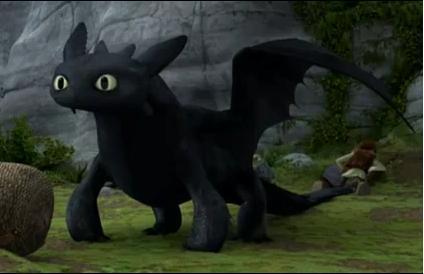
Side note2: Head canon says that Temeraire looks exactly like this.
4 of 5 stars